0
0

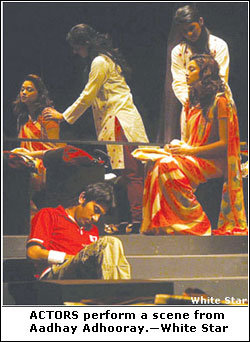 KARACHI: Isn’t it amazing how many theatre reviews from Karachi start with a mention of the ‘entertainment-starved citizens of the city’? This one certainly just did. But if the Napa Repertory Theatre Company has anything to do with it, this phrase will soon become redundant.
The company, whose aim is the promotion of quality theatre productions in Pakistan, took its bow earlier this year, and its sophomore effort is Mohan Rakesh’s play, Aadhay Adhooray, being performed at the Karachi Arts Council until July 20.
The plot revolves around a woman, played by Aiman Ali, and concerns her hopes and dreams for herself and her family. Her interactions with the men in her life, all of them portrayed by Saqib Khan, form the crux of the story. The Woman, as she is known for most of the play, is unhappy with her situation, and drives both herself and those around her to improving it, whether they want to or not, whereas the men in her life are all disappointments in one way or another.
The Woman is embittered, and it is a matter of interpretation whether this is due to her nature being coloured by her experiences, or vice versa. Her children (Rubab Hashim, Sana Hasan and Mohsin Ali Shah) are portrayed as being incapable of providing her, and to a lesser extent her husband, of the things they expect of them.
The parents, in turn, appear to be incapable of understanding what their children require of them. The men in her life, in different ways, make demands on her and provide different things, while she seeks in them – her boss, her friend – qualities that she feels are missing in her husband.
For a play that claims in the programme notes to not be anti-woman, there is a slight feeling of misogyny running through the entire play. The male characters’ failings are never explained except in terms of the women’s contributions to them, whereas those of the female characters are held out to stark review. This is somewhat inevitable given that the play does focus on a female character and how her actions affect those around her, resulting in her actions being judged by the audience a lot more than those of her male counterparts.
First impressions are quite important for a play, and the programme provides that for Aadhay Adhooray. Thankfully devoid of any corporate advertisements, the programme was printed entirely in Urdu, leading to many members of the audience flipping through the pages hoping to reach the English version. The programme itself is well-produced and well-written, though some phrases do read like they have been literally translated from English; perhaps an inevitable consequence of the recent downturn in the fortunes of Urdu literature.
The set by Tanveer Abbas is designed to evoke a feeling in the audience that there is more to this situation than meets the eye, but the liberal use of mirrors means that the lights from audience members’ mobile phones were a constant distraction. The light design by Zain Ahmed and Uzma Sabeen was well-executed, serving to illuminate, rather than dominate, proceedings.
The overall performances were very good; Aiman Ali has clearly learnt much in her short time treading the boards and, in a role that requires her to carry the play on her shoulders, does so remarkably well. Unfortunately, her one misstep came in her most challenging scene, but her overall performance cannot be faulted.
Saqib Khan clearly relished the challenge of creating five entirely different characters for his performance, and was pitch perfect for most of the duration. Rubab Hashim, Sana Hasan and Mohsin Ali Shah all did very well, in roles that were neither small nor insignificant.
The direction, by Rahat Kazmi, was in large part extremely good; one could almost sense him bringing his entire wealth of experience to bear on the subject at hand. I felt that the one genuinely comic scene of the play was executed too heavy-handedly; but the audience laughed, so who am I to judge?
Aadhay Adhooray is, at its heart, a story of conversations unfinished, thoughts half-expressed and emotions half suppressed. From the audience’s point of view, it is a good play to watch, with familiar emotions, characters and language making the play accessible. There are no pretensions or experimentations at play, making it a sincere effort to broaden the net of quality theatre, the immediacy of which can never be captured on video or television.
One can only hope that this performance, as well as future ones staged by the Napa Rep, are well-received and well-attended, for the talent on display on stage certainly deserves wide and sustained patronage.