0
0

RUSUTSU (Japan), July 6: The world’s top industrialised nations face pressing financial and environmental troubles at their annual summit on Monday, confronted with demands they reinvigorate the stumbling world economy, push ahead languishing climate change talks, and make good on pledges to battle poverty and hunger.
Leaders from the Group of Eight – the United States, Japan, Germany, Britain, France, Canada, Italy and Russia – began gathering in the northern Japanese resort village of Toyako on Sunday for three days of meetings among themselves and with heads of African nations and rapidly developing countries such as China.
The summit also coincides with demanding foreign policy issues such as the effort to strip North Korea of its nuclear weapons, mounting international pressure on Iran to stop its uranium enrichment programme, and the threat of UN Security Council sanctions on Zimbabwe over its recent one-sided presidential election runoff.
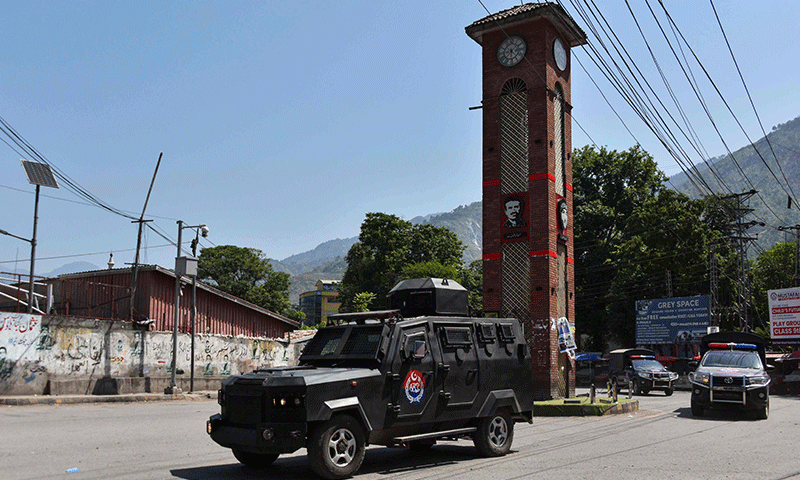
The meeting’s Japanese hosts poured security agents and riot police – about 20,000 of them – into the isolated venue and surrounding towns, sealing access to the summit hotel and cloistering the 5,000 journalists covering it at Rusutsu, a resort 30km away. Protesters were limited to rural villages or the distant city of Sapporo.
Despite the demanding agenda, concerns were high that the political uncertainties in some member countries – particularly the United States, where President George W. Bush is 200 days away from the end of his term – could prevent decisive action. The leaders of France, Japan and Britain also face domestic problems.
Bush on Sunday urged his fellow leaders to push forward stalled talks on world trade in the so-called Doha Round, and to pour more aid into Africa, after a bilateral meeting with Japanese Prime Minister Yasuo Fukuda.
“It’s an opportunity for us, Mr prime minister, to promote free and fair trade, and it’s going to be an essential part of the development agenda,” Bush said.—AP