



 0
0

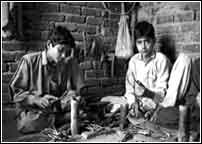 Is it only a matter of law enforcement to abolish child labour? The answer would be ‘yes’ and ‘no.’ ‘Yes’ in the case of bonded child labour and children engaged in hazardous occupations. Iron hand of the law must strike to put an end to this inhuman form of child labour.
Law enforcement cannot, however, work against child labour in areas where they go and work with mutual consent of their wards and their own too in some cases. As for children’s own consent, it is not forthcoming even for school going. Many young ones are literally pushed into school vans in the interest of their future that the children cannot see.
Similarly, the young ones of the poor have to be trained for a vocation. Since parents cannot send them to school, they encourage them to engage in skill-building activity from childhood. Children who neither go to school nor engage in vocational training would be a huge burden on the society.
It would be a disservice to not just to the society but to the poor themselves who are not interested in schooling due to its high opportunity cost even in the interim. At a very young age of 10, the children begin supplementing family income significantly. As rational-maximisers, the poor satisfice as above if they cannot optimise.
And, the poor also know that many educated fail to land the desired jobs, so why must they think in terms of schooling? As one illiterate driver put it, “I am a driver and so are many others with school and college certificates who drive taxis. If those with school and college diplomas do what I can do just as well or better, why must I send my sons to school?” This question is a huge challenge for this educated elitist society. The answer to child labour in safe areas lies neither in law nor in poverty as child labour is but a manifestation of poverty.
To search for an answer, the entire gamut of socio-economic and political landscape needs to be scanned. Then only will we get somewhere near the root cause. Poverty is not the root cause of child labour as poverty is itself a symptom of our socio-economic malaise. Nor can poverty be eliminated through child labour. For, child labour merely keeps the poor from getting submerged completely.
Child labour results from and is a form of deprivation. This deprivation is experienced by children and by adult women and men alike. Not all adult men and women who seek paid work are gainfully employed as desired by them. Many are underemployed. That is, they are either overqualified for the work they do or they cannot find work for the number of hours they would like to work or they are not productively utilised for the number of hours they are kept engaged with the result that their potential remains underdeveloped and untapped.
There are a huge number of dissatisfied workers in all cadres who experience various forms of deprivation. These forms exclude the deprivations of those potential workers who can contribute immensely but who cannot due to non-availability of suitable employment opportunities or due to social taboos and family restrictions as in the case of women. And, this list of deprivations ranges from blue collar workers to executive cadres.
In this limited inventory of deprivations experienced by the labouring classes, it is only the child worker that commands all the attention to the neglect of other deprived workings classes. One reason is the profile given to this issue in the aftermath of liberalised trade. Businesses in the West remain wary of competition with products produced at costs that are lowered, inter alia, by child labour.
To remain cost-competitive, Western business organisations have been seeking a blanket ban on child labour in third world countries. As for hazardous occupations, one would agree whole-heartedly. As for those occupations that build the capacity of poor children to earn a livelihood independently, the issue remains moot until such time that the country offers equality of opportunity to all.
One proposed solution is to ban child labour across the board, send them all to school, and compensate the parents with a stipend. The solution is a non-starter to begin with. Two to three children in poor families can bring about Rs5000 or more as each child gets not less than Rs1500 to Rs2000 per month or more plus meals for either domestic help or
for help at retailers’ shop. It is impossible for the government to match this amount when its recent relief offering per poorest household is only Rs1000 a month for only about 11 per cent of the population. The percentage of the population that sends its children to work is several times over and will not settle for anything less than the income of their children.
Second, even if these kids go past even the primary or the secondary school levels, what opportunities will they then have for gainful employment commensurate with their level of education? A sweeper’s son will not want to pick up the broom again after acquiring school certificate. This could be a recipe for high levels of depression in the society.
If child labour emanates from poverty, it is the sources and causes of poverty that need to be dealt with. A cause-effect analysis will trace the roots to mal-distribution of assets and income, political control in the hands of the wealthy, and decision-making driven by the political economic considerations of the ruling classes that remain at odds with those who stand deprived. Until such time that the above web of relationships is disentangled through a transformational change effort, deprivations will be writ large of which child labour’s will be a very prominent and least desired manifestation.
In the meanwhile though, the employers of child labour should be required to give them education, to at least make them literate, and to provide for their clothing and wholesome nourishment. Child labour cannot be wished away by symptomatic treatment of banning it across the board. The causes need to be dealt with so that multifaceted deprivations are addressed and child labour is rooted out once and for all. That is, same opportunities are provided to the children of all so that they sprint past the ones who once engaged them for cheap labour.






























