0
0

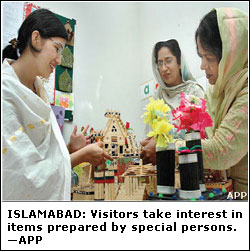 ISLAMABAD, June 23: Discrimination against individuals with physically impairments have pushed many people and their families towards conditions of poverty.
This was the gist of a national seminar on disability, organised by the Directorate General of Special Education here on Monday.
Speakers at the seminar, which was held in the National Institute of Special Education (NISE), said disability and poverty were inter-linked and key factors in the vicious spiral.
They presented their situational analyses and shared information on the services and facilities currently available to physically challenged persons in the country.
The discussion also dealt with the obstacles being faced by the special persons and their families.
The speakers said women and girls with impairments were particularly prone to discrimination. “Special people are seriously under-served by all basic services as only a few per cent of physically impaired children have access to schooling,” they noted.
Talking about the vision of the national policy for persons with disabilities, formulated in 2002, in pursuance of which a National Plan of Action has been approved by the prime minister, Director General Special Education Khalid Naeem said the policy aimed at providing an environment in which special people would be part of the mainstream society.
The plan, inter-alia, envisages increase in rehabilitation services, promotion of inclusive education for children with special education needs, reinforcement of vocational training, legislative support to persons with impairments, creation of barrier-free physical environment, provision of sports facilities and more support to NGOs for service delivery in rural areas, he added.
Mr Naeem said the ‘Disabled Persons (Employment and Rehabilitation) Ordinance-1981’ had been amended to raise the employment quota of special persons from one per cent to two per cent in both public and private sectors, besides declaring Islamabad, Lahore, Peshawar, Quetta and Abbottabad “Disabled Friendly Cities”.
These cities will cater to the needs of physically challenged persons through provision of ramps, rest areas, reserved car parking and service desks in public buildings.
Persons with impairments have also been allowed to appear in Central Superior Services (CSS) examinations, which will open avenues to enter top-level government hierarchy, Mr Naeem noted.
The Directorate General of Special Education has also developed a park for the special people inside the F-9 Park in Islamabad.
This is the first of its kind facility in the region, Mr Naeem said, adding that the park had a recreational and play area, a restaurant, amphitheatre, display hall, hall for indoor games, a jogging track, footpaths with railing and picnic and campaign area.