



 0
0

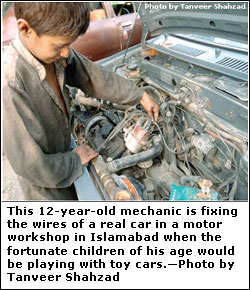 ISLAMABAD, June 11: Local and international civil society organisations have called for elimination of all forms of child labour and asked the government to focus on their education.
The renewed demands came on the eve of the World Day Against Child Labour, which will be observed on Thursday.
Save the Children-UK on Wednesday called for an end to child labour, following a report on its Child Rights Situation Analysis which indicated that child labour was pervasive in Pakistan.
According to the non-profit organisation, children were found working in almost every economic sector in the country. A large proportion of these children was invisible and was working in the informal sector. Many of them were traditionally and economically bonded and worked in hazardous occupations, including work with chemicals and pesticides in agriculture, with machinery, and in mines. Children were also working in the industries and construction work.
Save the Children said it was working in Sindh, Balochistan and NWFP, and reaching out to 36,000 working children providing education and vocational training and also facilitating the communities to improve their incomes through livelihood support.
Meanwhile, Liberal Forum Pakistan chairman Anees Jillani, in a statement issued in connection with the World Day against Child Labour falling on June 12, asked the PPP-led government to include changes relating to children in the constitutional package.
He proposed imposition of a complete ban on child labour and raising the minimum age of employment for children to 16 years.
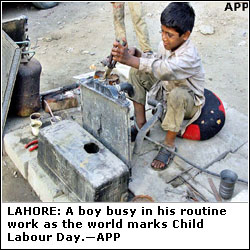 Mr Jillani has also called for strict implementation and enforcement of laws relating to child labour, including the Employment of Children Act.
Our Reporter adds: Society for the Protection of the Rights of the Child (Sparc) has asked the government and the civil society to help give every child his/her right to quality education in order to combat child labour.
Sparc said it was feared that the present economic and food crises would further heighten the plight of poverty-stricken children, adding that the figures of child labourers might surge, compelling more and more children to work to supplement the already beleaguered income of the family.
Sparc Executive Director Qindeel Shujaat lamented that the “attitudes of our policymakers and the society at large show total insensitivity towards children”.
Child labour is so common and acceptable that we do not even notice it anymore, he said.
“The emerging issues of child militancy, which is on the rise in Pakistan, is the result of neglect. Let’s not wait for any miracle; otherwise, we as a nation may sink very soon,” Mr Shujaat noted.
Sparc had also organised week-long activities from June 6-12 to bring to the forefront the plight of child labourers, who were living a life of deprivation.
Ten million children were working as labourers in Pakistan in 2005, according to a Human Right Commission of Pakistan (HRCP) report.
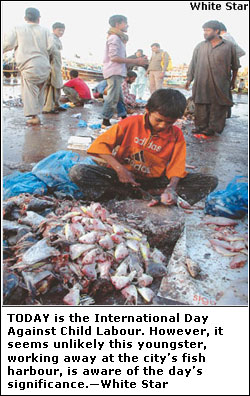 In 2003, Unicef estimated that eight million children under the age of 14 were engaged as labourers, mostly in brick kiln factories, carpet weaving industry, agriculture, small industries and domestic services.
According to the Federal Bureau of Statistics survey, about 73 per cent (2.5 million) of working children are boys and 27 per cent (950,000) are girls. About 2.1 million are between 10-14 years, and the rest are between five and nine years.
Pakistan ratified the United Nations Convention of the Rights of the Child in 1990. The convention urges the government to protect the child from work that threatens his or her health, education or development.
Article 32 of the same convention deals specifically with the issue, and calls for protecting the child from economic exploitation and from performing any work that is likely to be hazardous or that interferes with the child’s education, or is harmful to the child’s health or physical, mental, spiritual, moral or social development.



























