



 0
0

I never get despondent — Raghib Muradabadi
 RAGHIB Muradabadi, the noted Urdu poet, scholar of Persian and Arabic, who has been a popular figure at mushairas (poetry recitals) in Pakistan and abroad for decades, gave me a pleasant surprise when he showed me his book Tarian dee lo. The book is a collection of poetry in almost all genres — nazm, ghazal, rubai, salasi — written in chaste Punjabi.
How could a poet and writer from the erstwhile United Provinces of India, which has no direct connection with the Punjab, be so interested in learning Punjabi, I wondered. There are so many people from the UP and Bihar who speak fluent Punjabi. They might have learnt the language while working or living among Punjabi-speaking people, but there must be hardly any who would have made a significant contribution to Punjabi language and literature.
“Back in Delhi, I had a relationship with a Hindu Punjabi girl. She said to me one day, ‘You love me, but you don’t love my mother tongue.’ That sentence had such an impact on me that I soon began learning Punjabi. I read Punjabi literature and listened to radio programmes to have a good grasp of the language.” And he got such command over the language that not only did he read, write and speak it fluently, he composed scintillating poetry in Punjabi. Whether writing a Hamd, Naat, Salam or ghazal, he presents his thoughts in simple language:
Kaun kisay da hoya dardi/Dunya aiwen gallan kardi (Nobody has ever pined for others. Such claims are mere lip service.)
Since then he has been invited to Punjabi mushairas and TV programmes. Whatever may have inspired him to learn Punjabi, his pursuit of the language till this day shows his wish to bridge the social gaps in the nation. For that matter, all writers of non-native tongues have this spirit, whether pronounced or latent, behind their efforts.
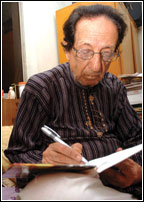 In all, he has 42 prose and poetry books to his credit. Another thing that sets him apart from other poets and writers is that he has written a travelogue in verse, the account of his visit to Hijaz. Besides, he has versified translation of many Quranic verses and sayings of the Holy Prophet (pbuh). Hansna manah hay is a collection of humorous poetry, showing the variety of his work.
He is famous for extempore poetry writing. And I witnessed him do so without pausing for a moment as his pen flowed to finish a rubai, a genre believed to be his specialization.
Raghib Muradabadi was among the people who arrived here from India by the last BOAC flight in 1947. His co-travellers included Maulana Abdul Haleem Siddiqui and many other known personalities. He was a government servant in the ministry of labour in Delhi, as well as a member of the working committee of the Muslim League at Simla, and had opted for Pakistan. Here he joined the department of resettlement, worked in various departments on deputation and retired as a public relations officer from the labour department in Sindh in 1980.
Raghib sahib remembers his ustads (teachers in poetry) Maulana Zafar Ali Khan, Yagana Changezi and Maulana Safi Lukhnavi. “Maulana Zafar Ali Khan was a great orator and freedom-fighter also. Nobody has suffered jail terms for freedom more than him and Maulana Hasrat Mohani.” The most famous of his disciples is Habib Jalib, who wrote under the penname of Must before it was changed by Raghib. His other students include Maulana Aijazul Haq Quddusi, Begum Sarwari Irfanullah and Ziaul Haq Qasmi. A collection of letters written to him includes those from Allama Iqbal, Josh, Jigar, Firaq and Niaz Fatehpuri.
Being a League worker, he had several meetings with Mohammad Ali Jinnah, who later earned the title of the Quaid-i-Azam. In a framed picture, he is standing behind while the Quaid, Liaquat Ali Khan and Sardar Sikandar Hayat are seated on a sofa in a Simla ballroom in 1939.
He also fondly remembers Gen Ziaul Haq as ‘a pious young boy,’ a few years his junior in the Simla school. “He lived at Tuti Kundi in Simla. When Zia became president, he — on several occasions — asked me if he could do anything for me, and every time I politely rejected his offer.” He thankfully acknowledges that Benazir Bhutto sent him, through Munawwar Suharwardy, a cheque for Rs100,000.
Two separate grants — Rs100,000 and Rs200,000 – were given to him by Sindh Governor Ishratul Ibad Khan, who he says “is a great patron of art and culture.” Besides, he received Rs50,000 with his Pride of Performance Award.
Arguing that Islam is a religion of peace and does not allow terrorism, in his book titled Dehshatgardi (Terrorism), Raghib condemns terrorists in rubaiyat (quatrains). Each four-liner piles condemnation on the phenomenon from a new angle.
Kia zulm-o-sitam ki tumharay hai koi hud/Kia noh-i-bashar he say tumhain hay koi kud/Hitler, Changez aur Mussolini hain/Dehshatgardo, tumharay he tau abb-o-jud
(Is there any limit to your atrocities? Are you an enemy to all humans? Hitler, Genghiz Khan and Mussolini were, oh terrorists, your forefathers.)
Although he moans that “the Quaid-i-Azam and Iqbal’s dream has not yet come to fruition,” he says the coming into being of Pakistan was a good thing for the Muslims of the subcontinent. But even the Quaid had said he had not known that he had some “base coins” in his pocket.
Born in Delhi on March 17, 1918 as Asghar Husain, Raghib received his early education in Muradabad, Delhi and Simla and did his graduation from Punjab University. Later he earned the degrees of Adeeb Fazil, Munshi Fazil, etc.
Raghib Muradabadi began writing poetry at age nine when he was in the fourth grade. His first poem was an amusing piece in which he described an exchange of invectives between a neighbouring woman and her daughter-in-law. He has been regularly writing since 1930.
He doesn’t want his future generations to follow in his footsteps because he thinks “poets tend to live life indolently. People think they are good for nothings who tell lies, borrow money not to repay it … and so on. Unfortunately, most poets do fit this description. There should be no contradiction in what one says (or writes) and what one does.”
When I visited his Federal B Area home facing a big park, I found him wearing a vest and shalwar. His servant, with silver appearing in his hair, was also wearing a similar dress as if to blunt the double attack of summer heat and load-shedding.
The nonagenarian, frail Raghib is hard of hearing and is reluctant to use a hearing aid. He also has a cataract problem. He is, however, upbeat and says despondency is a sin. “I do not smoke or chew paan. Israrul Haq Majaz was killed by booze,” says Raghib, a qualified Hakim, as if to reveal the secret of his longevity. “Besides, I always try to stay positive. I never get despondent.”



























