0
0

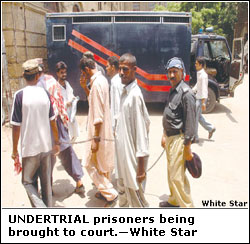 KARACHI, June 10: In a move to ensure the 100 per cent production of undertrial prisoners (UTPs) in court for their hearings, it is expected that the administrative control of the courts police will be handed over to the prisons police on June 15. The current rate of production of UTPs in court is about 75 per cent.
Well-placed sources told Dawn that the move was being made in accordance with an order of the Sindh High Court (SHC), which said that the change must be effected by March 3 this year. The implementation of the order has already been delayed by three months.
The courts police force is currently under the administrative control of the Sindh police. After the expected change on June 15, the courts police will be handed over to the prisons police that already controls prisons. It is hoped that by placing the responsibility of producing UTPs in court squarely on one police body, the process will be streamlined since at the moment, the Sindh police and the prisons police shift the blame on each other when the issue of the non-production of UTPs is raised.
Reportedly, the provincial government took the decision about the change in administrative control following an SHC directive, which was given when the court took strong exception to the non-production of UTPs while hearing a constitutional petition.
Delays in producing UTPs at their hearings results in cases dragging on for years, as well as the over-crowding of jails. Sources said that the slow progress of cases in recent years had led to a sharp increase in the number of UTPs in prison, who currently constitute over 80 per cent of the total prison population.
On the other hand, the sources also pointed out that since the courts police is currently under the control of the Sindh police, it has departmental support and back-up in case a prisoner escapes while being transported. Once the force is handed over to the prisons police – which would seek support from the Sindh police – they feared that an unexpected eventuality may become a lengthy procedure that may indirectly help escaping prisoners.
Blame game
Hearing the CP (constitutional petition) 1257/06 on September 4 last year, the SHC ordered that the administrative control of the court police be handed over to the prisons police and all relevant laws be amended according to a phased programme within a reasonable period of time that should not be longer than six months. This order therefore set a March 3, 2008, deadline for the change.
Sources said that the SHC took the decision because when prison chiefs were called to explain why UTPs had not been produced in court, they would claim that it was the court police’s duty to take UTPs from the prisons to the court. But when the court police were called for an explanation, they would claim that the prisoners had not been handed over by the jail staffers. Therefore, the court decided to unify control and apportion the responsibility of producing UTPs in court to a single body.
Dawn was informed that the Sindh police had been trying to hand the control of the court police over to the prisons police for a number of months. Reportedly, at an October 29, 2007, meeting chaired by the Sindh home secretary and attended by the IG prisons and SSP security [the court police chief], it was decided that the change would be effected on Nov 20 last year. This target date could not be met, however, and the home department approached the prisons police chief on Nov 27, 2007, and Jan 31, March 19 and May 20 this year. It is now hoped that the move will take place on June 15.
Shady deals
Referring to the city’s court police, the sources said that the force currently works at only half its sanctioned strength: only 323 personnel are available against the sanctioned strength of 745, leaving a shortfall of 427 policemen in all ranks from inspectors to constables. Similarly, they said, of the 27 prison vans available to the city’s court police, only 20 are currently roadworthy.
Explaining one of the potential reasons for the delay, the sources pointed out that the government gave the Sindh police over Rs271 million to purchase 153 prison vans to counter shortages in UTP transport vehicles. However, it was learnt that the funds were misappropriated and spent on the acquisition of other vehicles, including luxury vehicles for officers and police mobiles. Meanwhile, the prisons police wanted the change in administrative control to cover the entire fleet of prison vans, including the 153 new ones of which most were never purchased in the first place. In this regard, the sources cited a relevant government document that says “it has come to know unofficially that small prison vans are not being used by SPs in the interior of Sindh for production of prisoners.”
They told Dawn that currently, between 500 and 550 UTPs need to be taken from Karachi’s Central Prison to the court every day, but only 400 to 425 are actually taken, which brings the production percentage to around 80 per cent. Reportedly, a similar situation exists at the Landhi Jail. The sources said that data regarding jails in the Sukkar region shows that approximately 12,000 UTPs were supposed to have been produced in courts in April this year, but only around 9,000 were actually taken. Therefore, the non-production of UTPs stood at 25 per cent.
When contacted by Dawn, Sindh IG Prisons Yamin Khan said that 15 years ago, 80 per cent of the average jail population used to be comprised of convicts, while the rest were UTPs. By the end of 2007, however, the situation had been reversed and roughly 80 per cent of the average jail population consisted of UTPs. Four months later, the UTP population had increased by another five per cent to become 85 per cent of the total jail population.
He conceded that the non-production of UTPs was an issue but said that it was not a major one, since almost 80 per cent of them were produced in court when required. According to him, the major issue was that of lengthy trials and he suggested summary trials and that young offenders, first-time offenders or those involved in minor offences be given fines or non-custodial punishment and be released on undertakings given by parents, guardians or public representatives such as MNAs and MPAs.
Mr Khan also suggested that the existing Laws of Probation and Parole be used widely to the benefit of prisoners who display good conduct. About the change in the control of the courts police, he said that preparations were underway and he expected the court police to be handed over to his control, as well as over 153 prison vans, on June 15.