0
0

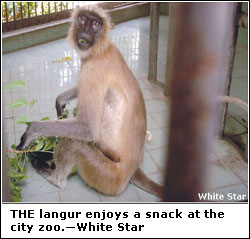 KARACHI, June 10: A male langur – Semnopithecus entellus – caught in Nagarparkar town, Tharparkar district and kept in the offices of the Sindh Wildlife Department, Mithi for about one-and-a-half months has been shifted to the Karachi Zoological Garden.
A tiled cage has been allotted to the animal that now lives in solitary confinement. The deputy conservator wildlife, Hyderabad, Saeed Akhtar Baloch, who has been associated with the department for the past 21 years, said that the wildlife department had for the very first time caught a langur. And perhaps, this was the first time in the 135-year history of the Karachi Zoo that a langur had been added to its collection of around 900 animals.
Dr A.A. Qureshi, the first director of the Karachi Zoo, also supports the claim made by the wildlife department’s official
The langur that has been shifted to the zoo is the same whose adventures came in the spotlight about two months ago when it took refuge on a tree after crossing the Indian border. It reportedly remained on top of the tree without any food for four days out of the fear of the excited people who had gathered in large numbers around the tree to take a close look at the animal.
According to reports published in a section of press, the langur was accompanied by a female that ran away as soon as they were surrounded by people and the male broke its leg. The Sindh Wildlife Department was also accused of not taking prompt action to save the animal’s life.
However, denying the allegations of any delay on part of the wildlife department, Mr Baloch said that his department acted swiftly and took the animal into its custody.
“The leg of the langur was not broken. It was slightly injured and the animal was limping when caught. It was immediately taken to a veterinary doctor and was provided with necessary medical attention,” he said.
“We took good care of the monkey during the past one-and-a half months due to which it not only gained weight but when it was handed over to the zoo officials, it was fit and healthy and could easily jump around.”
Mr Baloch said the monkey was commonly known as the ‘Hanuman langur,’ named after the Hindu monkey-god Hanuman. He said the famous mountain range of the Thar Desert – Karoonjhar – was home to various species of monkeys and a species of langur called the golden langur was found in Kashmir.
“Langurs are almost non-existent in Thar, but are found abundantly in certain habitats of India where the animal is worshipped.”
He said that the Hanuman langur had been classified as ‘lower risk’ by the IUCN.
Dr Qureshi expressed his disappointment over the fact that no special arrangement has been made at the zoo to keep the animal.
“Langurs cannot sleep on tiled floors. It’s most unfortunate to keep an arboreal animal in unnatural conditions.
Also, the zoo officials must arrange a female for the animal as soon as possible, which is necessary for its growth and future well-being.”