0
0

No light at the end of the tunnel
 Another hours-long sultry night has somehow passed without electricity in a third-floor apartment in the city’s suburbs.
The window curtains remained open throughout the stifling night but no breeze blew to lessen the suffocation inside. Attempting to break the silence that overwhelmed the night before, birds started chirping, though the morning heralded no reason to be happy about since the air was yet still and power not restored.
As I drew closer to the window in a bleak hope for wind to blow or clouds to shower, I could only see a news-hawker struggling to throw a newspaper roll, bound with a rubber band, into the fenced balcony of an apartment. After a few attempts he did succeed as the roll landed with a thud on the terrace and he moved on.
The hawker must be in a hurry to drop dailies at several other residences before the sun rises and stands above in the sky. In the news business, freshness and deadlines matter. And in the quest for that freshness many people like me, who spent a stuffy night without sleep, were waiting for the newspaper knowing well what little relief could it really bring home when things around were not pleasant.
Even towards the day’s climax the maddening calmness was to change only into chaos and commotion. Many poor people would die due to heat-stroke while waiting in long queues for their turn to secure a bag of wheat flour on a subsidy. While there was no respite for those better-off either in the absence of electricity as with the hike in fuel prices, generators have become unaffordable to a large segment of society.
The morning broadcasts of holy verses on radio would soon convert to news bulletins which would be counting the toll of people dying due to heat-stroke or gunshots in the name of robberies, politics or religion. In this utter despair, is it the lawyers’ movement planned for the day or the postponed budget session that people can bank on? I fear neither.
Taps were without water. The UPS had stopped working long ago. And I looked again for the typical fluffy clouds which might break the silence and the rain might decide to show up earlier than expected.—HA
Monsoon fears
The monsoon is upon us. In a week or two (days even?) the heavens will open up and a hard rain may well fall on the metropolis. This will be a welcome relief for many, as the cool rains will lessen the intensity of the stifling heat and humidity. And for the gastronomically inclined, there is always the delight of hot off the pan pakoras to munch on in the rain. Even the lack of electricity is momentarily forgotten as the whole family gathers to savour the rain-drenched atmosphere.
But one does not seek to romanticize the situation too much. For – mainly due to our own incompetence – this blessing of nature can become a right hazard for the city’s millions. One of the major reasons for this is the lack of a proper mechanism for the drainage of rain-water, as well as the KESC’s incredibly fragile distribution network. I clearly remember wading in almost knee-deep water as North Nazimabad’s KDA roundabout turned into something of a great lake last year.
Usually, a few weeks before the monsoons unleash their fury, the papers are filled with filler, with town and union council nazims announcing ‘rain emergency’ plans and cancelling leaves of relevant staffers left, right and centre. However, up till now, these statements have been mostly absent and an informal survey of North Nazimabad’s blocks C and D showed that the two major storm-drains of the area were choked with refuse of all kinds. Expectedly, the worst culprits were those awful plastic bags, ‘shoppers’ as they are called in local parlance.
But luckily, a day or two ago, the town administration seems to have wised up and a crack nullah de-clogging campaign was launched. Mounds of filth were unearthed from the nullah and conveniently placed by the roadside. This was a welcome sign, and one hopes this is being replicated city-wide, so that a flood of rainwater and sewage does not result. Also, it would be nice if all the filth dug out from the nullahs is removed and hopefully dumped in a landfill, to prevent another health hazard among the countless.Nature can be unpredictable and some damage is expected. But with a little bit of planning and foresight, the damage can surely be minimised. Here’s to hoping this monsoon is a safe one. Enjoy the pakoras.—QAM
Daylight saving time
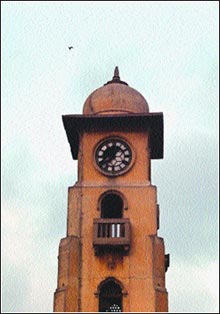 “Time is of the essence” they say, and those who value time seem to get somewhere in life. But I guess this does not apply to Karachians as I hardly find any scheduled event in the city beginning on time. It seems as if both organizers and their invitees have a tacit understanding about arriving late at events. Resultantly, only those adhering to punctuality suffer.
With the rising temperatures, people tend to adopt an even more lethargic attitude towards life, especially time. The government’s decision to advance the clocks by an hour seems to have had little or no effect on shopkeepers who wish to maintain their own timings.
This reminds me that the city does not have a large array of clock towers, while the clocks installed on the few existing ones often develop faults. Seldom does one find the accurate time on the four clocks of the Merewether Tower that stands at the corner of I.I. Chundrigar Road. The clocks installed on the KMC building on the M.A. Jinnah Road, the Empress Market in the heart of the city and the Frere Hall off and on need repairs. The Jinnah Avenue clock remained inoperative for months till its sponsors got it repaired, though that was before the clocks were advanced by an hour. At present, the one that stands at one extreme of Sharea Faisal near Metropole is running behind the standard time. Similarly the time at Lea Market clock tower is not set. And by the time the clock is set, another is expected to develop a fault. After all we — the Karachians — are not in the habit of valuing time.—Syed Ali Anwer
Compiled by Syed Hassan Ali
Email: karachian@dawn.com
The plight of roads
Sir,
 Many of Karachi’s roads have long been neglected. The portion of the road which goes from the Islamia College towards the Central Prison and the side which comes from the prison towards the college are particular examples. Firstly, the automobile dealers are in the habit of parking their cars on two of the four tracks of both the roads.
Secondly, the water tankers add to the misery by driving roughly and at great speed. The way they go around the U-turn just before the Jail Chowrangi traffic signal is despicable and it’s because of them that major accidents have occurred.
The traffic police has recently bisected one of the two roads to make way for a bus-lane, but this doesn’t seem to be working. This addition has actually crammed the traffic into two lanes. The constables are seen roaming around the roads instead of managing traffic. They are actually more keen about stopping and fining the bus drivers, without paying any heed to the traffic snarl-up this causes.
I would like to bring this scenario to the local government’s notice and am hopeful that something will be done to solve this matter.
FURQAN R. MENGRANI
Muslimabad
Shershah Bridge collapse
Sir,
This is with reference to the report by Imran Ayub on the Shershah Bridge collapse (May 20).
I was shocked to read that the CCPO has stated that “if there is an inquiry into the incident which proves negligence, then an FIR is lodged for further action.” I do not agree with this contention.
I totally agree with the statement of retired Justice Rashid A. Rizvi, President of the Sindh High Court Bar Association, that the collapse of the bridge was due to criminal negligence and there should not be any doubt about it.
It is also a fact that half a dozen people were killed and many injured under the debris of the collapse bridge. Furthermore, the country has lost billions of tax payers’ rupees, while a lingering inconvenience is being caused to heavy traffic from all over Pakistan heading towards Karachi Port.
If an FIR has not been lodged so far, I would request the CCPO to immediately have the same recorded and the investigation made public as soon as possible.
NAZIM F. HAJI
President and member
CPLC Advisory Board
Park site
Sir,
I regret that despite the CBC Karachi’s CEO’s commitment vide his letter No CBC/ACE/4887 dated June 9, 2006 to develop a park in the budget for the fiscal year 2006-07 for the residents of DHA Phase II Ext behind Plot No 08-C Sunset Lane No 9, no action has been taken so far, although a period of about two years has passed.
It is interesting to note that the said park site is the only one for the residents of Ph II Ext, whereas the other phases of the DHA have more than one developed and lush green park.
Further, the DHA/CBC taxes are equal for the residents of all phases. Regrettably, Ph II Ext has been neglected in all respects.
It is, therefore, requested to take immediate action for the development of the said park site.
ASHFAQ A. SHAIKH
& others
DHA
Anti-polio drive
Sir,
Dr Sohail Noman has rightly pointed out the lacunae in this programme (May 26). I may add that this campaign should simultaneously be carried out in schools, because school-going children are often left out as the staff visit homes during school hours.
They should, of course, visit homes too, so that those children who have not gone to school should not be left out.
ZAFARUL HAQ MEMON
Clifton
Lynch’s Law
Sir,
Although the recent phenomenon of lynching ostensibly started from Karachi and is spreading to some other cities of Pakistan, it has been in practice long before Pakistan’s creation. Although historical evidence suggests it existed well before Christ’s birth in Jewish tribes, when mobs stoned to death people for certain crimes. In the modern world, it was first known in American society because of a Virginian judge, Captain Lynch.
In 1780, Judge Lynch formed and headed an irregulars’ organization in the mid-sixteenth century to punish thieves, rustlers, rapists, outlaws and murderers, by lynching. Later, these illegal acts were known as Lynch’s Law. His aim was to cleanse and make society peaceful
In Pakistan, in the eighties, lynching took a new turn when General Zia introduced pro-religious legislation, specifically the blasphemy laws. This legislation played havoc with the country’s religious minorities.
People, especially semi-literate clerics, started settling their personal scores on the pretext of blasphemy. It was easy to announce through a mohalla’s mosque that Mr so and so who belongs to so and so religious minority was found committing blasphemy.
The rest was easy. Instantaneously, a mob of hundreds would prepare to lynch the person or persons who supposedly uttered the words.
The police seldom intervened. Neither an FIR was registered, nor was action taken against the culprits. If a case was registered by putting pressure on the government by the human rights NGOs, the judges were threatened by zealots attending the court proceedings.
Ultimately, the instigators and those who actually took part in lynching had to be released after one or two hearings. If the police and the courts strictly followed their principled stand, the lynchings in Ranchore Lane or North Nazimabad would never have taken place. Also, if the police would have intervened, Jagdeesh Kumar, the Hindu youth from Mirpurkhas, would have been saved from the clutches of his co-workers.
KUNWAR KHALID YUNUS
North Nazimabad
city@dawn.com
Amendments fail to reduce incidents of honour killing
 AYESHA, a three-year-old girl, who did not know even the meaning of honour, was killed along with her mother and 15-year-old sister allegedly by her father and brother in a backward hamlet of Swabi district on June 5. The father, who is a poor farmer, allegedly committed the offence with active support of his young son. Both the offenders fled away leaving behind the bullet-riddled bodies.
Two days prior to that occurrence, in the adjacent Mardan district a boy and girl were killed allegedly by the family members of the latter as they had escaped away bringing a ‘bad name’ to their respective families. Local people in Bikri Banda area claimed that the girl had left her residence with a boy in the neighbourhood. However, her family convinced them to come back with the commitment that their marriage would be solemnised. They trusted the commitment and when returned to their village they were killed. Their bodies were found in a field. The police have charged her father, brother, uncle and a cousin for the offence, who have fled away.
The law enforcement agencies have failed to check the growing incidents of honour-related killing. News items about such killings have been hitting the headlines almost on very alternate day. The existing laws could not prove to be a deterrent for reducing such offences in the society.
The much trumpeted amendments introduced to the Pakistan Penal Code and Criminal Procedure Code three-and-a-half years ago failed to serve its purpose. The offenders and the defence attorneys appear to be cleverer than the law and the courts. They know very well how to hoodwink the courts and the justice system.
Till Jan 2005, there was no definition of honour-related killing in the Pakistan Penal Code. Through the Criminal Law (Amendment) Act, which was published in the official gazette on Jan 11, 2005, various changes were incorporated in the PPC as well as in the Criminal Procedure Code. A sub-section ii has now been incorporated into section 299 of the PPC which defines honour related offence as: “Offence committed in the name or on the pretext of honour means an offence committed in the name or on the pretext of karo kari, siyah kari or similar other customs or practices.”
The government claimed trying to check those provisions of the PPC and the CrPC which often proved helpful for the offenders involved in honour-related offences especially the compromises which took place in such like offenders helping the offenders in most of the cases.
A new sub-section (2a) has been incorporated after section 345 (2) of the CrPC whereby an offence committed in the name or pretext of karo kari, siyah kari or similar other customs or practices may be waived or compounded subject to such conditions as the court may deems fit to impose having regard to the facts and circumstances of the case.
Through the Qisas and Diyat Ordinance about 40 provisions of the PPC related to bodily hurt and murder were repealed and replaced with new provisions which the government claimed were in accordance with the Islamic injunctions.
The Qisas and Diyat law was introduced through the Criminal law Amendment Ordinance VII of 1990. It was re-promulgated several times since 1990 and finally it became an Act of the Parliament in 1997 during the government of Mian Nawaz Sharif. This Act covers all offences against human body and provides for qisas (retribution) and diyat (blood money).
The entire pattern established through the Qisas and Diyat law is a sort of privatisation of crime, whereby crimes are no longer considered offences against the state, but against individuals. Thus, if these individuals so decide, offenders can walk free even after committing grave and heinous crimes like murder. Among the major changes introduced through the Qisas and Diyat law the offences relating to the human body were made compoundable. The legal heirs of a deceased have the right to make a compromise with the offender under section 309 and 310. In the first provision, legal heirs can forgive the murderer in the name of God without getting any monetary compensation in the form of diyat, while under section 310 the legal heirs can compromise after receiving diyat in their respective shares.
Moreover, under section 306 of the PPC, the qatl-i-amd (intentional murder) shall not be liable to qisas when an offender causes death of his child or grandchild, how low-so-ever; or when any wali of the victim is a direct descendent of the offender. These provisions ensured that several categories of killers can escape the qisas penalty, not on the basis of any difference in the nature of their crime, but because of their relationship to the victim or the victim’s walis.
Although the government made some cosmetic changes in the law through the Criminal Law (Amendment) Act, 2005, but these changes were not up to the mark thus failing to achieve the desired objectives. The matter of concern is that the practice remains a shamefully celebrated and accepted crime in many places.
An important factor that promotes violence and death in the name of honour is that the offender gets off scot-free or with a minimum sentence. This deplorable impunity is result of a social acceptance in the society permeating the institutions of the state that it is justifiable for a man to seek revenge for reasons of ‘honour’. Consequently, in most cases, the community intervenes in the shape of a jirga or other local influential to bring about a compromise and the case either does not reach the court or is withdrawn. In some of the cases the accused had spent only a month or two in prison when compromise took place between the legal heirs of the victim and the offender with efforts of local jirgas.