0
0

 KARACHI: One is not often able to say of a play that the presentation was as skilful as the script was sparkling. Yet this praise is well-deserved by Ismet ki do Kahanian, which opens today (Saturday) at the Karachi Arts Council.
Tehrik-i-Niswan’s hour-long presentation comprises adaptations of the short stories Kaafir and Amar Bel, penned by that doyenne of Urdu literature, Ismet Chughtai. As is the standard of her work, not only does the subject matter hit the nail right on the head but the characters and dialogue are delightfully constructed. More to the point, Tehrik-i-Niswan’s adaptation of the two vignettes are beautifully rendered and manage to bring out the true essence of Chughtai’s genius, along the way displaying the professionalism and maturity of the theatre group itself.
The first story, Kaafir, focuses on the socio-political divisions that exist in the subcontinent as a result of religion – which sounds dreadfully didactic, which the play and the original story are very far from being. What is so appealing about Chughtai’s work is that she presents the faults and foibles that exist in all of us – that we are all far too familiar with, were the truth to be told. But she uses language so spontaneous, so compelling and playful, that her comments invite empathy rather than judgement. It therefore goes to the credit of the director Anwer Jafri, who also adapted Chughtai’s story into the script, that he retained all the charm of the original work.
Salim Meraj and Asma Mundrawala, who play the Hindu Pushkar and the Musalman Munni respectively, are comfortable and convincing in their roles. The dramatic device of telling the story of the subcontinent’s quirks through children may not have worked had the actors not been so competent, but Meraj and Mundrawala turned in excellent performances. The switch between adulthood and childhood, expressed through subtle shifts in body language, expression and posture, are accomplished with deceptive ease.
(And, one must say, the moral high ground taken by Muslims appears in a new light when discussed through children and their understanding!)
The second piece in the performance, Amar Bel, is similarly beautifully directed and presented. The plot is such that it will strike a chord with all those who have observed the rather peculiar relationships enjoyed by women in the subcontinent, and the manner in which men’s lives are governed by them.
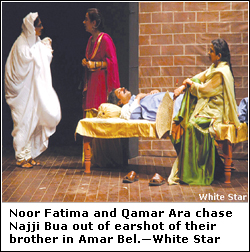
This piece has been adapted from the original and ably directed by Asma Mundrawala. Along with Mahvash Faruqi who plays Qamar Ara, Mundrawala also plays the role of Noor Fatima, one of the sisters of the widower Shujaat Mian (Saife Hasan), who arrange the second marriage of their only and beloved brother. While saying any more would spoil the plot, suffice it to say that the ensuing drama would be sadly familiar were it not for Chughtai’s sparkling language and spot-on insight. Sheema Kirmani, meanwhile, plays the roles of both Imtiazi Phuppho and Najji Bua, the former perhaps the character through which Chughtai speaks.
In this sequence, it is the chemistry between Mundrawala and Faruqi that is so striking, bringing to life not only the two sisters and their relationship, but also the soul of the middle-class Muslim women of certain situations that the characters represent.
The direction in both pieces is good, while the set and lighting design by Anwer Jafri is effective. Subtle changes in the light provide counterpoints to the stories unfolding on stage, and add depth to the performance without appearing over-bearing. It is rare to walk out of a performance smiling, but Ismet ki do Kahanian allows this. The play will run from June 7 to 9, with tickets available from Agha’s and the venue, and really ought to be seen.