0
0

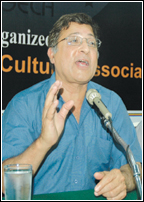 ISLAMABAD, June 4: Pakis-tan needs an education system that develops humanism, enligh-tenment and critical thinking in its children and not jingoism, according to physicist and peace activist Dr Pervez Amirali Hoodbhoy.
Education is not about getting degrees or jobs but about creating a tolerant, caring, progressive and forward-looking society, he said in a lecture at the Pakistan Academy of Letters as guest speaker of the Gojal Educational and Cultural Association (GECA) the other day.
“The education our children are acquiring today breeds hatred and violence,” he said, citing last week’s ethnic clashes on the campus of Quaid-i-Azam University. Such irrationality was not unexpected when children are taught about differences between Hindus and Muslims and the wars fought between India and Pakistan from very young age.
Dr Hoodbhoy said the foremost objective of education was to produce a good human being, who appreciates others’ rights and values and takes a scientific approach to decide about right and wrong. But the trend in Pakistan had been on the reverse.
“Students were more enlightened and liberal 30 years ago. Today 60 per cent of the girl students in Quaid-i-Azam University (QAU) come in burqa and another 10 per cent in hijab,” he observed.
“We should think about it, and find out the causes as the situation is getting worse in NWFP where girls can’t dare to go out bare faced and their schools are being bombed and closed,” he said.
Dr Hoodbhoy called for giving priority to primary education and criticised the low education budget — two per cent of GDP. ”If we want to improve the situation we should cut the defence and non-development budget and devise a secular education system,” he said.
“Secularism does not mean abandoning religion,” he stressed. ”In Europe there exist many religions but their followers live as equal citizens. There is no other way to take a nation forward than path of secularism and scientific thinking.”
While the Higher Education Commission (HEC) has been given big money, it was being spent on “producing degree holders in bulk and not scientific minds”.
A substantial amount is lost on ghost schools. Some 8,000 such schools had been discovered in Punjab alone.
“While the modern concept treats education as a problem-solving tool, our system encourages only cramming without comprehension or application of mind. Knowledge is a living thing which increases with the passage of time. We seek Tehsil-i-Ilm (acquisition of knowledge) and not Takhleeq-i-Ilm (creation of knowledge),” he observed.
Examinations just test the memory of a student and not his comprehension.
The lecture generated a lively question-answer session.
In response to the questions Dr Hoodbhoy said people of Gilgit-Baltistan need to know their natural resources and how to exploit them. For that education should be need-based. Technical and vocational schools should be set up to impart skills and training to the local people according to the geographical condition of the area.
In the context of Gilgit-Baltistan it would mean learning how to harness the region’s abundant water resources to produce electricity.