



 0
0

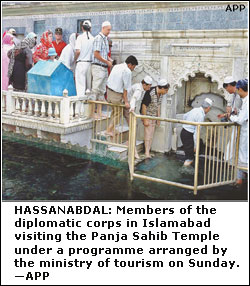 ISLAMABAD, June 1: Diplomats with their families from 35 missions on Sunday paid a visit to historical places like Sikh Temple and the museum in Taxila and Punja Sahib (Hassanabdal).
The visitors appreciated the old civilization and monuments of Bhudda preserved in the city.
The tour was conducted by the Ministry of Tourism to educate the diplomatic corps of China, Malaysia, Yemen, Germany, Kenya, Japan, India, Denmark, Kyrghstan, Ireland and Vietnam about the history of Buddhism, Sikh religion and Baba Guru Nanak, which has been preserved in the historical city.
At the Punja Sahib, Chairman Evacuee Trust Board Gen Muhammad Javed (retired) briefed the diplomats and media about the arrangements made for the Sikh Yatrees during their annual pilgrimage.
Mr Javed informed the diplomats about the history of Sikh religion and paid homage to the founder of Sikh religion, Baba Guru Nanak.
He said the government facilitates Sikh Yatrees from around the world who visit their holy site in large number.
The visitors also went to the ‘holy pool’ where Baba Guru Nanak’s hand is “imprinted on a rock” from where water has been constantly gushing for the last 500 years.
The Sikhs consider this pool’s water as having medicinal value which can “cure many ailments”.
Sikh cleric Kalbeer Singh told the visitors that the Sikh community from all over the world come here to take bath here and also take water from the pool to cure diseases.
Diplomats also visited the Dharmaka Stupa, a historical place and the largest Buddhist religious complex situated along the bank of Dharma rivulet.
It was built to enshrine the redistributed holy relics of the Bhudda b the famous king Ashoka who was also known as ‘Dharmaraja’.
Here, representatives of the ministry - Tayyeb Meer and Ilyas Bhatti - briefed the diplomats and journalists about the Chapels, votive stupa, mediations cells and monasteries that had came into existence 3,000 years ago.
At the complex, a tree captured attention of the visitors where Buddha is said to have meditated and got ‘Nirwan’.
In the Taxila Museum, the monuments of Buddha, figure of Buddha while preaching and mediation mesmerised every one present on the occasion.
The museum provided ample opportunity to the visitors to see the historical objects including spouted pots, handled jugs, water flasks, drinking vessels, cooking pots, moulds of ornaments and soldiers’ weapons.
Besides, diplomats also took keen interest in the ‘Bodhisattva Maitreya’ that was framed artistically. Decorated arched panels with mediating Buddha offered great inspiration to the diplomats.
The visitors lauded the three objects discovered at Bhir Mound during the archeological excavation carried out by the department of archeology and museum.—APP


























