0
0

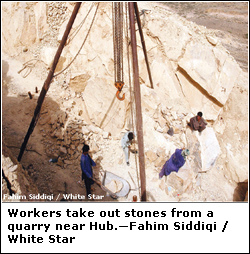 KARACHI, May 21: Hamidullah, Abul Waheed and Ashraf, along with 10 others, do not know that the World Biodiversity Day is being observed on Thursday. They remain busy taking out huge stones from mountains in an isolated area some 10 to 15 kilometres off Cape Monze near Hub.
Equipped with various tools, they begin the day early morning and continue hammering the solid mass till sunset. A number of plants, some endemic to the region, are destroyed in the process. Unaware of the dangers their work poses to the biodiversity of the area, what the poor workers do know is that they have chosen the hard life of living in mountains so their families could live in a little comfort.
“We are here to support our families back in a Swat village. Each one of us earns between Rs200 and Rs300 daily for the job, which is a good amount, since we could never earn that much money in our village nor could we find a job in the city,” one of them said.
Though none of them had any idea about the exact destination of the trucks they fill daily with stones, they believed that the stones were used for construction. According to them, the unbridled quarrying had been going on for decades and all of them were brought in here by people who were either familiar with the business or had worked at the site.
“Only once we were restrained by marine people from digging and we had to pay Rs500 for two years so they let us continue the work. After that they didn’t visit us.”
The workers have built small stone sheds, a makeshift water tank on one of the hills, where they live along with some goats. “We don’t have any problems here. It’s very peaceful. In fact, we hate the hustle and bustle of city. One of us goes to Mauripur every week and brings necessary foodstuffs while for water we collectively pay Rs1,000 for a tanker trip that lasts a month.”
It’s amazing to see how well the road networks have been developed to different mountain sites for quarrying. At another location, about 150 metres high, a Dawn team, accompanied by a Karachi University group carrying out research on plant conservation in the area, spotted four people engaged in quarrying.
Answering questions, the workers said they came from Lasbella and received a monthly salary of Rs5,000. “We come here daily in a truck and work till evening. The contractor deducts Rs250 from the salary if someone fails to turn up for the day,” one of them said.
Despite the hardship the poor workers face while eking a living, their activities have endangered the biodiversity of the area, according to Haider Abbas, an assistant professor researching on plant conservation at Dr A. Q. Khan Institute of Biotechnology and Genetic Engineering. Mr Abbas is part of the KU team working for conservation and rehabilitation of two highly endangered plant species, Acacia nilotica ssp. hemispherica and Cadaba heterotricha, found in the mountains area near the coast. “Our team has regularly been visiting Hawkesbay, Cape Monze, Paradise Point and the adjoining areas since 2005 to collect data about the natural regeneration of the species and monitor the various threats they are facing in that region,” he said, adding that the igloo-shaped species of Acacia, boasting striking yellow annual flowers, existed nowhere in the world except along the Karachi coast while Cadaba was rare in Pakistan.
Explaining the reasons behind the restricted growth of these plants, Mr Abbas told Dawn that the plants were “in a state of shock” because they were unable to cope with the rapid changes taking place in their environments. However, the plants face a graver threat from the large-scale stone quarrying from their rocky habitat.
“There is a dire need to evaluate the status of these plants in the area and their habitat should be protected from foreign intrusions, including the shepherds who bring in grazing cattle from nearby villages,” he said, adding that there were about 50 sites along the Karachi coast where such activities were taking place.
Giving details of other plants existing in the area, Dr Anjum Perveen of KU’s botany department said: “There are a number of them which have wonderful medicinal properties. They include Tribulus terrestris (gokhru), Solanum nigrum (mako dana), Fagonia indiaca (shuka), Citrulus colocynthis (tuma), Withania somnifera (asgandh), Capparidus decidua (kabra), Achyranthes aspera (Heran Khuri), Ziziphus nummularia (jangli baer) and Cuperus rotandus (hiran Khari).”
Dimension stones
Regarding the specific details of the stones being quarried along the Karachi coast, Prof Dr Shahid Nasim of KU’s geology department said that apart from the aggregate stones that were used in road construction, the valuable stones called the ‘dimension stones’ were pelagic limestone with impurities.
“The samples represent the different members of Thakar group (Khirthar formation) of Eocene Age, commonly present in a Pab Range (a belt ranging Bojhar in South and Gundbo in the north),” he said, adding that the stones were initially used in lithographic printing before the Metal Age.
“The colourful stones, some having ripples in them, are excavated in a way that they need no refinement and are fixed in their original form. However, a number of factories exist which make tiles from these stones.”
According to Ghulam Akbar, head of the WWF-Karachi, Hawkesbay, Cape Monze and the adjoining area is a treasure trove of diverse plant and animal species and needs to be declared a ‘nature reserve’.
“The place is home to a number of endemic species, including Acacia nilotica ssp. hemispherica, which exists nowhere except along the Karachi coast. Losing that plant means losing a major link in science. The area, regarded as lungs to the city due to the presence of mangroves, is a turtle nesting ground, besides being home to a number of coral species,” he said, adding that the WWF has been pursuing the cause to have the area declared ‘a nature reserve’.
Talking about the long-term consequences of stone excavation in the area, he said: “Though it’s difficult to point out the exact impact of these activities, what we do know is that disturbing the ecosystem could have serious implications. It might lead to the gradual destruction of turtle habitat. That could cause increasing growth of seaweed and that in turn could affect the environment in many different ways.
“Something odd may happen when you play with nature. What is dangerous is to be in a situation when it’s too late and you are left with no option but to rectify the damage.”