0
0

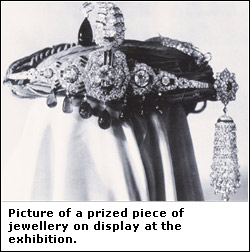 KARACHI, May 15: Even if the subcontinent’s multifarious princely states had not been abolished, one feels evolution would have gotten the better of them, as the sheer opulence displayed by the princes and potentates that ruled them just wouldn’t have cut it in the modern world, especially when bread lines are becoming a common sight in the third world.
However, a window to this opulent world has been opened at the Alliance Francaise Karachi, where an exhibition titled ‘Indian princes and French jewellers’ opened on Thursday. The exhibition explores the relationship between pre-partition India’s Maharajas and renowned French jewellery houses through photographs and sketches.
The work of three jewellery houses is on display: Cartier, Mauboussin and Van Cleef & Arpels. Pictures of stunning jewellery pieces are accompanied by vintage shots of erstwhile Indian royals studded with jewels from head to toe. Along with the pictures are detailed captions, as well as information about the jewellery houses.
The Cartier collection is by far the most interesting. The firm, started by Louis-Francois Cartier in 1847 in Paris, has designed jewellery for courts worldwide. Edward VII, king of the United Kingdom, proclaimed Cartier the “jeweller of kings,” and the company received royal warrants from the courts of Spain, Portugal, Siam, Russia, Greece, Romania and Egypt.
There is a great photo of Jacques Cartier from 1911 seated with a group of Indian jewel merchants, while a group photo of the Maharajas of Dholpur, Alwar, Patiala and Jhalawar, with jewel-encrusted ceremonial swords, rings, turbans and practically everything else, takes the cake.
A picture of a parade necklace of Bhupindra Singh, the Maharaja of Patiala, is a manifestation of lavishness, with the caption claiming the piece was made up of 2,930 diamonds, two rubies and the De Beers diamond. A gravity clock is shown, which is said to be ornamented with gold and around a dozen precious stones.
The Van Cleef & Arpels collection is also quite interesting. The company was founded by Leon Arpels in 1894, also in the French capital. It is said the Duke of Windsor – formerly Edward VIII, king of the United Kingdom – presented a bracelet to his controversial wife Wallace Simpson in 1937 made by the jeweller.
Van Cleef & Arpels also designed jewellery for Princess Fawzia’s – Egyptian King Farouk’s sister – wedding to the Shah of Iran, while they designed the coronation crown and necklace in 1967 for Farah Pahlavi, formerly Farah Diba.
There is an ironic sketch of a cigarette lighter showing the Buddha in a meditative pose. It is ironic because the Shakyamuni is recognized as an icon of renunciation. Another remarkable portrait is that of Maharaja Mohun Shumshere from his coronation day.
The Maharaja is wearing a sirpech, said to be the traditional crown of the Ranas of Nepal. The crown consists of diamonds, pear-shaped emeralds and bird of paradise feathers. Shaded by a parasol, he has two courtiers by his side while what seem to be the remains of a dead lion and tiger lie at his feet.
The photo of the Devi of Baroda – with her son ‘Princie’ by her side – is accompanied by a caption which states that the Devi was known as the ‘Indian Wallace Simpson’ for her love of gems. It is said she had over 300 pieces of jewellery, some dating back to the Mughal era, in her collection.
Mauboussin, established in Paris in 1827, boasted the Prince of Wales as well as the Maharajas of Indore and Kapurthala as clients. The crowning glory of their collection is a tiara with a platinum mount encrusted with diamonds and emeralds belonging to the Maharaja of Indore.
The exhibition will run for 10 days.—QAM