



 0
0

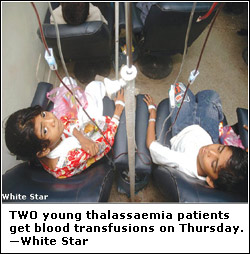 KARACHI, May 8: As Mohammad Iqbal talked about his son Kashif Iqbal, who died of thalassaemia some years back, there wasn’t a dry eye in the house. The man behind the Kashif Iqbal Thalassaemia Care Centre (KITCC) explained how he ran from pillar to post in Pakistan and abroad for his son’s treatment, but could not save him. After his son’s death he decided to help children who had this disease and set up the centre.
The thalassaemia conference, which was arranged by the KITCC in collaboration with Jiba’s Karachi chapter (ladies wing), was held on Thursday to commemorate International Thalassaemia Day at the Federation House. Observed on May 8 each year, the day is held to bring about awareness of the disease among people throughout the world.
Chief guest Saifuddin Zhoomkawala said that prevention was better than the cure, and couples should get their blood tested before marrying. “I feel small in front of these people who are doing so much for this cause,” he observed.
Jiba, along with the KITCC, visits various schools and conducts blood tests for the detection of thalassaemia minor on a regular basis.
“The alarming fact is that approximately seven per cent of the students are detected with thalassaemia minor during the tests,” said the chairperson of Jiba, Maleeha Bhimjee. “As treatment is very expensive, awareness of the disease is essential to prevent its increase,” said Mr Iqbal.
Every year, about 6,000-7,000 children are born with thalassaemia major in Pakistan, while five to six per cent of the total population is thalassaemia minor. This great number is due to lack of awareness as well as the lack of means for testing the disease among the poor.
A genetically inherited disease passed on from parents to their children, thalassaemia major requires blood transfusion every 15-20 days for the affected children to survive. The life expectancy of a child suffering from this disease is between 5-18 years depending on the treatment. Due to regular blood transfusions, complications tend to develop, which include excessive iron in the body. To clear the body of this excessive iron, regular iron-chelation therapy is needed side by side with blood transfusions.
Thalassaemia affects the red blood cells. Due to this, red blood cells are easy prey to mechanical injuries and die easily, thus regular blood transfusions are needed. The spread of the disease occurs when two minors with thalassaemia get married and have children, who then are at great risk of being thalassaemia major or minor themselves.


























