



 0
0

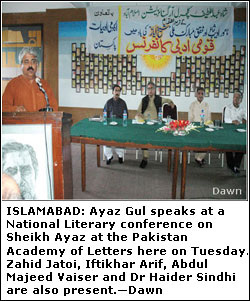 ISLAMABAD, May 6: Speakers on Tuesday termed Sheikh Ayaz as one of the great poets of 20th century who dominated the Sindhi literary scene for the greater part of his life emerging as the poetic conscience of his land.
Speaking at “Sheikh Ayaz National Literary Conference” arranged jointly by Shah Abdul Latif Cultural Organization and Pakistan Academy of Letters (PAL) here speakers called him an authentic voice which he had become even before independence as his poetry symbolised the aspirations of the downtrodden people generally, and the hard life of the common Sindhi people, in particular.
The speakers praised him for raising his voice against the unjust exploitative system prevalent in Pakistan and fighting for democracy, freedom, peace and a just social order.
The seminar was addressed by Iftikhar Arif, Chairman, Pakistan Academy of Letters, Dr Haider Sindhi, Aman Memon, Sumaira Bukhari, Dr Noor Muhammad Larrak and Abdul Majeed Vaiser. The proceedings were conducted by Zahid Jatoi.
Ayaz Gul in his presidential address said Sheikh Ayaz’s thought-provoking poetry awakened the Sindhis. He was a great patriot who loved his land. His works should be translated into the major languages of the world to project the catholicity of his vision. His poetry should be made part of university syllabi.
He said that Sheikh Ayaz belongs not only to Sindh but to the whole country. He enriched the Pakistani literature and his contribution can be compared to any great writer of the world.
Iftikhar Arif said that in the present era Sheikh Ayaz is reckoned as the greatest representative of the Sindhi spirit in Pakistani literature. He expressed his creative talent in both Urdu and Sindhi.
Sheikh Ayaz’s poetry has a philosophy and deep awareness of life. He revolutionised all genres of literature with his distinct style.
The PAL chief said Sheikh Ayaz had a vigilant eye on the contemporary world which mirrors in his literary works. He had great contribution in shaping the Pakistani literature. He exposed truth without caring about the consequences and wrote for people’s rights and against oppression and the history of Pakistani literature was incomplete without him.
Iftikhar Arif said that Sheikh Ayaz is considered as the greatest figure of the last century in Sindhi language and literature. He occupies an exalted status due to his anti- establishment, progressive thought, exemplary struggle, sense of justice, humanity and championing of human values. His entire life was inspired by a mission. He introduced a new idiom in Sindhi language. Along with a number of famous poetic collections his biographical and critical essays were also significant works to understand the Sindhi temperament in Pakistani literature. He emphasised the need for more research on Sheikh Ayaz.
Dr Haider Sindhi said that Sheikh Ayaz was a great poet and raised his voice for the sake of truth. He said that Sheikh Ayaz’s poetry was based on humanism. He depicted the sorrows of Sindhi people in particular and Pakistani people in general in his poetry.
Aman Memon said that Sheikh Ayaz spoke the truth and suffered hardships for this. He is a great name in Sindhi literature. His thought-provoking poetry awakened the people and gave awareness to the people about their rights.
Dr Noor Muhammad Larrak said that Sheikh Ayaz’s work on Shah Latif was memorable. His work was objective, forceful and defiant and therefore he was not liked by the establishment and the religious circles which sometimes labelled him as a communist.
Qasim Haider, Abdul Majeed Vaiser, Sumaira Bukhari and Zahid Jatoi expressed similar sentiments and called him an asset for the Pakistani literature.
Zahid Jatoi said that Sheikh Ayaz’s poetry acted as a metaphysics on the intellectual mind. He had a sea-like knowledge which gave his poetry a unique depth and colour. He said Sheikh Ayaz taught people the ways to live life and gave voice to the common man. He said he did not contain himself merely to revolutionary, progressive and resistant poetry but had a variety of thoughts which enriched his work.


























