0
0

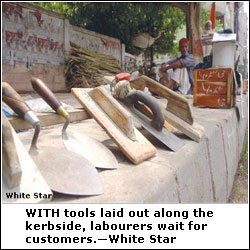 KARACHI, May 1: “To me, Labour Day only means a day off from work and today, my daughters and I have earned nothing at all,” says Sughra, who works as a sewing machine operator in a garments factory.
With a husband who gambles away whatever little he earns collecting and selling old paper and tin scraps, she says she can’t be bothered much about the day that is being observed. Even when the history of the heroic labourers who fought for their rights and died while doing so is explained to her, it hardly leaves her inspired.
Owing to her hardships, Sughra is justified in saying that she feels little is being done to eradicate her pain and concerns by both the government and the unions working for labourers.
“Why should we celebrate Labour Day when we have got no medical benefits, no permanent employment and no other benefits to cheer for? These days are not meant for us, but for foreign workers,” she says.
Along with her daughters, she work half of the month in a garment factory and for the rest of the month she has to wait for the orders to be delivered and the cloth to be printed and be readied for stitching.
Forty year-old Sughra is not only afraid to reveal the name of the factory where she works, but also its whereabouts for fear that she might lose her only source of income. She also questions if this interview could be of any good to her.
She laments that her wages have been reduced. According to her, her employers have said the reason is because the prices of thread and machine oil have gone up. With five kids to tend to and a husband who doesn’t earn much, this explanation does her little good.
“I leave home at 8 in the morning and return almost after 8 in the evening” she says. She lives in a rented house which costs her Rs3,000. All her kids are under the age of 16, out of which only the youngest two go to school. “I would love to send all my children to school, but the inflation rate leaves us all broke and we end up borrowing money from people, both on credit and otherwise,” she complains.
Sughra and her daughters earn between Rs4,000 and Rs7,000 a month. But since December 2007 when strikes and clashes made it impossible for people like her to step out of the house and make a living, she has had to borrow money in order to make both ends meet. Out of this she also has to spend Rs50 per day on bus fare for herself and her daughters to get to work and back.
“There is tough competition as when the factories remain closed, there is no work. Labourers then tend to seek work in other factories and that creates hardships,” she says. Most of the factories are unregistered and so are workers like Sughra.
‘Millions of daily wagers’
“There are millions of daily wagers in Karachi only, as there are numerous unregistered companies. Apart from that, even some of the registered companies might have a minority of permanent staff and the rest work on daily wages,” says Noor Mohammad, General-Secretary of the Pakistan Trade Union Federation. He explains that if a person works for more than 90 days at any workplace, he should be hired as a permanent employee.
“The new minister for labour has promised many things and says that trade unions and labour unions will be restored. But there have not been any written orders on this. Moreover, it is the female workers that are exploited the most as the time for them to leave is described as Maghrib, but they often work till 10pm.” He says women workers are usually found in the pharmaceutical and garments industries, whereas men are found in the automobile, chemical and other sectors.
Nabi Ahmed Baloch of the Muttahida Labour Federation is quite critical of the overall situation. “When the employees have not been registered as permanent, no matter how many years they have served in the job, the law then has no protection for them,” he says, pointing towards the crux of the problem.
“No one has the exact count for unregistered daily wagers as it is the contractors who hire them,” he says when asked about the number of daily wagers in the city. “Over the past few years the government has in fact patronised the employers,” he adds.
“Over the past few years we have seen that there has been no inspection of the factories and industries alike, which gives encouragement to the owners to exploit the daily wagers to the max,” he says. The daily wagers are not only deprived of basic benefits, but they are not even given proper overtime, whereas they have to work many hours more than they actually should, he explains.
Mr Baloch says a permanent employee is entitled to sick leave, medical benefits if the company has social security, gratuity, provident fund, bonuses, and overtime, which is calculated by doubling the salary and then dividing it by 208 (the hours in a month required to work) and the amount which results is wage for one hour of overtime.
‘The law varies’
Karamat Ali of the Pakistan Institute of Labour Education and Research (Piler) says the application of the law varies with each employer.
“In a standard organisation, a daily wager would be paid on a per hour basis double whatever the minimum wage is, medical coverage would be seen to if the person gets injured on the job etc. But this is hardly seen,” he says. He adds that according to a survey, there are 55 million labourers in the country, out of which Karachi has the biggest share owing to its status as an industrial hub.
Though every year there are numerous rallies and programmes organised to observe May Day, one hardly finds efforts are being made to solve the problems of those who are exploited. The law hardly has any protection for those who work as daily wagers as all the benefits seem to be for those who are permanent employees.