0
0

Aziz Hamid Madni: the poet who avoided limelight
 You may or may not agree with what is attributed to Thomas Hood:
“What is a modern poet’s fate?
To write his thoughts upon a slate;
The critic spits on what is done,
Gives it a wipe — and all is gone.”
But you would perhaps agree that rarely does a poet have such highly developed critical faculties and such a high standard of sincerity as to spit on the slate himself and wipe out what he has written.
Ghalib was one such poet. He ruthlessly discarded his early works in Urdu and what now we have of his poetical works in Urdu is but a slim volume.
But sometimes a poet is a scholar and a critic himself and though he may not have to discard his works, his critical acumen guides him through his creativity and his work reflects his critical sense. Aziz Hamid Madni was one such poet.
While remembering Aziz Hamid Madni, in an issue of ‘Qaumi Zuban’, Asif Farrukhi quoted Zia Jalandhari and Hameed Naseem as saying: “Among the modern Urdu poets, Madni stands apart and his voice is totally different. He uses the diction and terminology of the 20th century. His thoughts are synchronized with his times. Only the history will decide Madni’s standing as a poet but his prospects are limitless. He has an overflow of emotions but understands as well the perils and the possibilities of our times. He is trying to relate the absolute values with the present day circumstances and if he succeeds in this, he would be the poet to whose name the next era of Urdu poetry would be dedicated.”
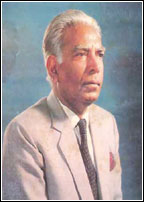 This may sound a bit too optimistic to many but the fact that Madni was one of the great poets of our times is often ignored or people simply do not know enough about him. It was his lack of social interaction and his pathological abhorrence to the limelight that kept him from becoming a celebrated poet in his lifetime. Otherwise, he had all the ingredients that make a poet genuine and appealing to many. If he had a different kind of personality, outgoing and opportunist, that is, he would have cashed in on being a high official in a government department, a qualification that appeals not only to fans but also to some critics who might just drop in someday looking for petty favours, only casually referring to what they had written about the official who, by sheer coincidence, happens to be a ‘great’ poet as well. It is a pity that not enough has been written about Aziz Hamid Madni, who was a poet with modern sensibility and a deep sense of classicism.
This publicity-shy scholar-poet was an exquisite critic too. As Asif Farrukhi wrote: “His poetry and critical writings complement each other and while reading them one feels creativity is blended with criticism.”
Aziz Hamid Madni was born on June 15, 1922, in Raipur. His father, Mohammad Hamid Saqi, was Shibli Naumani’s student and Maulana Muhammad Ali Jauhar’s classmate and a member of his cricket team. Madni Sahib migrated to Pakistan in 1948 and settled in Karachi. After doing his Master’s in English, he had brief stints in teaching and journalism and later joined Radio Pakistan as programme executive.
A voracious reader and scholar by nature, Madni Sahib was sometimes so engrossed in reading that he would forget to eat and sleep. Much erudite as his hugely vast reading had made him, he would talk on Shakespeare, Milton, Eliot, Hafiz, Firdousi and people would listen in rapt silence. A reticent and unassuming person, though Madni held a high post at Radio Pakistan, his poetry was rarely, if ever, recited on the radio as he did not like it and had issued strict instructions to that effect.
‘Chashm-i-Nigraan’, ‘Dasht-i-Imkaan’ and ‘Nakhl-i-Gumaan’ are collections of his poetry. ‘Jadeed Urdu Shaeri’ is a two-volume critical survey of Urdu poetry, published by Anjuman Taraqqi-i-Urdu. ‘Aaj bazaar men pabajoulan chalo’ is an overview of Faiz Ahmad Faiz’s poetry.
His unpublished works include translations of Shakespeare’s ‘Othello’ and ‘Antony and Cleopatra’. Madni had rendered translations from French poetry and the versified translation of Rilke’s poem ‘The Calling of Muhammad (PBUH)’ is just one of them but most of his French translations into Urdu remain unpublished. Recently, ‘Jareeda’, the journal of Karachi University’s bureau of compilation and translation, published some of Madni’s unpublished works.
Aziz Hamid Madni died in Karachi on April 23, 1991.
Nazim dents deep in treasury
Mohammad Saleem
IT is ‘ignorance of law’ or undue favour reportedly extended to a contractor by the district nazim, in any case, the city district government of Faisalabad has to suffer a loss of close to Rs20 million on account of cancellation of the advertisement contract by the provincial government.
The advertisement contract for the year 2007-08 was awarded to contractor Abdul Waheed against a bid of Rs71 million which was cancelled four months after the execution of the contract. Now, the CDGF is not in a position to put the contract under the hammer again as the new fiscal year is just two months away. The Punjab government cancelled the agreement when the contractor refused to continue with the contract, though he was reportedly fully facilitated by district nazim Rana Zahid Touseef, even against the prescribed laws.
The CDGF had succeeded in awarding the advertisement contract in fourth attempt on Sept 1 last year against a bid of Rs71 million. The district assembly approved the contract on Sept 15 while it was executed on Dec 14 after a final approval by the Punjab government.
The contractor was bound to furnish the bank guarantee within 15 days from the date of agreement under clause 5 of the contract terms and conditions. But, he approached the district nazim on Dec 12 for relaxation instead of going by the book. Sources said the district nazim had allowed him extension till Jan 15, although he was not competent to do so.
Opinion of the EDO (law) had also been sought in this regard who clearly stated: "Extension given by the district nazim is not warranted by the law."
Sensing the gravity of the situation, DCO Azam Suleman summoned the contractor but he always fought shy of appearing before him. Perhaps, alarmed by the situation, the contractor again contacted the district nazim and ‘convinced’ him to accept two sureties instead of the bank guarantee, and the case was immediately forwarded to the Punjab government.
After perusing the case, the local government secretary also asked the contractor to submit the bank guarantee, a pre-requisite for getting the contract. He also pointed out that the district nazim was not competent to extend the period as advertisement fee was to be charged once in a year which indicated that there was no justification for extension beyond June 30.
On the direction of the provincial government, the district government had placed the matter before the district assembly. The district administration formed a six-member committee, including EDO (municipal services), EDO (finance), EDO (IT), EDO (law) and DO (SP), on Jan 24 for the collection of advertisement tax contract and recommendations to resolve the issue efficiently.
Sources said the committee met many a time, but the contractor never bothered to appear before it to resolve the issue. The DCO had also invited him personally, but the contractor sent a female advocate to plead his point of view.
Sensing some foul play, the sources in the district nazim office said, the committee sent a draft resolution to the district nazim for strict stance against the contractor.
The committee also made recommendations which were: "The contractor is making excuses and going into litigation as well. The district government’s aim should be the recovery of contract money with requisite guarantees as advertised. The changes being made after the contract may cause a loss to the CDGF. The district nazim should have taken the decision in the interest of the district government, but he has forwarded the draft resolution to the house for decision”.
Sources said some hidden hands made members of the house to go beyond their limits who deleted prescribed rules against their competency, forcing the DCO to again draw the attention of the district nazim towards this serious issue.
They said the district nazim was repeatedly asked to initiate action against the contractor aside from making recovery through self-collection at the risk and cost of the contractor, but the DN did not move.
The contractor initially used delaying tactics in depositing the bank guarantee and finally submitted sureties through the district nazim office. Moreover, the contractor submitted the sureties belonging to Bannu (NWFP) district, although he himself belonged to Faisalabad.Requesting anonymity, a district government officer said: "You can easily play with the prescribed rules if you have sound connections with those at the helm of affairs."
He said because of the favorable behavior of the district nazim towards the contractor, the district government approached the local government secretary for the cancellation of the contract to save the treasury from further loss. Now the district government was itself collecting the advertisement tax, he said.
About taking action against the contractor for inflicting a heavy loss to the exchequer, he said: “Who will bring the contractor to book”?
Denying all allegations levelled against him, the district nazim claimed that the DCO office had not provided the relevant record of advertisements to the contractor on his repeated requests which caused the cancellation of the contract. He said he favoured the stance of the contractor.