



 0
0

Everything other than love is redundant — Tajdar Adil
 Renowned scholar Dr Asif Aslam Farrukhi was explaining to his university students how a short story should be written. To illustrate the techniques, he pulled out a specimen from his papers and showing it to the students said that, that was how a piece of fiction should be written --0 complete in every aspect. When the class was over, a student shuffled across to the teacher and “respectfully begged to inform” him that the story the teacher had mentioned was written by him when he was a schoolboy.
The teacher was surprised and impressed in equal measures. But he said, “I know that your elder brother writes fiction. Your father wrote both fiction and poetry. You two better divide your father’s legacy in a way that you let him write what he does and you focus on your poetry.”
Probably that was the piece of advice that Tajdar Adil took heed of and devoted himself only to poetry. The son of great scholar and poet Saba Akbar Abadi, Adil has a collection of poetry Maat honay tuk to his credit, published in 1982. His second collection is ready for publication under the title of Teray naam. Maat honay tuk contains both poems and ghazals. But, following in the footsteps of his father, he has also written Marsia, Naat and Salam.
“The difference is that my father wrote marsia containing as many as 400 couplets, I wrote short ones of about 40 to 50 couplets,” says Tajdar Adil, the noted poet and broadcaster, now general-manager of PTV’s Karachi centre. He, however, says marsia is a most difficult genre to write — one must have a vast knowledge and be extra cautious while writing it. So is rubai, which he hasn’t tried his hands at.
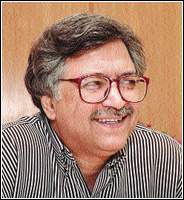 He began writing poetry when he was a grade two student. “Poetry was everywhere. It even blocked my way when I wanted to go to school,” says Adil with a mischievous smile.
His poetry mostly revolves around love. “Man’s actual art is love. To ascend love or go beyond it is something I cannot do. Whether this love is just for an individual or for people at large is the question. The flow of my love is towards human beings. Humans, humanity -- this should be the centre and orbit of our love. In this pursuit we may come across an individual, with whom we may be on the same wavelength, with whom we may enjoy meeting, sharing views. It is not necessary that we have only one such poerson. We may have several such persons at the same time.
Mohabbat kay Ilawah hai hunar kia
Kia hai aur hum nay umr bhar kia
(What art have I known but love throughout my life?) And
Aik muhabbat kafi hai
Baqi baat izafi hai
(Love alone is enough. Everything else is redundant.)
Talking about his passion for PTV, he said when he joined it, he was asked by Jamil Nishtar, the then vice-president of the National Bank and son of the late Abdur Rab Nishtar, to multiply his PTV salary by four and join the NBP. “But I declined the offer saying that the bank could give me a higher salary, but not the satisfaction I was getting from PTV. This was the place where I could use my dreams, my thoughts, my ideas for the welfare of the public.”
He has been with PTV for more than three decades and has directed or co-directed many memorable programmes. He wants to promote regional languages and cultures and during the last four years he has done programmes on PTV in almost all regional languages – Sindhi, Balochi, Brahvi, Punjabi, Siraiki, Pushto, etc.
Under his stewardship, Karachi centre is doing a couple of commendable programmes to promote literature. Diar-i-Sukhan is a music programme, where not only the poetry of noted poets is rendered by popular vocalists but an intellectual, a poet or a musician is also invited to offer his comments as the programme progresses. Another programme, Café Adab, had been very popular as long as it ran and Tajdar intends to revive it.
And how does he handle PTV producers, most of whom are believed to be work-shy. “Most of our directors want to do work. There may be a debate on the quality of their efforts, but they do work. This work involves creativity. You cannot force anybody to be creative as you cannot force an artist to paint what is in your imagination. This job involves dreams, and you cannot force someone to see the dream you want him to see,” says the GM in defence of his colleagues. “However, during the last three-to-four years, PTV’s Karachi centre has been more active than any other single channel.”
Tajdar says he finds little time to write now, but he still manages to do a lot of reading. “For instance, before preparing for office this morning, I found an old book and read it for full one hour. During my travels the few minutes I get, I read one thing or another.”
He is hailed as a representative poet of his generation. His father’s literary achievements may, however, outshine that of any big name in Urdu literature. Saba Akbar Abadi’s unpublished works, according to Tajdar, may fill as many as 50 volumes.
Five books of Saba sahib’s marsias have been pubished -- Shahadat, Qirtas-i-Alam, Sarbakaf, Dawam and Khaunaab. In ghazal, his books are: Auraq-i-Gul, Chiragh-i-Bahar, Sabat and soon to be published is Meray hissay ki roshni. Dast-i-Zarfishan is Urdu translation of Omar Khayyam’s 100 rubaiyat. In all he has translated 1,200 rubaiyat. Humkalam is the translation of Ghalib’s all Persian rubaiyat. In 1936 a book of his was published under the title Zikr-o-fikr, which contained his naats, marsias and salams. The only naat collection published so far is called Dast-i-dua, whereas two more collections may be published from his unpublished works.
Born in Hyderabad in 1950, Tajdar did his Master’s from Karachi University first in Economics and then in Mass Communication.
The waning charm of having been there
 One needs to travel to arrive somewhere. ‘Wilayat Pass’ or ‘London Palat’ was the degree we conferred on anyone who would return from abroad after spending a couple of years or more in Britain. It was not necessary to have been at Oxford or the Lincoln’s Inn. There were few like Allama Iqbal who returned with a PhD and Bar in three years, that his son Javed Iqbal could achieve in nearly seven years and that neither Muhammad Ali Jauhar, or Hafiz Mahmood Shirani, his contemporaries, could do in any number of years. Sixty’s actor Asif Jah in his delightful comedy Wilayat Pass indeed made a mess after his return home but foreign travel and migrant stays overseas having become so common in recent decades, today’s London Palat does not enjoy the kind of respect and fascination in the eyes of the home-grown as he did not many years ago when the green card was envied as the ticket to paradise. In fact families with some culture hesitate to tell about their sons overseas lest they were thought to be living on forex. It is not that exciting any more, some of the thrill is definitely gone.
Writing also must flap wings and find a lamp post in London or New York to perch if one wants to escape the ignominy of being local and small. It is meritorious to mention in how many languages your work has been translated, and writers take pride in naming the nameless foreign lists which mention them among the ‘also ran’ category. That too in most cases requires more than a bit of public relationing, as editors do not navigate across the Atlantic for readable materials unless controversial writings cause an uproar of some kind as in the case of Bangladeshi writer Tasleema Nasreen. But since Salman Rushdie’s scandalous and Arundhati Roy’s well deserved success, a channel of possibilities for recognition-cum-publication overseas has opened both for the smart guys who know their way around as well as the unknown upstart.
A most curious thing that is observed is the near total absence of our established writers — Quratulain Hyder, Saadat Hassan Manto, Ghulam Abbas, Intezar Hussain, Abdullah Hussain and others — from bookshops in metropolitan cities in Europe and America, although nearly all of their works have been translated into English. It means only one thing: not many people have read them and those who are not impressed enough to create a saleable readership. In comparison the works of Latin American writers — Paulo Coelho, Gabriel Marquez, Julia Alvarez, Ernesto Sabato etc — have a huge market with an avid readership all over the West. In what way Marquez’s A Hundred Years of Solitude is a better piece of writing than Quratulain Hyder’s Aag ka Darya, one questions. On the other hand, Khaled Hosseini’s novel, The Kite Runner, which is neither literature nor good fiction, has launched the author on a successful writing career in America.
A good source of limited exposure are the different anthologies of poetry, short fiction and sundry writings on specific topics that mostly universities publish with the help of foreign students and teachers to introduce contemporary trends in foreign writings to their reading public, generally people in research, academics and aficionados of the exotic in literature. In case of original writings in English there is a section of readers who are more interested in knowing how their language is being used or misused by non-English speaking countries, though now increasingly a more charitable view of such writings is being taken and even acknowledged as African or South Asian English, and being placed higher than the pidgin variety.
One anthology of poetry, international in character, and by that measure of wide interest anywhere where English is read, is The Poetry of Men’s Lives, published a couple of years back by the University of Georgia Press, has 295 poems by 253 poets from nearly 100 countries, including Pakistan’s Faiz Ahmad Faiz, Iftikhar Arif, Alamgir Hashmi, Taufiq Rafat, Harris Khalique, Shuja Nawaz and Moeen Faruqi. Of these seven poems only Faiz and Arif’s are translations. Bunched under 11 themes like boyhood, politics, sex, identities, myth, families, death etc the poems purport to “tell us a good deal about who men are and what they are feeling and thinking at this particular juncture of world history. In this sense, these poets are surrogates or representatives of men in general. By inclination and training, they are capable of articulating the feelings many men are unable to express.”
The Annual of Urdu Studies (AUS) brought out by the University of Wisconsin-Madison’s Department of Languages and Cultures of Asia and edited by Muhammad Umar Memon, is a fine selection of criticism, fiction and poetry, newspaper columns on literature, book reviews and events related to Urdu issues. But for the fact that it is an English publication, it has the flavour of a good Urdu literary magazine and for one interested in the state of the language, a very enlightening and instructive choice of readings. This 2007 issue, though in memory of Ahmad Nadeem Qasmi and Munir Niazi, has just one light piece on Munir Niazi by Harris Khalique, nothing on Qasmi Sahib. There is one brilliant article by M.A.R. Habib on T.S.Eliot and modernism in Urdu poetry that studies the verse of Noon Meem Rashed in that context. The Language Culture of Lahore by Celeste Sullivan is the kind of engaging and provocative work we should also learn to do in Pakistan. The poetry section has Zeeshan Sahil and Azra Abbas. Their’s is the kind of verse that gains weight in translation. In comparison the ghazals of Khwaja Mir Dard that appear in the articles section, though excellently translated, suffer a real diminution and loss of impact. The fiction part is rich with stories by Naiyer Masud, Shamsur Rahman Faruqi, Abdullah Hussein, Ahmed Ali and Sajjad Zaheer. The account of the workshop on “Between popular culture and state ideology: Urdu literature and media in present day Pakistan” organised by the South Asia Institute at the University of Heidelberg (Germany) in which scholars from Pakistan (Prof Fateh Muhammad Malik, Fahmida Riaz, Zaheda Hena, Harris Khalique) Germany, Britain and the USA participated, looks like the gathering ended somewhat like government meetings with the writing of the minutes.


























