0
0

Coalition govt must help curb price hike
Baba Najmi
By Naseer Ahmad
 A famous four-liner by Baba Najmi, the eminent Punjabi poet, goes like this: ‘Your father and mine is the same; your mother and mine is one, we share the same place of birth. Then why is it that you are the master and I am the servant?’
This question must be haunting Bashir Husain, whose penname is Baba Najmi, as he earns his living from shining cars at Plaza on M.A. Jinnah Road. But this is not the only question he raises in his poetry. Being a daily wage earner, Baba has first-hand knowledge of workers’ sufferings, which are multifaceted. Naturally, through his poetry he seeks remedy for workers’ woes.
He wishes that the new coalitions government stay intact and help solve at least the basic problems of workers. And none of them is more basic than wheat flour, which is getting harder and harder to buy. “Benazir Bhutto once asked me if I didn’t have any other problem to highlight than that of flour, I said the others are less important though I do write on them,” says Baba while talking to this correspondent in a Mehmoodabad restaurant on Tuesday. In one of the numerous couplets on the subject, he addresses the ‘Chaudhrani’, Benazir Bhutto the prime minister, and beseeches her that rather than increasing the price of wheat flour, she rightsize her cabinet and spare the poor of an extra burden. Another couplet says: ‘Many people crying aloud like me would be put to sleep by the sword of flour price hike.’ When a group of girl students went on hunger strike at the Karachi Press Club, he wrote a poem asking the authorities that they, being the daughters of the city, must be given admission.
He attacks tyranny, injustice and price hike with full force. A diehard PPP supporter for decades, he visits Larkana every year to pay homage to the late Z.A. Bhutto. From now on he might be visiting there twice in a year as Benazir Bhutto, his favourite leader, also lies buried there. But he admonishes every ruler he sees is not doing what he should for public welfare.
“When Gen Musharraf took over on Oct 12. I at a gathering on Oct 16 warned him not to prolong his dictatorial rule. When the lawyers’ movement began, I was the first to write in its favour.”
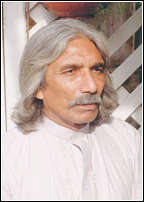 He says he is lucky that several Urdu publications publish his poems, which are a sort of comments on current affairs -- may that be violence, price hike or political wrangling.
Born in a Lahore settlement in 1948 and called Baba since his early youth, he has been living in Karachi for the last 30 years. It was here that he attended his first mushaira, where he recited a Punjabi poem. The audience at the Urdu poetry recital must have enjoyed it because he became a frequent invitee at such gatherings.
An ardent proponent of the Punjabi language, Baba Najmi says there is no threat to the language as long as the teeming millions of Punjabi-speaking people live across the globe. “Punjabi has reached out from Punjab and Delhi to Mumbai (Bollywood), where several renowned vocalists have made it more popular in the world.”
In this regard, he mentions his last month’s visit to Amritsar, where he had gone to receive the Baba Bulleh Shah Award. The Punjabi Sath gave him the award in recognition of his services to Punjabi language and literature. The organisation also publishes Punjabi writers and poets’ books and distributes them free.
Baba says though there is not a single Punjabi-language newspaper being published in Pakistan, there are as many as a dozen being brought out in India. “I was told that one of them has a daily circulation of 4,000,” says Baba.
He says any language may flourish if ‘roti’, a living, is attached to it. “If the Punjab government announces that henceforth Punjabi will be taught in schools and 2,000 teachers will be required for it, many people will begin learning Punjabi to get the jobs. A living has been attached to Sindhi as several newspapers are being published in this language and people get jobs there. So the language is naturally prospering.”
He, however, says Urdu is a link language of Pakistan. “If I want to talk to a Baloch friend, or a Pathan friend, for instance, I have to speak Urdu.” A constant Paan-chewer, Baba’s Urdu has few traces of a non-native speaker.
He has three poetry collection to his credit – Akhran vich samundar, Sauchan vich jahan, and Mera naan insan. His works’ popularity can be judged from the fact that each book has run into a fourth edition. He has no pretension of having read Persian, Arabic or any other foreign language. So his language is simple and has tremendous appeal for the common people.
When he gets into a romantic mood, which he does rarely, he manages to touch the cords of hearts: “ Why don’t I love my sweetheart when I know only water extinguishes fire?”
Baba Najmi did matric in Lahore and began working with a film distributor firm as a clerk and became its manager. He first came to Karachi in 1973 for the distribution a film. But in 1976 he arrived here to seek a job as he had suffered a big loss in the film industry. “A friend of mine trained me for a few days in how to polish cars and then I got going. It is a blessing of sorts as whenever I have to attend events away from the city, I don’t have to seek leave from a boss.”
He is blessed with seven children – two sons and five daughters. Two sons and a daughter are married. Living in a rented house in Mehmoodabad, Baba seems content with life. He has won several awards at home and abroad.
Our Christian poets and writers not far behind
 Readers may have stopped reading but writers continue to write. A directory of Christian writers and poets compiled by Dr Yusuf Masih Yaad, president Pakistan Christian Writers Guild, Peshawar, and editor quarterly Piyam, lists 644 of them, contributing to over 30 literary and religious magazines and periodicals from all over the country. We have 57 Christian writers and poets in the twin cities alone with Lahore leading at 154. The catalogue gives data for 2002; the list must be longer now in the spring of 2008. The proportion of poets among them, in keeping with the national ratio, is greater. A substantial percentage among them comprises women. It is a sign our Christian community despite difficulties created by the extremist fringe in the recent past has not succumbed to despair and is contributing its share to society’s creative output.
Dr Yaad has done this work in three years collecting data from remote places as well as larger towns and cities. The list is complete with postal addresses and telephone numbers. He deserves to be complimented. It is also necessary that these writers and poets should be encouraged to write in other than Christian publications. The Academy of Letters which has done such valuable work in the promotion of regional literatures has work to do among the minorities also so that they may join the mainstream without any inhibition. This should be part of our work to absorb all Pakistanis in the nation as one people and end the minority distinction in the polity.
H H H H H
AL-AQREBA: The quarterly Al-Aqreba published by the Al-Aqreba Foundation from Islamabad will now be completing nearly a decade of its regular publication with its annual edition for 2008. It is a less known periodical not because it is less weighty in content than any other literary magazine but probably with its survivability strength it has not made the proportional promotional effort, but I was told the people behind it (Syed Mansur Aqil, Shehla Ahmad, Mahmood Akhtar Saeed) have no other uses for literature as currently available to the more imaginative of its practitioners. From a professional angle it comes to mind probably the name is not catchy enough. Nor either the title cover which celebrates the year 2008 through a Soduko- like chart of 25 squares called Naqshe Kamal. Each square carries a wish or prayer with its numerical weightage on the Abjad scale, one of which interestingly points to the hope the year may make the country constitutional. Well, at last, maybe. Obituary verses denoting dates of passing away is an old tradition of Urdu poetry. It is one among the many exercises in futility that we remain fond of, and why not since there is little else to do.
The present annual issue of Al-Aqreba has a number of scholarly articles and essays of a staple nature. One short but very scintillating on Muneer Niazi by Prof Fateh Muhammad Malik, another on the linguistics of Urdu idioms by Dr Arshad Mahmood Nashad and on the beginnings of Urdu literature by Mahmood Akhtar Saeed have much to offer to the serious student of literature. Then there is a section devoted to Iqbal studies. Of the five essays the one on Quratulain Hyder’s impressions of Iqbal, though loosely written, has good anecdotal material, in particular how she fumed at the neglect the Allama suffered in the West when compared to the unnecessary fuss Rabindernath Tagore enjoyed.
In the prose section Dr Hasrat Kaasganjvi’s essay on Imagination is a piece of writing that Urdu writers do not much care about though it has limitless possibilities for a fertile imagination. In the West, the essay on a single theme is still very popular. But it needs inventive intellects.
Al-Aqreba’s poetry section is complete with its share of Na’ats, Hamds, Ghazals and Nazms as well as a good portion of Qata’at. The section devoted to critical reviews examines Dr Taunsvi’s book on Shahab Dehlvi, Aziz Ahsan’s collection of critical essays, Syed Mohammad Sulaiman’s book on Islam as a religion of peace and Azra Asghar’s novel, Musafaton Ki Thakan.
The editorial on the Year of Languages laments the tragic neglect of the national language by the government of Pakistan and castigates the United Nations for dubbing Urdu as Hindustani. It asserts Urdu’s international position and status.