Reprehensible conduct
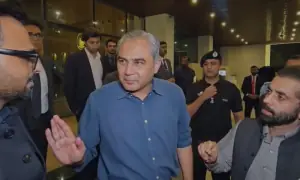
NO amount of censure is enough for those who manhandled Dr Sher Afgan Niazi in Lahore on Tuesday. The former parliamentary affairs minister, who locked himself inside the chambers of his advocate for several hours before being attacked by angry lawyers, is a heart patient. But this consideration did nothing to lessen the wrath of the frenzied mob that verbally and physically assaulted him as he tried to get into a waiting ambulance. Coming in the final hours of the caretaker government, it would, of course, be very tempting for some quarters to attribute the unwholesome event to elements seeking to undermine the lawyers’ movement. If indeed there is a grain of truth in this theory, then it is even more incumbent on the lawyers to thwart such designs by showing restraint when passions are whipped up. The truth is that a movement that stood for the rule of law and the independence of the judiciary is in danger of turning into a self-absorbed, opinionated entity with no regard for the values of tolerance.
There is no doubt that Dr Sher Afgan fully supported President Musharraf’s autocratic order that played havoc with the judicial institution. But the lawyers’ revenge could have been sweeter had they kept within the limits of civilised and lawful conduct and refrained from attacking the former minister. If victory is finally theirs, it will be marred by such instances of wild behaviour and their inability to understand that the rule of law is not about heroes and villains but a clear vision achieved through a principled struggle.
The other concern is the inaction of the police. Is it possible that a force that previously showed itself to be quite adept at thrashing and tear-gassing lawyers could, in this case, not protect a lone man against the mob’s excesses? The fact of the matter is that the law-enforcement forces are too politicised for anyone’s good. Caught between the outgoing and incoming political orders — both having diametrically opposed visions — there must have been considerable confusion within their ranks. Would they be hauled over the coals for forcibly restraining the lawyers whose star is in the ascendancy? Or would they receive a rap on the knuckles from a pro-Musharraf dispensation for not protecting a politician who was the president’s right-hand man? This is yet another example of how institutions are impeded in their duties by political masters whose individual or party agendas keep them from following the course of the law.
In keeping with the newfound spirit of forgiveness and national unity, the coalition government would do well to promote tolerance among the public. Both the Sher Afgan and Arbab Rahim incidents show that the anger of those who suffered under President Musharraf has reached a boiling point. Unless they are advised to keep their anger in check, in fact to channel their energies to protect the rule of law, the government, despite its democratic credentials, will find it difficult to prevent the country from sliding into an era of anarchy.
Politics of blood
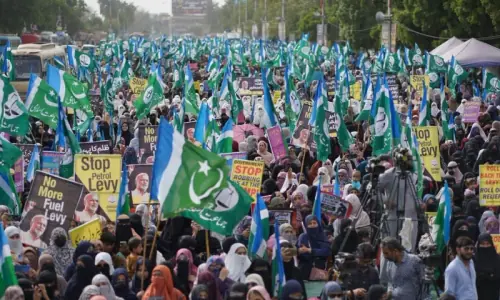
FEARS abound that once again Karachi may become the backdrop to a theatre of blood and conflict. Even before violence erupted on Wednesday ostensibly triggered by the Sher Afgan episode there had been a sharp rise in targeted murders of political rivals in the city as over two dozen were slain in the month of March. According to law enforcement agencies, political violence flared up shortly after the Feb 18 elections to claim 25 activists of various political affiliations. Political parties such as MQM-H lost six workers, Sunni Tehrik lost four, two victims belonged to Jeay Sindh Mahaz and surprisingly, PPP and MQM, two major political stakeholders in the province did not go unscathed either. Police authorities maintain that this spate of political confrontations is unlikely to subside in the near future. This becomes all the more apparent as representatives of MQM-H dismiss official statistics, asserting that they have ‘received the bodies of 35 party workers since the polls’. The party also lays the blame for the bloodshed on the MQM, which in turn is vehemently refuted by the latter’s leaders. Although the Sindh home department maintains ‘it is more exaggerated than the ground realities’, Karachi’s political environment is becoming eerily reminiscent of the days of MQM’s bloodstained confrontation with the state; a virtual wipe out of a generation of young party faithfuls.
Last week’s climate of ‘brotherhood’ and reconciliation, which is now under serious strain, did little to assuage existing differences in the lower rungs of various political factions. The recent attacks on PML-Q leaders, particularly the incident in the Sindh Assembly, demonstrate that party leaderships have clearly failed to take their workers on board and create a culture of appeasement, or restraint, within their ranks. As party influentials were working out power-sharing formulas to protect their own stakes, they closed their eyes to a deeper malaise that plagues their representatives on the street. As a result, these long festering demons have wreaked much blood-letting. Undeniably, real solutions lie with party leaders who should make peace a priority before entering power deals. Perhaps the inclusion and consent of party workers is a clear route to general accord and until this is achieved, amity in the city will remain a major challenge.
Karachi’s water problem
A REPORT prepared by a researcher of the Orangi Pilot Project confirms what has been suspected for long. Karachi’s water deficit has been artificially created for the monetary benefit of the tanker owners who supply water to domestic and industrial users at an exorbitant rate. With the consumers not getting the piped water for which they pay taxes, they are forced to turn to the tankers to meet their needs. This has become a simple economic issue for the tanker owners who, according to this report, earn Rs49.6bn per year — a staggering amount before the annual budget of the Karachi Water and Sewerage Board which is peanuts at Rs5.3bn. The intriguing point to be noted is that the hydrants should go dry first, if there is not enough water. But they don’t. With the help of irrefutable statistical evidence, the author of the report points out a grave anomaly in the overall water supply mechanism. Against a total demand of 601MGD, the city gets a supply of 665MGD. But 100MGD is lost through leakages while 272MGD is siphoned off from the bulk distribution point before it is supplied to various towns.
The solutions tabled by the OPP report deserve all the attention that they can get in relevant quarters. It is only by strengthening the KWSB with technical manpower, its own power-generation units and equipment to professionally meter bulk supply to the towns that there can be any hope of a long-term, sustainable solution to the perpetual water crisis in a city of 16 million people. The KWSB, and not the Rangers, should be responsible for whatever supplies are made through tankers. This would enable the agency to raise an additional Rs5.8bn every year by selling surplus water at an affordable rate of five paisa per gallon — the present price is ten times higher. With consumers getting piped water at a nominal charge, and the KWSB raising more than cent per cent of its existing budget, there can be no losers in the equation, bar the tanker owners. The elected nazims and representatives of public forums should be made accountable for managing this supply.
OTHER VOICES - Middle East Press
Constitutional amendments
Yemen Times
OVER two weeks ago, the ruling party, the General People’s Congress, approved a number of amendments to the constitution, which the party proposes to present to the parliament for endorsement. The majority of the members of parliament are members of the GPC and so endorsing these amendments is just a matter of time….
The most significant amendment (concerns) … the Shoura (consultative) council as a legislating power in Yemen side by side with the parliament….
As it is the situation today is that there are at least 200 members of the parliament from the GPC, comprising a 66 per cent majority.
Only 150 members of the parliament need to congregate in order to discuss any new amendment and only 76 of them have to say yes in order to pass any new legislation. Now with the Shoura council members having the same power the idea of a balanced legislating power is turning (into) … a joke.
….It will be impossible to pass something that the president or the government does not want.
The only thing to do is that we raise awareness on the significance of such amendments and hope that someone with influence will care enough to stop this from happening. — (April 8)
Law vs mentality
The Jordan Times
NOW that both chambers of parliament have rejected the temporary law on traffic, drivers need to know where they stand on traffic rules. The alarming traffic conditions in the country and the rapid increase in fatalities and injuries on the roads have attracted much public debate.
Whatever the country decides on how to deal with the worsening traffic crisis, it is obvious now that parliament does not share the existing guidelines and the penalties on traffic violations.
The temporary law has been applied for many months now and has been used as a test ride during the past few months to determine its effectiveness. The outcome of the law is thus the best test of its effectiveness….
Surely the authorities have gathered enough statistics on traffic conditions since the temporary law was enacted and applied. If, in fact, traffic accidents have been reduced and traffic deaths and injuries have dropped significantly, then the temporary law is sound and should become law.
This would be the correct way to go about passing judgment on the current traffic law.
Parliament could have looked into the data before deciding to reject the law. Since it did not, its opposition to the law seems unjustifiable. — (April 7)
A house for every citizen
MR Gilani’s speech setting out his 100-day programme was interesting mainly because the words were uttered by an elected prime minister. In truth, he appeared to say we know the problems, without saying much about the solutions.
One cannot take issue with an elected prime minister regarding his perception of the problems that confront Pakistan. However, this article intends to propose solutions in one of the key areas of his speech. The prime minister mentioned that he wants to revive both the five-marla grant scheme in rural areas and build a million low-cost homes a year.Undeniably, housing is key to developing a country. However, there is little originality in land grant schemes. Roman emperors did it; so did the Mughals and the British colonialists. The practice was kept up by their inheritors in Pakistan — the Pakistan army. One of my journalist friends always used to ask the so far unanswered question: what will happen to the army when the plots run out?
In Pakistan, the results of grants of land have been unfortunate. The wealth they bring to the rich adds only to their unproductive lifestyle. In the case of the poor, such land does not usually improve their standard of living because they are unable to build good housing on the land.
In economic and legal terms, such schemes are also suspicious. It is after all the equivalent of giving away good government land for nothing.
Government land should, therefore, only be provided after applying means testing to low- or zero-income people in the form of a sale and not as a grant. The title should remain with the government (or its nominees) and the money payable for the land should be payable in instalments by the people acquiring the land.
These instalments may be made payable over 20, 25 or even 30 years. Participation in a housing project which provides a house for each plot of land should be compulsory for anyone wanting to acquire the land. In other words, you do not get land alone but a house to live in as long as you work and pay for it.
The government should then raise capital in the capital markets from investors against the projected income streams from the mortgages granted to provide housing schemes. And before people get too excited and raise the argument that this would be too huge a credit risk for investors, I would ask them to think again.
The reality is that whenever micro-credit has been made available to low-income or zero-income groups together with income and job development programmes such people have generally been better at repaying than the bigger defaulting houses of Pakistan.
This responsible credit behaviour of the low-income groups has actually been evident in success stories like the Grameen Bank and there is no reason to believe that this cannot be replicated in relatively less risky areas like land and housing. The important issue in ventures like this is to remove the need for collateral (which the poor will never have) to acquire housing and at the same time give them jobs which can pay the loans back.
This leads to the question where will the jobs ensuring that people are able to repay the mortgage for the land come from? In this connection, there would be two categories of people: firstly, those who would be employed at the time of the implementation of these schemes who would typically have the wherewithal to repay the loans from the income provided by their ongoing jobs; and secondly those who are unemployed.
For the employed, the scheme should be relatively straightforward as the type of housing it provides would be linked to their incomes. For the unemployed, the proposal would include a scheme of employment in the very same housing development schemes.
Such a process would virtually see people who buy the land employed in building their own housing and paying for the land and the housing at the same time. Not only will this be an incentive-based mechanism but should also result in training them as semi-skilled construction workers. These skills can then transfer to new and bigger projects and continue repayments.
In effect then, this article is arguing that the government should use its own land as collateral to raise money for housing. It can then recoup its investment by issuing asset-backed securities linked to the mortgages it provides to the people who acquire the land from it.
The current global credit crunch and the resulting suspicious approach towards asset-backed securities would, of course, need to be confronted. But given that such a scheme would take some time to put together, the global appetite for such investment may well have changed positively by the time this comes around. If not, imaginative measures to address credit default risk can be devised to make the securities attractive to investors.
In advanced countries, this process of raising finance is called securitisation and is a common financing structure. In Pakistan, as far as I am aware, it has mainly been used in the telecoms sector.
As a matter of fact, at some level irresponsible dealing in such securities is considered responsible for the current American sub-prime mortgage market crisis. This, however, should not dissuade the government as long as it can put together an attractive package for investors.
The return on such securities for investors would, of course, be linked to the future income streams that are expected from people repaying their loans. If the people repaying the loans perform better than expected then the investors benefit and it is a win-win scenario. The government’s test will lie in ensuring that the economic cycle generated by the schemes are sustained by its overall economic management.
In fact, this would also be a tremendous way of regularising katchi abadis and developing new townships with proper architecture that fits our climate, is environment-friendly, wastes less water and above all leads residents to develop self-respect and socio-political cohesion.
The obvious benefit of such an approach would be to interlink housing and employment both of which are key to the success of any government. If such an integrated approach is adopted then labour-intensive building projects can also be linked to local economies which can generate further growth.
Admittedly, politicians are merchants of hope but in Pakistan’s history there has always been a question mark regarding their abilities to drive programmes that work. Let us hope that the time to turn this around is now.
The writer is a corporate lawyer and political analyst
lawgroup.q3@gmail.com
Tory wolf in liberal clothing
THE Conservatives are studying how the Swedish right beat the long-serving social democrats at their last election. What was their magic template?
“There is a lot the Conservatives can learn from the Swedish Moderates,” Cameron said, welcoming prime minister Fredrik Reinfeldt in London recently. “How to make bold and lasting change, how to reform welfare, in health how to put the consumer in control, in education how to put parents in control.” He listed the rolling international victories of the right: “Everywhere the centre-right has the right ideas at the right time!” That evening he took Reinfeldt home to dinner to glean the secrets of his electoral success.
So a visit to Sweden to find out what Reinfeldt’s conservative coalition has done in office may offer a glimpse into what a Cameron government might do. First, how did they win? Set the scene back in 2006 when Goran Persson had been finance minister, then prime minister for 12 long years. He was deeply unpopular, leaden, lacking in charm and out of touch.
His natural successor, Anna Lindh, popular and talented, had been assassinated and the social democratic party, as well as its leader, seemed incapable of averting what it knew to be the coming electoral catastrophe. Failing to eject Persson despite disastrous polling predictions, they sleep-walked over the precipice with their eyes wide open. Even Moderate party ministers admit there was no national swing to the right — only a desire to evict an unpopular leader, so the voters did what the social democrats should have done. Familiar?
The Moderates only had to make themselves respectably electable and wait for the ripe plum to drop. At the previous election they had crashed at just 15 per cent, so Reinfeldt, an appealing and eloquent 41-year-old, had a free hand to change everything. His tactic was to adopt virtually all social democrat policy so there was no observable difference — familiar? His one key issue was hidden unemployment and government inertia over too many people on sick pay.
What has Reinfeldt done? A lot more than voters bargained for. Welfare reform has been radical: benefits are cut and so are taxes. Everyone in work gets new tax credits: in Britain tax credits are benefits aimed at the poorest, in Sweden they are tax cuts for all. National insurance contributions have been raised sharply, with the unplanned effect that nearly half a million of the lowest paid have walked away from the scheme, leaving them nothing if they lose their jobs.
Since the scheme is administered via the unions, union membership has dropped by the same amount. This strikes at the heart of the Swedish model which delivered industrial peace and prosperity with 90 per cent union membership arranging civilised pay agreements with employers. Generous unemployment pay was key, allowing unions flexibility to let jobs go in dying industries, encouraging new industries to start up and Sweden’s GDP to grow faster than most. But the assault on benefits and unions puts all this in peril. At the same time, the Moderates abolished wealth tax: it wasn’t large, but it was symbolic.
This wasn’t what the public voted for and polls show Reinfeldt’s government extremely unpopular. Applying more of the same medicine, they hope a third round of tax cuts at the next budget might restore their fortunes —though neither tax nor benefit cuts please voters. Meanwhile more of the health service is contracted out, with GPs free to charge for the first time, raising alarms that they are moving out of poor areas to richer places where they can earn more. The prime minister’s wife, in charge of the Stockholm region’s health service, has been particularly radical.
State-owned Absolut vodka has been sold to the French, and state-owned liquor stores are about to be sold off too. Museums that were always free now charge high entry fees — for British visitors a crisp reminder of the Thatcher years.
Education is where Cameron draws most from Sweden. When last Swedish conservatives were in office, in the early 1990s, they allowed anyone to set up a “free” school, however small, and claim the state’s per capita allowance for pupils: voluntary and private for-profit schools opened, as well as Muslim and Christian schools. Cameron now plans to do the same. The biggest for-profit company — Kunskapsskolan — is about to open academies in Britain next year, justified to their shareholders as experimental loss-leaders. But if Cameron wins, the company will be in prime position to open as many “free” state schools as there are parents wanting to use them.
Interestingly, however, this is not a programme the present Swedish conservative government is expanding; only about 10 per cent of Swedish children attend “free” schools, and Reinfeldt’s ministers say their energy is directed to improving ordinary state schools. “Free” schools have proved socially divisive, attracting more middle-class families and minorities, many have restrictive academic admissions criteria, and there is intense unease over new segregated faith schools.
Here is an example of how “choice” can also restrict choice: a former social democrat minister tells me he is sad he feels he no longer has the choice to send his child to the once socially mixed neighbourhood school that he attended. Instead she travels miles away to a “free” school, where the brightest children have congregated, making his old school much worse. It’s an irony that the Swedish conservatives no longer promote the “free” schools that Cameron will make his centrepiece policy: expect similarly divisive effects.
At present, the Swedes look certain to vote out the right: the nation’s history is of social democracy punctuated by brief evictions as wake-up warnings. This time they voted for a wolf in sheep’s clothing and are now appalled at what may be permanent damage to the successful Swedish model of cooperation between unions and industry, with high taxes and a generous welfare state.
Putting up taxes and benefits again is far harder to do, so even a modest dose of ideological Thatcherism could break the harmonious political ecology that made Sweden one of the most economically and socially successful societies on earth. The Swedish social democrats have a popular new leader in Mona Sahlin — while the man now most reviled is Goran Persson for hanging on like grim death and taking this party down with him.
Long incumbency requires a dramatic political renewal that he could never provide. Cameron is not the only one looking to Sweden for lessons and warnings.
—The Guardian, London