0
0

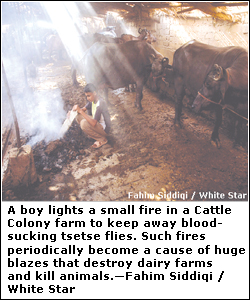 KARACHI, March 24: Filthy conditions and absence of a proper sewerage and drainage network for the disposal of animal waste are the main causes of the recent fire incident in Cattle Colony, which resulted in the death of over 200 buffaloes and losses of millions of rupees to dairy farmers.
The basic issue of hygiene and sanitation, which has remained unresolved for decades, also leads to milk shortages and price hikes.
The acting director of the Sindh government’s animal husbandry department, Dr Abdul Qadir Junejo, told Dawn that the city district government, which earned a lot of money from dairy traders and farmers on account of different taxes, must pay heed to their grievances and resolve the sewerage problem in Cattle Colony, home to about 400,000 animals.
“The prime source of milk supply to millions of Karachiites, the Cattle Colony faces some very basic problems. Heaps of cow dung lie unattended in the entire colony while blood and animal remains from the slaughter house and sewage go directly into the sea. The sewerage points located near the coast are breeding grounds for tsetse flies, which invade nearby cattle farms periodically,” he said, adding that apart from regular fumigation, the colony needed a sewage treatment plant.
The coastal area, he said, also needed to be cleared of bushes in order to eliminate these flies. Giving details about the treatment being provided to wounded animals, Dr Junejo, who had returned from a visit to Cattle Colony on Sunday, said that 40 animals were being treated by his team and Dr Hafeez Shaikh, the head of the Government Veterinary Hospital, Landhi.
“Fifteen animals have less than 30 per cent burns which means that the rest of them have a slim chance of survival. Even those recovering will eventually be slaughtered as they will no longer be able to give milk,” he said.
Explaining how tsetse flies affect milk productivity, he said that swarms of blood-sucking flies, similar to house flies in appearance, irritated animals so much that they gradually stopped eating, causing a three to four litre drop in milk production.
“The flies appear in the day and bite both animals and humans. So far, there has been no evidence that these flies are causing trypanosomiases in animals or humans,” he said when asked if these flies were vectors of trypanosomiases, the name of several diseases in the vertebrae caused by a parasite, which had killed many animals at the zoo in recent months.Dr Junejo also held the chronic issues of inadequate sewerage system and filthy conditions prevailing at the colony as one of the major reasons of a constant rise in milk prices and its shortages.
“Operating in poor infrastructure and unhygienic conditions, farmers are forced to resort to unethical means, for instance adulteration, to meet the market demand. The city government has shown no interest in resolving their problems; so whatever little the poor farmers earn, they invest the least in infrastructure and improving animal health,” he said.
Dr Shahana Urooj of the Pakistan Agriculture Research Council, Islamabad, endorsed Dr Junejo’s views and said that creating hygienic conditions in Cattle Colony was the best strategy to tackle the menace of tsetse flies.
“The flies infect animals with different diseases and, therefore, their productivity is also affected in the process. Milk from such diseased animals is not healthy. Boiling destroys harmful bacteria, but has no impact on traces of toxicity, if any,” she said.
The most effective preventive measure, she said, was to set up a mechanism for disposal of dung and other waste, besides conducting regular fumigation.
Tracing the history of fires in Cattle Colony, Shaukat Mukhtar of the Karachi Dairy Farmers Association said that almost every year such incidents took place. For instance, last year there were two occurrences. The biggest fire outbreak, -- in terms of casualties -- took place in 1998, when 4,000 animals were killed.
“All these fires were caused by smoldering dung cakes burnt to keep tsetse flies away from animals. Farmers have never been compensated for the losses. In fact, our colleagues are still waiting for the compensation of over 500 animals that died of feed poisoning,” he said, adding that a fire station must be set up at the colony to prevent farmers’ losses.
Dairy farmers in Cattle Colony told Dawn that no government official had so far visited the site of the incident.
The major victim of the fire, Chaudhry Tariq Mehmood, who has been hospitalized after the incident, has lost almost all of his animals -- 142 were burnt to death while 10 are under treatment. Talking to Dawn, his brother, Lieutenant Commander Shahid Mehmood, said farmers did carry out fumigation on an individual basis, but the entire colony needed to be disinfected and that could only be done by the government.
“We have sent complaints many times to the nazim and government officials but to no avail. Farmers are persistently suffering loses, but there has been no compensation,” he said.
No government official, including the EDO for agriculture, was available for comments.