



 0
0

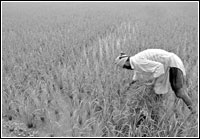 The World Bank has advised the developing countries to place agriculture at the centre of their development agenda , make huge investments in farming and deliver urgently needed agrarian reforms. The advice has come in the wake of soaring world food prices and absence of modern farming that could boost agriculture production.
Agriculture is the foundation of many of the developing economies and provides raw materials and market for their nascent industries. And yet the vast majority of the people living in rural areas are worst hit by poverty. Pakistan is no exception to the problems arising out of the outdated farming practices and stagnant agriculture.
If the agriculture produce is to be increased to widen rural prosperity, make essential food items available to the urban people at affordable prices, and cut on food imports, expected to touch $2.5 billion this year, massive investment has to be encouraged in farming. Too much money is going into shares market and other non-productive pursuits which needs to be curbed through taxation.
lf you have to eliminate abject poverty from our midst and reduce the number of the poor according the UN millennium goal of half the present number by 2012, the agriculture sector should not be starved of investment and bank credit. . The poor farmers have to be liberated from the grip of the money lenders, middle men and feudal cultural practices.
It is landless farmers and share- croppers who are worst affected by poverty. They are so poor and culturally backward that they imitate the cultural values of the feudal lords and become more indebted and poorer in the process. Some of them and their families end up as bonded labour. They are not able to free themselves from their debt even when their whole family works for the landlord all the year round. The nature of the inequity of the bonded labour system has been exposed time and again but it continues because of the might of the feudal lords in their areas and the helplessness of the borrowers. The poor farmers are unable to raise loans from banks. If the banks charge 14 per cent interest, the money lender charges 50 -100 per cent at compound rate.
The batai or crop sharing system needs to be replaced by cash contract system to facilitate corporate farming for local farmers before attracting foreign investment in agriculture. A simple legislation can do the job.
The banks have been advised time and again to lend more to the small farmers but they are reluctant to do that because of lack of collateral. Some beginning has however been made by extending micro-credit to peasants but not to the poorest of the poor.
Grameen banks founder Mohammed Younus has gone all the way to New York to lend to the American poor who have no bank accounts..
If anyone breaks out of the system, he does not have the opportunity to market his products , much less export them as the government agencies serves big business. In such a context, the Asian Development Bank has come up with a fund for small loans of $320 million in rural areas. The bank finds that when the money is given to the government for lending to the farmers it is used in its own way and the poor farmer does not truly benefit. The intermediaries also grab a share of the money so the bank has come up with a scheme for all kinds of small loans including postal loans through the banks. If the scheme works well, it will help a large number of farmers.
In democracy, there is equality of opportunity and economic rights to improve the lot of every citizen. The elected government has to work for the common good. So if more such lending schemes come up, it will be good for the farmers.
The basic problem with a small land holding is that it is not viable. As the families expand, the land gets divided further and further . Fragmentation of small parts of land has to be discouraged and larger more viable holding encouraged. If the 320 million dollar loan helps in this process in the rural areas, it will be a very beneficial step.
The government of India has decided that commercial banks write off $15 billion given to poor farmers as part of its policy of rural debt relief. The banks will be compensated by the government.
The small farmers need to be encouraged through co-operatives. With the help of a real co-operative system they can buy what they need collectively and cheaply and sell what they produce at competitive prices. Loans and common services like provision of tractors, seeds etc can also be provided by it. They can have supplementary income from cattle farming, chicken breeding, raising flowers and fruits. The crop yield will go up appreciably..
It all begins with the ownership of the land and the family staying together instead of the sons migrating to cities and staying in Katchi Abadi in cities. The need of the hour is that the land be given to the tillers and surplus government land to the landless farmers. Too many people are afloat now and that number has to reduced.






























