0
0

 KARACHI, March 10: The Sindh Forensic Science Lab (SFSL) does not appear to have scientific technology in its lexicon and carries out all its work through outdated manual methods, a senior investigator told Dawn.
Established in 1983 on Garden Road, the lab is meant to conduct ballistics tests, collect fingerprints, carry out the authentication of vehicles and issue opinions on handwriting samples where legal implications are involved. Its latest acquisition is the installation of a computerised automated fingerprints’ identification system (AFIS), a project of the National Police Bureau.
According to SP Qurban Ali Shah, who is in charge of the lab, “this facility will be the provincial headquarters of the AFIS and will act as a bridge between the 10 link stations in Sindh and Islamabad. Links will also be made with three SP Investigation offices, CID offices and the office of the DIG investigation.”
SP Shah told Dawn that fingerprint data from the interior of Sindh and Karachi are currently being fed into the central database in Islamabad and the formal work of the project – the comparison of the fingerprints – has not yet started. However, he added, the system could at a later stage be hooked up with the National Database and Registration Authority.
Impressive as these plans sound, the situation on the ground appears very different since the facility looks more like a museum than a science lab. There are piles of obsolete equipment dating back to the early 1960s and 1970s, which no one knows how to use. A former DSP who used to be posted at the lab told Dawn that “when the suppliers of this equipment were contacted to teach our experts about their operation, they [the suppliers] expressed their inability on the grounds that the manufacturers no longer make such equipment and they didn’t even have manuals that could have proved helpful.”
However, officials at the lab maintain that they are carrying their tasks out effectively and that their methods work. An SFSL official gave the example of the June 10, 1996, murder of Justice Nizam Ahmed and his son, when the spent bullet cartridges were collected from the crime scene and sent to the lab, where they were stored in the record. “Some time after the incident, the police arrested a suspect and charged him for his involvement in the case,” he told Dawn. “The police sent the lab the weapon he had purportedly used in the double murder but the ballistics test showed that the weapon did not match the shells collected from the crime scene. Subsequently, the accused man was released by the court.”
Training and equipment issues
SP Shah said that two courses on fingerprints are held every year at the lab in Karachi, while staff members are sent to Peshawar for other courses. Asked about training by foreign instructors, the official expressed a certain lack of confidence. “The Citizens Police Liaison Committee conducted training in vehicle examination by some foreign experts,” he cited as an example. “But their methods were quite destructive and spoiled the evidence.”
The official refused to impart any information about the staff strength at the lab and whether there were any grants meant for the facility. Similarly, he also withheld any comments on the difficulties faced by the lab.
However, he reiterated that every suspect arrested in any police station in Karachi or in the interior of Sindh is fingerprinted at the lab and this record is being fed into a central databank in Islamabad.
Sources recalled that three mobile forensic units were donated by the United States in 1985.
“A video system installed in the vehicles was stolen the moment they landed at the port,” the sources said.
Only one such mobile unit could now been seen parked on the ground floor of the SFSL but the whereabouts of the other two vehicles were not known.
Answering a question about the utility of crime scene vehicles, SP Shah said their fuel consumption was huge.
“Carrying a briefcase, our two men are better off without the vehicle when they head out to collect fingerprints from a crime scene,” he said.
Experts at the laboratory obtain fingerprints employing the conventional method of using powder and papers – a method said to be only 62 per cent successful. However, fingerprints obtained through scanners yield cent per cent results.
But SP Shah insisted that the conventional method is better.
Although they have practically no facilities, officials claim that they have solved and helped enormously in some high-profile cases, such as establishing the identities of the navy personnel who died when their plane was shot down by India in the Rann of Kutch in 1999. The bodies were badly charred and believed to be unidentifiable.
“We established the identities of the servicemen by matching the thumbprint impressions from their passports with parts of skin collected from the bodies,” a former staffer said.
Similarly, experts were requested to collect fingerprints from a vehicle left by terrorists following their attack on the then Karachi corps commander.
Very rarely, assistance of the fingerprints department is also sought in civil cases.
“We go to a crime scene only when we are called by the relevant senior officer; otherwise fingerprints are not collected from every crime scene in the city,” SP Shah explained.
Sometimes cases from Balochistan are brought to the lab and customs cases are also referred to the lab for which Rs2,000 is charged as a fee.
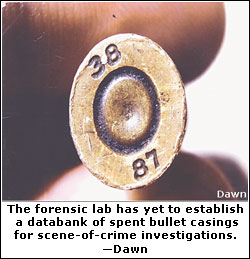
A senior investigator told Dawn that the idea of establishing a centralized computer databank of bullet casings found from different crime scenes has never been taken seriously by police authorities.
He explained that such a databank would be of immense help in analyzing the criminal history of suspects booked by police under Section 13-D of the Pakistan Arms Ordinance 1965. The relevant section pertains to the offence of keeping an unlicensed weapon.He said weapons seized from suspects could be sent to the ballistics lab and the results obtained from the lab could be matched against the databank of bullet casings.
The sources told Dawn that the reports issued by the SFSL enjoyed crucial legal importance as they were admissible in a court of law. They explained that if the lab issued a report saying that a weapon – a key piece of evidence in most cases – had a faulty pin that did not work and the gun did not match with the bullet shells also collected as evidence, the court would dismiss the case and set the accused free.
They said that in cases where the collection of spent bullet shells from the crime scene and the arrest of suspects with guns did not take place at the same time, the guns were sent to the ballistics lab and made to fire. The bullet shells thus obtained were matched with the casings collected from the crime scene, they said.
The sources said that such information came in handy in cross-examination in court.
They said that handwriting experts at the lab also issued reports on authenticity of documents. They added that cases of forgery and property dispute were referred to the handwriting experts of the SFSL.