



 0
0

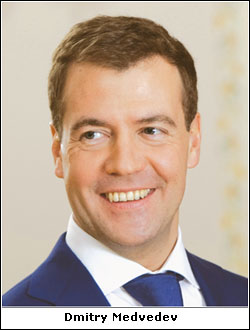 MOSCOW, March 2: Dmitry Medvedev, President Vladimir Putin’s handpicked successor, won a landslide victory in Russia’s presidential election on Sunday, early results showed, as opponents charged the result was rigged.
Medvedev had 64.8 per cent of the vote after 20 per cent of polling stations were counted, the Central Election Commission said. Exit polls also predicted a crushing Medvedev victory.
Communist Party leader Gennady Zyuganov was in second place with 19.7 per cent of the vote, according to the electoral commission count. Populist nationalist Vladimir Zhirinovsky was third and the almost unknown Andrei Bogdanov a distant fourth.
Medvedev’s victory was a foregone conclusion given his backing from Putin, who is now expected to become prime minister and retain a key role in the world’s leading energy exporter and biggest country.
Independent observers highlighted a stream of violations, however, saying the media was censored, people were pressured to vote, absentee ballots were abused, and monitors were refused access to polling stations.
Medvedev, 42, the first deputy premier and head of gas monopoly Gazprom, has promised to follow the policies of Putin, who is stepping down after two four-year terms.
Medvedev represents a new generation of post-Soviet politicians and unlike Putin, 55, he has no KGB or other security service background.
But analysts say that Medvedev will make few dramatic changes and could end up being little more than a puppet manipulated by his mentor.
Putin indicated clearly last month that he expects to wield significant influence and that the “highest executive power” lies with the prime minister’s office.
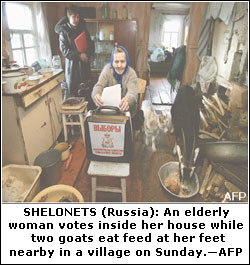 The biggest hurdle for the authorities was to overcome widespread apathy following a campaign in which Medvedev refused to debate and the streets were bare of posters.
Incomplete figures from the central elections commission showed 64.2 per cent participation among the 109 million eligible voters, although this was expected to rise.
According to critics, the high figure reflected the authorities’ use of fraud and coercion to avoid an embarrassingly low turnout.
“There can’t be a small turnout when people are forced to go to the polls,” said Grigory Melkonyants, deputy director of Golos, Russia’s leading independent election monitoring organisation. The authorities dismiss foreign criticism as meddling in Russian politics.
Many Russians are also grateful for stability following the trauma of economic upheaval and instability in the post-Soviet 1990s under Boris Yeltsin.
Vladivostok voter Gennady Dultsev complained that “everything is being decided in a Soviet way.” Medvedev as president was “not the worst possible outcome,” the telecoms engineer said.
The main European election monitoring body, the Organisation for Security and Cooperation in Europe (OSCE), boycotted the vote, citing restrictions on its monitors. US Democratic presidential hopefuls Hillary Clinton and Barack Obama last week also criticised the election as a fix to keep Putin in power.
One of the most controversial aspects of the election was the authorities’ attempt to increase voter turnout.
Chechen leader Ramzan Kadyrov said that “nearly every single resident of Chechnya will go out and vote.”—AFP



























