0
0

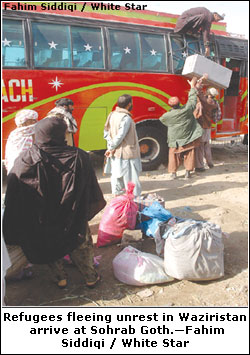 KARACHI, Feb 25: Hasan Ali, one of the hundreds of people fleeing strife-torn Waziristan and pouring into Karachi, cannot help but feel a strong sense of irony.
A transporter by profession, back in the early 1980s he used to ask Afghan refugees struggling to rebuild their lives in a shanty town along the Super Highway what it was like to have to flee their homeland. Now he knows, for the same fate has befallen him.
Along with his wife and seven children, the 47-year-old bid his hometown a final farewell three months ago and undertook the voyage to Shireen Jinnah Colony in Karachi. They had little choice in the matter: their chances for survival looked increasingly bleak in Waziristan, given the ruins left behind by the war between shadowy militants and the Pakistan Army.
“It was a difficult decision but there was no other option,” Ali told Dawn. “Now, my family has to start from scratch here. We will have to struggle on many fronts, whether it is education for my children or setting up social ties and facing economic issues. We are facing a great many challenges.”
Like Ali, dozens of South Waziristan families have been forced to flee to other, relatively safer parts of the country, including Karachi. They consider the challenges that lie ahead the price they must pay for protecting their lives.
The metropolis is no stranger to the influx of persons displaced by war or strife: after all, thousands of Pushto-speaking refugees poured into the city in the aftermath of the 1979 Afghan war. This time, however, it is the so-called war against terror and Pakistani ammunition that is forcing the people in tribal areas along the Pak-Afghan border to abandon their homes and take their chances in the country’s melting pot.
As a result, Pushtoon-dominated areas of the city such as Shireen Jinnah Colony and Sohrab Goth are hosting a growing number of displaced families who left their homes under a cloud of fear in the wake of the Pakistan Army’s fresh assault against allegedly ‘foreign’ militants in South Waziristan – a conflict that triggered a war in what was once a peaceful part of the country. The armed operation brought with it ‘collateral damage’, civilian deaths and eventually convinced hundreds of thousands of people to flee. And for many shattered and battle-scarred families, the urban jungle of Karachi provided the most likely haven in terms of both community support and employment opportunities.
‘Army not responsible for resettlement’
There is no official estimate on the number of people continuing to flee Waziristan, where they are going and how these influxes will affect the areas where they ultimately settle.
The director-general of Inter-Services Public Relations (ISPR), Major-General Athar Abbas, told Dawn that “No exact numbers are available as such about how many people have left from Waziristan and where they have moved to. We have assured safe evacuation for families leaving the area and have arranged temporary camps in Tank, Wana and Miramshah.” However, he added, “the resettlement of these people is the responsibility of the political administration, not the army.”
While the guns have recently fallen silent from both sides after a deal between the government and the militants, most of the fleeing tribesmen fear that the peace will be short-lived. The number of people displaced from South Waziristan entering Karachi has declined in recent days but the influx has not stopped.
And, the major challenges still lie ahead.
Bound together by fear
“Some of the families are relatively well-off and have rented out homes in the first phase of resettlement,” said a real estate agent in Sohrab Goth who helped newly-arrived refugees find shelter. “The people belong to various different tribes, including the Mir Ali, Mehsood and Drawar tribes. The one thing they have in common, the experience that binds them together, is fear.”
The real estate agent told Dawn that many of the refugees could not speak Urdu and the majority were dependent on their family connections in the city since employment is the biggest problem facing them.
In Keamari on Massan Road, Azam Shah managed to meet this challenge by establishing a puncture shop. But the next hurdle is no less difficult yet completely different. “We are viewed with suspicion since we are from the tribal areas,” he said bitterly. “The police have subjected me to questioning several times and in Sohrab Goth, one of my cousins was forced to pay a bribe to protect himself from being grilled off and on.”
Alienated amongst their own people and marked out by the law enforcement agencies, Shah’s family nevertheless clings to the conviction that Karachi is their city too. As Pakistanis, their sense of ownership stems from and establishes the country as a one-unit federation. Yet the arrival in southern Pakistan of uncounted numbers of families displaced from South Waziristan has raised concerns about their ability to re-settle in a purely urban set-up that already faces a hug influx of jobseekers from other parts of the country.
“The re-settlement of people after a civil disturbance of some sort always brings about a negative impact on infrastructure and puts increased pressure on available services,” pointed out political economist Kaiser Bengali, who works with the Collective for Social Science Research. “Some issues always remain unresolved when people from the isolated mountains, who have not accepted urbanisation as such, face social and economic changes whilst re-settling in the cities.”
Bengali’s assessment is borne out by Azam Shah’s sentiments: although he plans to take up permanent residence in Karachi, he is firm on the intention to celebrate every Eid in his hometown. “For the first time after I migrated to Karachi a few months ago, I visited my home recently on Baqra Eid,” he said. “I hope to be able to continue this practice in the years to come; it helps keep you refreshed and your originality alive.”