0
0

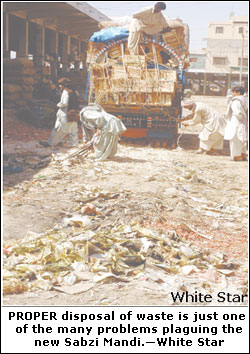 KARACHI, Feb 24: Rising crime and the lack of basic amenities are the two prime issues hampering businesses at the new Sabzi Mandi, located off the Super Highway.
Having been forced to operate in pathetic conditions for years, traders are demanding the provision of the basic facilities promised to them seven years ago, when the market was shifted here from the middle of the city in 2001.
They also accuse officials of the market committee of misappropriating millions of rupees under the pretext of market fees. Considered amongst the largest vegetable and fruit markets in the country, the 96-acre Mandi has no water, sewerage or road infrastructure.
The entire area, comprising some 5,000 concrete sheds where an estimated 10-12,000 people work, is littered with garbage.
The pace at which the Mandi operates can be gauged from the fact that the working day begins at midnight and hectic trading carries on well into the morning, as consignments arrive from all over the country. According to a trader, Mohammed Aslam, around a thousand trucks loaded with produce arrive every day.
Depending on the season, the main suppliers are markets in the interior of Sindh and the Punjab. “However, potatoes come mainly from the Punjab, onions from Sindh, apples, grapes, pomegranates, watermelons, cherries and peaches from Balochistan while the bulk of the oranges come from Sargodha, Multan, Vehari, Arifwala and Burewala,” he told Dawn.
“Despite the volume of trade and the extent to which the city relies on the mandi, the government has done absolutely nothing to improve our working conditions,” complained a group of traders. “Even after seven years, there are no sewerage or drainage systems.
We have to buy water at exorbitant rates from tankers and suffer huge losses during the monsoons.
No proper storage facilities exist and we incur losses not just because of such infrastructural issues, but also because we lose buyers — only a few come, hoping to take advantage of our predicament and extract the maximum benefit from us,” they explained.
Rising crime
In recent months, rising levels of theft have also emerged as a major threat to business at the mandi. “Even retailers are being looted now,” the traders told Dawn. “We hear of a daylight robbery almost every day, even though there is a police picket in the market. People are scared and some went to the extent of hiring private security guards after a trader was shot dead upon resisting theft some months ago.”
Some of the mandi’s traders believe that the set-up of political offices in the market a few years ago has led to the deteriorating law and order situation since the members of some political parties provide refuge to criminal elements. “The situation has worsened to the extent that gun-toting political parties’ workers extort money from traders and drivers, and the police are reluctant to register FIRs,” the businessmen informed Dawn.
“What’s more, we were duped by the officials who told us that this new market would be an alternate to Gulshan’s mandi,” they complained. “It was just a big lie; we are forced to pay for even the most basic of utilities.”
The Sabzi Mandi lacks facilities to meet any emergency situation. “There is no clinic or fire station here, and it is difficult to lodge an FIR immediately after an incident since the nearest police station is quite far away,” they told Dawn, referring to an occasion when a scuffle between a pushcart owner and a trader led to the torching of a restaurant a few years ago. “We eventually managed to douse the flames but by that time, nearby shops had been damaged,” they said.
“Traders were shifted to this location at gun-point since they wanted to retain the old Gulshan venue for the retailers’ market,” said Haji Mohammed Shahjehan, president of the Falahi Anjuman Wholesale Fruit and Vegetable Market. “Our case is still pending in the courts. In no way is this market an alternate to the old one, as the authorities promised. We were forced to pay comparatively more money in terms of land prices and utilities that are yet to be provided.”
Haji Shahjehan told Dawn that though traders had paid between Rs23,000 and Rs75,000 for electricity meters in 2001, these were yet to be installed. “Today, traders are charged between Rs500 and Rs5,000 – depending on the size of their shed – for electricity,” he pointed out. “Vehicles are charged an entry fee from Rs5 to Rs25, while heavy carriers pay between Rs15 and Rs20 as market fees but not a single penny of this revenue has been spent on the market’s infrastructure.”
He pointed out that according to the market committee act enforced in all markets in the country, money generated through such fees should be spent on traders’ welfare. “But as is evident, this rule is not implemented here,” he complained, adding that the entry fee demanded of each vehicle is in fact illegal since it is not mentioned in the act. According to Haji Shahjehan, between 20,000 and 30,000 vehicles visit the mandi from the city every day, and make purchases.
Fake allotments and land scams
The traders with whom Dawn spoke also raised the issue of delays in the leasing process despite allotment, apparently because of a conflict between the now-defunct KDA and the Malir Development Authority. As a result, they complained, they are unable
to apply for development loans while the administration had minted millions in the name of allotment in recent years. They added that cases in this regard were pending in various courts.
According to newspaper reports, the labour courts are currently hearing one such case in which market committee officials are accused of land scams involving millions of rupees.
The people charged in the case, which involves the administrator and secretary of the market committee as well as the director-general of the Sindh government’s Agriculture Extension, are accused of having converted into shops 164 amenity plots that had been reserved in the master plan for a fire station, a weighbridge, a service station and lavatories.
The traders Dawn spoke said that not just amenity plots but every bit of open space was up for grabs, claiming the involvement of powerful mafias operating in connivance with officials of the market committee.
The various issues raised by the traders were conceded by the recently-appointed administrator of the mandi, Anwar Ali Gopang, who also confirmed that between 300 and 400 cases, mainly related to fake allotments, were in the courts. He dismissed concerns about the security situation, however, claiming that “things had started to improve.”
“Yes, the law and order situation was bad some months ago but this is no longer the case,” he said. “The number of police personnel was increased and there have hardly been any robberies in recent weeks. The police force was given space in the market committee offices, where FIRs can be lodged.”
Mr Gopang claimed that the installation of electricity meters has been initiated and that a water tank would become functional within a few days. He added that drains were also being cleaned and after taking traders into its confidence, the market committee would register the workers.
Refuting the allegation that market committee officials continue to be involved in irregularities, he said that he had scheduled a meeting with top Rangers’ officials next week to discuss the removal of encroachments.