



 0
0

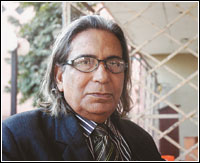
Indian shows promoting Urdu — Sahar Ansari
 KARACHI: As a schoolboy in Aurangabad, Sahar Ansari was deeply touched by the Indian army’s invasion and takeover of the princely state of Hyderabad. It was shortly after the death of Quaid-i-Azam Mohammad Ali Jinnah on Sept 11, 1948. The state’s Muslim population was in the grip of agonizing political, social and economic turmoil. The historic event put him on a long road to literary achievements and in 1954 his verses started to appear in literary magazines.
Sahar was born on December 27, 1941. After doing his pre-primary from Aurangabad in India, he arrived in Karachi in 1950 and did his matric from the Kotwali Building school. He joined the government college and then D.J. Science College. But instead of pursuing his science education, he switched to literature and did his master’s in three subjects: Urdu, English and linguistics. First he taught at Balochistan University and then joined Karachi University, where he still teaches linguistics.
When I called on him last Friday, he sat among books piled very high all around in his Nazimabad house devoted to study and books. I sat down opposite him in a chair wedged between mounds of books.
“The books on top of the shelves are those I have read and benefited from. Journals such as National Geographic are also kept in the background as I rarely need them. But encyclopedias, new books on poets, criticism, and some Persian works are kept nearby for handy reference,” explains the poet. He plans to have the books rearranged in proper order though many lots are already carefully kept in shelves. Karen Armstrong seems to be his latest topic of interest as her book on Muhammad (peace be upon him) sits on top of a pile.
He doesn’t believe that the younger generations would love books as much as people of his generation do. “Even my daughter, Ambreen Haseeb Ambar, a poet doing her PhD, doesn’t care so much about books.” A visitor like this writer may wonder if it is humanly possibly to make use of so many books. But Sahar may convince you that it is.
“Many talented young people do have an urge for poetry. But they do not do justice to it. They look for shortcuts. Their job has been made easier by the concept of free verse and whatever they write, they call it ‘free verse’. They neither have the capacity nor do they want to follow the conditions set by the old masters.”
 He is however satisfied with the incentives the young writers have, and says: “Although mushairas are held less frequently than before, there are magazines and newspaper sections which encourage young writers. Although there is no due state patronage, there is nothing that may discourage young people from writing poetry or prose.”
Although he has entered in the new age of technology with an open heart, he laments that the arts of calligraphy and letter writing have almost vanished because of computers.
The quantum of his published works may not reflect his literary achievements. His first poetry collection, Namood, was published in 1976. Writing a preface to that collection, Faiz Ahmed Faiz had described the book “as a credible addition to modern literature”. Another collection of his poetry, Khuda say baat karta hain, is set to be published in a couple of months. In between he compiled Maqalat-i-Josh, which received accolades from critics. After the launch of his poetry collection, he plans to collect and publish his research papers, which he has presented at seminars or published in various magazines and newspapers. He is also in the process of writing his memoirs, which will include his encounters with luminaries like Faiz Ahmad Faiz and N.M. Rashid.
The amount of reading done by him daily can be gauged from the fact that he subscribes to three newspapers daily. “Twice in a week I have four newspapers and for Sundays the regular number of newspapers is seven.” And, of course, this is besides the literary periodicals and books.
To satisfy his literary thirst, he has not only read Urdu and Persian classics in depth, he has also studied Punjabi and Sindhi poets, from Baba Fariduddin Ganj-i-Shakr to Amrita Pretam and Ahmed Rahi, and Shah Latif, Sachal Sarmast, Shaikh Ayaz to Atiya Daud. “Since I can’t read Pushto, Balochi and Brahvi, I read their literatures in translation.”
His daily routine is to go to the university where he teaches, to visit Urdu Bazaar to look for new books and visit friends working in magazines and at the Arts Council of Pakistan.
When it comes to naming his favourite poets, he doesn’t leave out any known or little known names, including that of the vice-chancellor of Karachi University, Dr Pirzada Qasim Siddiqui. He was careful not to omit any Urdu classical poets and even didn’t want to offend any of the Persian poets – Rumi, Saadi, Omar Khayyam, Urfi, Firdausi and Shaharyar, the Iranian poet who died just a couple of years ago. But when pressed to name just three of the women poets he likes, he said: Ada Jafri, Fehmida Riaz and Kishwar Naheed.
Talking about sufi poets’ works, he says their subjects were common. For example, he says, “Shah Abdul Latif Bhitai and Maulana Rumi both wrote about the love of God, Sufism, human suffering and truth. They used human characters of peasants, herdsmen, kings and maids as similitude to enlighten people. They both used simple language, which has been a key characteristic of all sufi poetry, so that their message is understood both by laymen and scholars equally.
Urdu’s future
Talking about the future of Urdu, he smilingly says, “As long as the language used in Indian films and TV shows beamed from across the border is continued to be used, there is no threat to Urdu’s popularity.” He says so many new channels and Urdu newspaper are naturally promoting Urdu as a language. Besides, a lot of research work is being done in Urdu not only in India and Pakistan but also at many centres across the globe.”
Sahar has won Tamgha-i-Imtiaz for literature and had also been editor of the Urdu Dictionary Board on deputation for two years. He has been chairman of the arts council’s literary committee.
Civil servants in search of new friends
 “It is your duty, as civil servant, to fulfil your official responsibilities. You should not align with any political party. Politics is the job of politicians, not yours. Make the people feel that you are their servants and friends, maintain the highest standard of honour, integrity, justice and fair play,” Quaid-i-Azam Mohammad Ali Jinnah had advised civil servants in 1948.
This framed inscription is displayed in almost every office of senior bureaucrats in the Frontier province, reminding them to be impartial and take purely non-political decisions while disposing of official business.Ask anybody in the bureaucracy whether they follow these golden words of the Father of the Nation or not. The answer will be in negative.
Political backing has become a norm because it is considered essential not only for securing most of government jobs, but also for attaining comparatively lucrative posts.
In the wake of Monday’s elections, we may see reshuffling of officers on key positions and that is why placement of officers under the new rulers has become a favourite talk in the civil secretariat nowadays.
Take a round of the civil secretariat and you will see officers busy in establishing or rejuvenating contacts with the Awami National Party and the Pakistan People’s Party, which emerged as the two largest parties in the province.
Family ties, student politics and old friendships are the main links the officers are trying to revitalise with the two parties with the hopes of getting or retaining prized posts in days to come.
Some of the officers had close relations with the previous MMA provincial government and had attained good posts, surpassing several senior and comparatively better performing officers.
Blessing of the ruling class to attain lucrative posts is not a new phenomenon, but many argue it flourished during the five-year rule of the MMA.
Many junior officers, during that period, were given senior positions. In some cases junior officers were heading departments with senior officers as their subordinates. For instance, the province had more than five officers from the District Management Group (DMG) and the now-defunct Provincial Civil Services in grade 21, but the previous government posted a grade 20 officer as additional chief secretary of the province. Likewise, in the environment department, the officer acting as secretary was one grade junior to heads of three subordinate agencies, the Environmental Protection Agency, wildlife department and the Forest Development Corporation. Same was the situation in the industries department where a grade 20 officer from the Audit and Accounts Group was serving as secretary and a grade 21 officer from the DMG was his subordinate.
Placement of junior officers as district coordination officers, district police officers and sub-divisional officers in the works and services department was a normal practice, which continued even under the caretaker set-up.
It is a general perception that most of the officers attained ‘prized’ posts during the MMA government through their family relations and friendships with the ruling group. Competence and the principal of placing the right man at the right place were ignored by and large.
These grey-haired officers were often seen rolling beads, offering congregational prayers and signing all official correspondence in Urdu, besides keeping Islamic books on their tables and shelves. Many believe they did all this to exhibit their loyalty to the rulers of that time and that they will do whatever is liked by the future rulers for remaining in their good books.
This trend, many say, benefits a certain class in the civil administration, at the cost of merit, causing heart burning among senior and competent officers.
Apart from dealing with the issue of militancy, the future rulers will have to put things on the right track for good governance. This is the only way forward for attaining higher standards of civil administration as desired by the Quaid.
| © DAWN Media Group , 2008 |



























