



 0
0

Fuel for thought: What goes around compressed, making us depressed?
 WE have yet to know for sure if the ‘heavyweight’ former American trouble-shooter, Richard Armitage, put then-General Musharraf on message about bombing our lovely land back to the Stone Age post-Nine Eleven if we didn’t get his import on which side of the terror swing to sit on.
In his aptly-titled memoirs In The Line of Fire Musharraf claimed receiving the dire warning, which the former US Deputy Secretary of State and second-in-command at the State Department, subsequently, denied making.
But, perhaps, Armitage needn’t have flexed his bullish muscles, given the precarious condition of our gas-seekers, of all hues.
A picture last week on the metro pages of a daily showed a couple of men straining to hold on to a log of wood, they had probably procured by grinding an axe on the few trees left in Islamabad for fuel. Callous authorities have already done a hatchet job on a sizable chunk of these over questionable claims that the felled trees were causing allergy.
“Wood for the trees” is no longer fiction. The sight of people carrying the burden of fuel is as real as that world famous beverage slogan gets. In a time of scarcity, who can blame the poor for slogging at trees a la Shahid Afridi. It is for them, if anything, fuel for thought.
While the Musharraf regime staked a claim to showing grace under pressure when Armitage exposed his bodybuilder arms, what residents in the twin cities, as elsewhere in the country, are discovering is gas under pressure.
Now, gas under pressure is far removed from grace under pressure, though given their banalities, they appear to be in the realm of a “zero” sum game.
One is certain to find any number of people, who are complaining of “zero” gas pressure, their lives already intertwined by the lack of enough water, power and even flour. It would seem the only thing left to complete the Stone Age experience is to go back to the caves and may be give Osama bin Laden some company!
It is not just the issue of getting the right gas pressure for the vast majority of this nation, which is fuelling the fire of the current gas crisis, but also how to keep the wheel of life spinning.
Those foolish enough to have contributed to energy-saving by using environment-friendly and economical fuel, a.k.a Compressed Natural Gas (CNG), are now a regular feed for the cameras.
The long queues — if the wilting consumers are fortunate enough to get some gas back into their vehicles — offer a good view of how bad the situation is. It has ceased to be a spectacle since it has become so commonplace.
Petrol-users have suddenly assumed a privileged status — you can see them strut their way to the ‘super lead’ or ‘hi-octane’ stands at the filling stations as if they have partaken a prized pie. As one friend, who once covered the green mile (ran on gas) suggested, tongue firmly in cheek, he now belongs to a class above the pied pipers on the other side of the green (CNG) belt.
The one common grouse of consumers pertains to low gas pressure — or “zero” (gas pressure) according to the more inflamed amongst them. The piquant note is understandable given that it fails to lift the experience of cooking, heating and running gas heaters, in bone-chilling cold, to the required level.
Typical of a situation compounded by confusion, consumers are at a loss to understand how come they are in the middle of a gas vacuum in a country projected as rich in natural resources and who is to blame for it — the Sui Northern Gas Pipelines (SNGPL), the mushroom growth of CNG stations, industrial units (which are reportedly, getting the cut in share meant for CNG stations) or even consumers themselves, who like to keep things warm to a greater degree in winters?
The SNGPL blames the demanding CNG sector for the deficiency in end supply but the CNG station owners return the compliment, alleging that the country’s largest integrated gas company is kind to the industrial sector beyond stipulation — in other words, deviating from the script.
While the industrial units are also under a strain given the unbalanced distribution of gas, it is fair to assume their heart lies in that slogan dil maange more (the heart seeks more).
As for the hapless consumers, they have all the three aforementioned to blame for leaving them out in the cold, literally.
The gas conundrum does not end here. In view of the countrywide shortfall in supply, last week the CNG sector volunteered to shut down their filling stations before partially, restoring gas supply. Commendable as the gesture was, ironically, it hurt a legion of consumers, who were unable to ‘feed’ their vehicles or were simply short-changed because of low gas pressure.
Ultimately, the responsibility rests with the government, which should have known better than to encourage consumers to seek CNG conversion with some ado without having a grasp of the demand-supply economics. They also failed in their duty to inform the general public about the crisis in advance, once it had become obvious that they were running out of gas.
The writer is News Editor at Dawn News. He may be contacted at kaamyabi@gmail.com
A historian who paints for pleasure
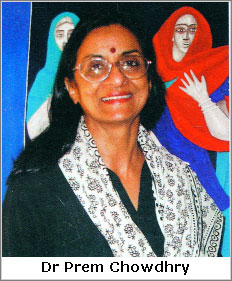 Very rarely do we find people who wear two hats comfortably. One such person is Dr Prem Chowdhry, an artist who paints captivating images on canvas and who researches in history. She is a Delhi-based Harianvi, who studied history and later did her doctorate in the subject. She is also a social scientist and her books – Contentious Marriages, Eloping Couples: Gender, Caste and Patriarchy in Northern India (2007) and Colonial India and The Making of Empire Cinema: Image, Ideology and Identity, to name just two – show her interest in the two disciplines.
She is in Karachi to display her canvases at a new gallery in Bath Island. Most of Dr Chowdhry’s work has been sold. She didn’t know anyone in Karachi but thanks to a friend in Delhi, whose brother is here, she got the opportunity to show her work to art lovers in this city.
Except for a year that she spent in Triveni Kala Sangam, an art institute in Delhi, Prem Chowdhry has been a self-taught artist. Arun Chopra, her husband, is into visual arts and advertising. But what brought him fame was the art film Ashray (meaning shelter) that he made years ago. It had Amol Palekar and quite a few lesser known performers in the cast. The film got Chopra a couple of awards.
Well-known historian David Page, who lives in London and has friends on both sides of the Wagha border, introduced her to fellow historian Dr Hamida Khuhro, whose hospitality is, according to Prem Chowdhry, “truly warm.”
Like all ladies Dr Chowdhry cannot resist the temptation of shopping. The grass, as they say, is always greener on the other side of the fence. Our womenfolk too turn shopoholics once they fly to India.
Urdu is no strange language to Prem Chowdhry. Her parents communicate in the language. Her sisters can read and write Urdu and she learned to read it because all the documents produced in Haryana before Partition were in Urdu. She had to read them as part of her research since her doctorate was on the Unionist Party in the Punjab during the dying days of British India.
At one time she applied for a visa to come to Pakistan to access documents in archives but her request was turned down. She then went to the next best place – London – where she met David Page, who was of immense help to her. He proved to be her friend, philosopher and guide.
I leafed through her book on the Indian cinema of colonial days and found it to be a result of painstaking research. Dr Chowdhry is an avid cinema-goer and it was an experience talking to her on the three versions of Devdas. She prefers Bimal Roy’s version and is convinced that Shahrukh Khan, though good, was no patch on Dilip Kumar. Saigal, of course, was more of a singer than an actor, she feels.
Prem Chowdhry was very impressed with the Pakistani film Khuda ke liye. “It’s very well directed and the performances are powerful. In short, it leaves an impact on the viewer,” she said. In saying so, she displayed a quality she feels Pakistanis have in ample measure: “You people are generous in expressing your appreciation of anything you like.”
| © DAWN Group of Newspapers, 2008 |



























