0
0

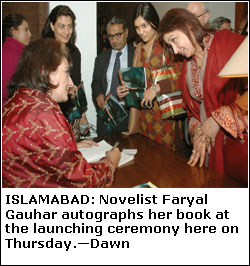 ISLAMABAD, Jan 31: Former TV artist and writer Feryal Ali Gauhar’s second novel, No Space For Further Burial that records the haunting indictment of the madness of Afghan war and human survival in a nightmarish world had a ‘houseful launching here Thursday evening in the warm artistic ambience of National Art Gallery’s imposing auditorium.
The architectural grandeur and the glittering elites did not, at first, seem in sync with the settings of the novel — a mental asylum compound in an Afghan village and the sufferings of simple tribal men and women who are bombed, killed, tortured and even raped.
After introductory speeches of her admirers who came from as far as Kabul, the author read from her book extensively to a very receptive audience. She narrated the prologue and a few sub- chapters of her novel while assuming the tone, expression and gestures of her characters in such a way that made one’s heart beat fast. It wasn’t just a reading. It was a dramatic recital during passages of which Feryal had the audience in tears.
Following the speeches the tortured images of the devastated land of Afghanistan were screened to the accompaniment of a soulful dirge on the land, that kind of set the mood for the evening. It must have been Madiha Gauhar’s work who was there to give the evening to her sister.
An old family portrait was also shown with the author’s grandmother in the Kabul of 1928. That seemed to establish the emotive connection for the novel.
Set in Afghanistan in 2002 an American soldier is on a reconnaissance trip to liberate Afghans from Taliban. He is taken prisoner by rebels and locked in a mental asylum under the charge of its caretaker, Waris, and his wife, Noorjehan. Each day, he is fed with soup of potato peels and weak tea by Bulbul, a half- crazed boy with terribly mangled feet who communicate with the American in a smattering of European languages, pictures and hand gestures, telling him stories about the other people in the compound.
As the war progresses, and finding food and space for burials become a bigger problem than guarding prisoners, the line between victors and victims, prisoners and their captors slowly disintegrates. And even as the narrator plans his escape, he is drawn into the lives of the people who are his captors.
David Elisha, a teacher of English literature, appreciated the literally devices Feryal has applied while telling the readers the desolate history of plunder and war, waged by insiders and outsiders, and fuelled by ideology, desperation and greed.
He said Feryal’s work was an “outcry of her inner soul” while bringing forth the brutal exploitation of the weaker by the highly organised ‘mighty’ in the name of ideology (democracy). She has explored, through simple literary devices, “our collective complicity” as we as humans have failed to reflect upon our own conditions.
Mohammad Athar Tahir, an educationist at McGill University, Canada, gave a brief overview of the plot of the novel.
Fainula Rodriguez, a public policy expert working in Afghanistan in organisational development and conflict resolution over the last five years, revealed how deadly Afghanistan was turning with each passing day since the arrival of the US army. She said the book has tried to explain the terrible past and a dangerous present of Afghanistan with no signs of a hopeful future.
“Vibrant and cinematic”, the Indian Express rightly acclaims the beauty of the narrative which records Afghanistan’s present tragedy caused by the perversity of international politics in which an entire nation of a very proud and independent people has been made a pawn for petty territorial and strategic gains. In the words of Ratna Menon of Women’s Features Service, Delhi, Feryal demands to know how do a people survive in a world where the boundary between sanity and insanity dissolves. There is no answer.