



 0
0

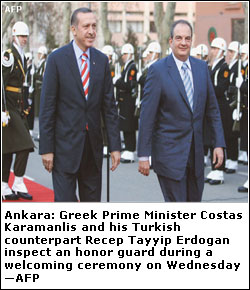 ANKARA, Jan 23: Greek Prime Minister Costas Karamanlis arrived here on Wednesday for a landmark visit, the first to Turkey by a Greek premier in five decades, aiming to boost efforts to bring the two former enemies closer.
Karamanlis, accompanied by Foreign Minister Dora Bakoyannis, was to hold talks later in the day with Turkish Prime Minister Recep Tayyip Erdogan.
Even though the two leaders have a warm personal relationship — Karamanlis attended the wedding of Erdogan's daughter in 2004 — territorial disputes in the Aegean Sea and the Cyprus conflict continue to cast a shadow on the improvement in bilateral ties over the past decade.
A tense face-off between Greek and Turkish patrol boats near a disputed islet in the Aegean had marred the visit of then Greek foreign minister Petros Molyviatis in 2005.
Karamanlis has said his government has “neither excessive optimism nor pessimism” over the visit.
“We are seeking the gradual restoration of mutual trust. We are working for the full normalisation of Greek-Turkish relations, which, of course, also presupposes a resolution of the Cyprus issue,” he said last week.
The Greek leader was to hold talks also with President Abdullah Gul on Thursday and travel on to Istanbul for meetings with the head of the Orthodox Church and Turkish business people on Friday.
The traditional hostility between the two Nato allies received a boost from an unprecedented outpouring of solidarity after deadly earthquakes hit both countries in 1999, paving also the way for improvement in political ties.
Since January 2002, diplomats have been holding regular closed-door talks over the territorial disputes, but no progress is publicly known.
Mutual accusations of territorial violations, meanwhile, continue on an almost daily basis.
At the core of the dispute is Greece’s claim of a 10-mile air space. Turkey recognises only six miles, arguing that under international law, Greece's air space cannot go beyond the extent of its territorial waters.
In 2005, a Greek pilot was killed when fighter jets from the two countries crashed during a mock dogfight over the Aegean.
The two governments handled the incident calmly and set up a hotline between their militaries to improve communication and prevent further accidents.
Greece is also bitter over properties confiscated from Turkey's tiny Greek minority, the continued closure of an Orthodox seminary and Ankara’s refusal to endorse Istanbul-based Patriarch Bartholomew I as the spiritual leader of the world’s Orthodox Christians.
Athens continues to back the ethnic Greek majority in Cyprus, while Ankara is the only capital to recognise the state declared by the Turkish minority in the island's northern third, occupied by Turkish troops in 1974.
More progress, however, has been achieved in the economic field, with a significant increase in bilateral trade and mutual investments.
In November, Costas Karamanlis and Recep Tayyip Erdogan inaugurated a pipeline to carry gas from Azerbaijan to Greece via Turkey, hailed as a symbol of a new era of economic cooperation.—AFP



























