Consequences of income inequity
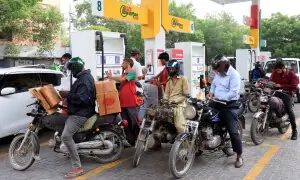
THE politics of martyrdom and mayhem should not distract from the economic inequity that prevails in the country and that prevents fair elections. The spiralling prices of food are keenly felt by the poor because of the additional inflationary burden this places on them, including costs of earning an income. Even biased official data indicates an appalling impact.
Many of the barely non-poor 30 million will now slide into poverty. Of the 25 million just-poor, few will escape ultra and extreme poverty. Chronic poverty faces the new-poor. The marginally-poor will become victims of ultra poverty; while destitution confronts others after assets are consumed to stay alive.
Food inflation threatens health and dilutes earning capacities, leading to the indignity of charity, the trap of child labour and debt bondage; the humiliation of trafficking. Many more underweight children will die in their first year, already the fate of hundreds of thousands.
Fortunate are the undernourished mothers who do not live to mourn. How many more children will fail at school because of poor health, joining millions of undernourished youngsters with shattered dreams.
Even a fraction of these victims add up to millions of citizens. What a staggering indictment of our economy managers whose publicly funded trips to Davos and Washington are lauded only by the obese.
Will rising wages offset food inflation? Colleagues at Piler suggest otherwise. They point out that Islamabad acknowledges a very large proportion of urban, underemployed and underpaid workers. Whither PRSP?
When hired, unskilled urban labour at the daily wage rate of Rs250 (above the minimum wage) allows a family with old parents and young children to consume just over one kilo of atta per capita, when spent wholly on atta, or half a kilo of rice, one of sugar and one litre of milk.
In the less inequitable circumstances of a decade ago, daily wages would buy twice as much wheat and rice than now, but somewhat less sugar and milk. Are Walls and Igloo the answer to pangs of hunger?
Except for hard-core market ideologues and their beneficiaries, the atta crisis has starkly underscored a central political fact. Public provisioning remains essential to the fundamental right to life across the country.
The atta crisis is a direct consequence of the ‘market-led’ growth fostered by Washington, Tokyo and Manila, and thrust upon the citizens by the no less distant Islamabad, The ‘aid’ troika is contributing to the distortion and dislocation of the people’s economy.
Adding insult to injury, the ADB country lending strategy includes Military Inc. Why this collusion in ‘governance deficits’ that embraces ‘social protection’? The increasingly obscene entitlements of cantonment, civil lines and hostels are at the cost of the citizens’ rights?
Curiously, all those aspiring to state power agree with the donors to rely on utility stores, Baitul Maal, the poverty alleviation fund rather than return to ration shops which are at the core of universal food security.
Some view ration shops as ineffective vehicles of social targeting, one reason being that subsidised food gets hijacked by the non-poor.
Besides, the consequent public subsidy is unsustainable. This argument is baseless for citizens with threatened livelihoods. They point to the following facts.
First, defying the obligation to protect life — in exchange for power to rule — results in violence by citizens. Why did rioters locate overflowing godowns of food after shops declared empty stockrooms?
Second, the market choreography is simple — how deep is your pocket? Hence, the numbers of those who fatten themselves on clean water, burgers and pizzas are small, with most starving by candlelight.
Third, the rich obtain massive public subsidies in the form of mass tax evasion and indecently paid labour. Degradation of the ecology robs the people of subsistence livelihoods dependent on rivers, the sea and forests. Millions across the country suffer from ‘development infrastructure’ in the form of projects such as LBOD, Chashma, Taunsa and Tarbela.
How will new mega dams and canals prevent an atta crisis at a time when wheat production is adequate.
Fourth, state and private security expenditures clearly indicate much fiscal space for human security via reordered priorities and waste reduction.
Finally, without decent employment for all citizens the state cannot cut short their right to affordable public provisioning.
Expropriation of the livelihood of fisher-folk and the occupation of their islands is shameless.
What is the food potential of land grants given to princes by the badshahs of the state? Can citizens aspire to the state protection given to serving and retired public officials against food inflation?
There is much potential human food security even in the implementation of ZAB’s proposed land reforms. The Shariat Bench has ruled against the expropriation of land. The government expropriates livelihoods routinely. Whither the rule of law?
Innovations are necessary for food security. Can we not adopt India’s consistent use of the ration shop system and its recent income-guarantee scheme? Symbolic of the a reformed state, Punjab should set the pace by following Kerala’s example. Others could show patience to realise their dreams by non-violent means.
Given their direction, neither the IBA in Karachi nor the PIDE in Islamabad will take up these issues. Does it not disturb them that there is fiscal inequity in stabilising the dollar but not the price of food? Friends in Ibrahim Hyderi cannot afford to eat pomfret which is destined for export by wealthy processors.
Acclaimed as public-private partnerships, Szabist, the SPDC, or even LUMS should counter the incompetence of mandarins who can only supply nightmares.
Stance of the nationalists
THREE important and active nationalist parties of Balochistan, including the Pashtun Khwa Milli Awami Party (PKMAP), Balochistan National Party (Mengal), and the National Party (NP) are not taking part in next month’s polls. Since their boycott of non-party elections in 1985, this is the first time that these nationalist parties have decided to stay away from general elections.
They are part of the All Parties Democratic Movement (APDM) which was reconstituted following the decision of the PML-N and the Awami National Party (ANP) to participate in the polls.
The PKMAP and NP announced their boycott purely as an expression of support for the lawyers’ struggle for an independent judiciary. However, the BNP-M cited as its reasons the military operation, the killing of Nawab Akbar Khan Bugti and Nawabzada Balach Marri, the arrest of party chief Sardar Akhtar Mengal, and the extra-constitutional incarceration of hundreds of Baloch. The judiciary was also cited as a controversial issue.
The nationalist parties are of the view that there is no possibility of free and fair elections in the absence of an independent judiciary.
According to them, poll participation in the prevailing situation would be tantamount to strengthening the hands of a dictator.
The nationalist parties and JUI-F are the biggest political parties with street power and a vote bank in Balochistan. The PPP and PML-N have their organisational set-ups in the province but do not have the same street power and vote bank as the nationalists and the JUI.
The PML-Q consists only of those who win seats from different areas of Balochistan because of tribal and family influence. Most politicians switch loyalties according to the direction in which the wind is blowing. Thus before the creation of the PML-Q they were affiliated with the PML-N.
The PML-Q, JUI-F and the Balochistan National Party (BNP-Awami), an ally of the PML-Q, were components of the previous provincial coalition government formed under an agreement ironed out by a powerful secret agency.
The coalition government not only failed to make head-way in resolving Balochistan’s problems but was also in office when the army operation was launched in the province, provoking the Baloch population.
The JUI-F, which traditionally clinches a majority of seats in the Pashtun areas of the province, also failed to make progress with respect to its claim regarding the enforcement of Sharia. Its policy decisions apparently proved helpful for President Musharraf who is an important ally of the US and Nato.
This created a political environment that the nationalist forces used to their advantage. Their stance helped them project the partners of the erstwhile coalition government in a negative light.
But they surrendered a golden opportunity to gain the upper hand in electoral politics and opted for a boycott.
Nationalist forces did their utmost to mobilise a countrywide boycott of the elections but their efforts failed in the face of the challenge from the PPP which did not agree to a boycott on the plea that the field should not be left open for undemocratic forces.
Nationalist forces are of the view that for the first time a large number of apex courts have shown courage. Instead of validating the measures adopted by a dictator, the judges have stood up against an unconstitutional government. Sixty judges did not take oath under the PCO following the imposition of emergency.
“Politicians have always been blaming the judiciary for legalising unconstitutional steps taken by dictators. But after 60 years, the judges of the superior court demonstrated their courage and rendered a big sacrifice for democracy and the rule of law.
Now it is for the politicians and political parties to stand behind those judges who did not take oath under the PCO,” said Mehmood Khan Achakzai, the head of PONM and convener of the APDM.
The decision to boycott elections adversely affected the National Party.
But its senior vice-president Sardar Sanaullah Zehri and provincial president Muhammad Ayub Jattak did not agree with the boycott decision. The party did not care for the loss and stood by its decision.
Announcing a new group to be called the National Party Parliamentarians, Sardar Sanaullah Zehri said that the central committee of the party had linked the boycott of polls to the PML-N decision.
“The PML-N did not boycott the polls. Therefore, the decision of a party not taking into account the decision of the PML-N was in violation of the decision of the party’s central committee,” pleaded Sardar Sanaullah Zehri.
The National Party comprises ideological and committed workers. Except for three or four candidates, the others withdrew their nomination papers under the APDM decision.
The decision to boycott the polls by three important nationalist parties has eased the situation for the PML-Q, BNP (Awami) and the JUI-F. Political pundits in the province are of the view that the nationalists’ boycott would benefit them. Because of the boycott the election campaign has not picked up.
The nationalist forces have launched a campaign against elections which are bound to be affected badly.
Political observers predict that the turnout will be very low in Balochistan because of non-participation due to the boycott of the nationalists.
It would have a negative impact as it would support the plea of those forces in Balochistan that are stressing that Baloch nationalists quit parliamentary politics forever as it was not a solution to the problems of the Baloch.
This could be a prelude to a period of uncertainty in Balochistan because the absence of the nationalists from the assemblies could lead to a constant stream of street protests.
Deconstructing the ‘dynasty’
THE death of Benazir Bhutto and the subsequent transfer of her party’s leadership to her son have reinforced divergent perspectives and narratives on the dynasty syndrome, the legitimacy of collective memory and the cultural archetypes of political populism in Pakistan.
Perhaps, the westernised, urban educated intelligentsia has posited a rigorous critique to the way the gearshift of the largest populist party has been handed over to the son and husband of the slain leader. They argue that the hope of a democratic culture in party politics has become elusive and the appointment of 19-year old Bilawal as PPP chairman has further validated dynastic traditions in Pakistani politics.
It is true, indeed, when the politics of Pakistan is looked at through the “efficient” and “cost-effective” modes of “instrumental rationality”, reducing complex political dynamism to the ceremonial and linear electioneering within and beyond parties. It is false when the notions of dynasty are deconstructed within the social framework of collective memory triggered by civil-military authoritarianism in Pakistan’s history. Critics of instrumental reasoning have contended that it is a specific form of rationality which restricts itself to explaining the hows of an event and action by shrugging off the whys of the same.
In Pakistan’s case and that of the rest of the region, the grundnorm of political populism revolves around cultural symbolism, subjective derivations, emotional convictions, cathartic fixations, charismatic contours and, more pragmatically, household alliances. The collective memory of social transactions remains central to the formation, subscription and rejection of a political identity, judgment and perspective.
Seemingly enlightened and rational discourse on the ethics of politics does not connect to the contextual intricacies and the baseline of everyday politics. Professed principles like internal democracy remain marginalised. Yet marginalised communities do not break away en masse from the “dynastic” mainstream. Why? Is it because of lack of awareness? No.
It is suggested that our memory gives us our past, and our past gives us our identity. Only then can we look to the future and see ourselves as part of a larger temporal and spatial whole. Memories are controlled and articulated to give and seek meanings and sense to events and experiences in our individual, family, community and collective domains.
How is the Bhutto family situated in the collective memory of Pakistanis? Of course, there can be different responses to this but dominantly Benazir’s departure is perceived as a yet another following in the path of bloodline.
The heroic sufferings of the Bhuttos in politics have, arguably, become a captivating factor in influencing the political cognition of the “uneducated” but culturally sensitive masses — more than the objectification of principled politics by a culturally detached intelligentsia. This clash of meanings draws a line between those who interpret the Bhuttos as a dynasty and those who relate to it as a faithful tradition.
Memory is continuity of suffering for some and sickening irrationality for others who tend to break the cycle for expediencies. It is equally irrational. This strand of thinking, according to Jens Brockmeier, a German senior scientist of psychology, stems from a “decontextualised mind” — a mind taken out of its discursive and cultural environment. To quote Brockmeier: “It is an abstraction that isolates just one moment in a continuous flow.”Correspondingly, the episodic memory of individuals and communities flows in the stream of their encounter with and experience of the realities of life. The subjective meanings of objective reality are constructed, stored and recollected in an inter-subjective way, contrary to the sectoral and functional perspective of reality.
I recall a personal instance. During the 2002 floods in Sindh, I was part of a research team. While interviewing people on disasters in Keti Bandar, I spoke to an aged respondent who listed the hanging of Zulfiqar Ali Bhutto as one of the major disasters including cyclone, drought and floods. This reflects the inter-subjective rationalisation of an apparent political tragedy which was adjudged by the old man — residing in a vulnerable coastal area — as a natural disaster.
It is argued that tragedy and sufferings are primordial expressions of humanity and these prove more enduring communicators in the realm of collective memory. Is it, then a politics of tragedy or the tragedy of politics? The symbolism of suffering and tragedy in politics is not new, rather it is traditionally considered as necessary luggage for “experimenting with the truth”.
Some studies in social psychology suggest that the symbolism of tragedy is seated deep in the “collective unconscious” of the people living in the Indo-Muslim subcontinent. Marx made repeated references to the “Indian melancholy” in his essays on India.
There is a saintly tendency in the Indus valley to commemorate with more zeal the symbolism of martyrdom, the sufferings of resistance and un-muted reverence to victimhood.
Tragedy in this case rules memory, and memory provides the basis for the social and political extension of thoughts and actions, dialectically contributing to the formation of religious, cultural or political expressions with intense appeal.
The instrumentalists tend to miss the point and remain encircled in borrowed inspirations without connecting their imagination to the longitudinal context of the politico-cultural landscape.In communitarian societies where voting is determined not by private individual choice but by consensual considerations engineered by household and clan alliances, how can internal democracy in parties be called upon to dethrone the popular appeal of “dynasties” and “legacies”? Especially a party based on the legacy of martyrdom — the Bhutto legacy can be referred to as an example — invokes the trust that a martyr dies and de-legitimises tyrannical powers and exposes injustice to its fullest. In the political context, it creates an emotional bond between a legacy and its subscriber.
It must be remembered that the Bhutto “dynasty” was founded and flourished in response to military authoritarianism, first under Zia and now under Musharraf. Invincibly, the party led by the Bhuttos still sustains its image as the most powerful contender in contemporary politics. It galvanises the sentiments of protest, resistance and sacrifice more effectively than any other political outfit.
But it does not abide by the editorial advice of the intelligentsia to democratise internally. Still, it rules the collective memory and carries the potential of mobilising people for wider change. If it is a legacy, it is shaped by collective memory which bags popular sanction; democracy also envisions instituting an ethical basis for majoritarian rule.
Theoretically, in line with its own logic, the West-inspired democracy should allow the sentiments and beliefs of the majority to actualise its own perspectives and preferences, with due respect to others. Why contradict, then, the principles of democracy by dismissing popular dynasties? Let’s think about it.
| © DAWN Group of Newspapers, 2008 |