



 0
0

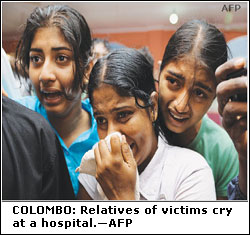 COLOMBO, Jan 16: At least 24 civilians were killed and scores wounded on Wednesday in a suspected Tamil Tiger bomb attack on a crowded bus in southern Sri Lanka coinciding with the end of the island’s ceasefire.
The defence ministry said the bus packed with schoolchildren was hit by a powerful Claymore-type mine — a bomb packed with explosives and ball-bearings.
It also said the bus was shot at after the blast.
With the island sliding back into all-out war, Nordic truce monitors packed their bags and made a renewed appeal for the government and the Tigers to return to talks — arguing that neither can win the decades-old war.
But Sri Lankan President Mahinda Rajapakse said the bus bombing was precisely the kind of “act of savagery” that justified his decision to abandon a Norwegian-brokered 2002 truce.
The ceasefire officially ends at midnight on Wednesday.
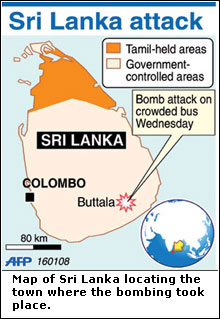 According to the defence ministry, Tamil Tigers “exploded a Claymore mine targeting the bus and subsequently opened fire at the survivors.” More than 60 people were wounded in the incident, which took place at Weliara, 230 kilometres southeast of the capital Colombo.
Eight were reported to be in critical condition, with many women and children among the casualties. The government appealed for blood donors and ordered schools in the province to close for three days.
The military said an army vehicle in the area was hit in a second bomb attack, and a villager also shot dead — blaming the Liberation Tigers of Tamil Eelam (LTTE), who are known to occasionally strike in the far south of the island.
It also repeated its view that the rebels, who want to carve out a separate homeland for Tamils in the north and east of the ethnic Sinhalese-majority tropical island, were “a ruthless terrorist outfit.” The government withdrew from the ceasefire two weeks ago, arguing that there was no point in attempting to negotiate with “terrorists” and that the Tigers had merely used the ceasefire to smuggle in more weapons.
The Norwegian-led Sri Lanka Monitoring Mission (SLMM), set up to keep an eye on the tattered truce, meanwhile closed down its operations.
“We are absolutely convinced that this complex conflict cannot be solved by military means,” SLMM chief Lars Jon Solvberg told reporters hours before the 31-member Norwegian and Icelandic team were to leave the island.
“We have been hated over the past six years... But that’s the nature of our job. We tried to be neutral in every single incident,” said Solvberg, a retired Norwegian army general.
He said his team was “disappointed” by the island’s return to war, and that he hoped there would be a return to talks “sooner rather than later.” A statement from the United States embassy condemned Wednesday’s bombing, but also pointedly called for both parties to hammer out a political solution.
Sri Lankan defence officials, however, are convinced they have the upper hand in the 36-year-old conflict, and have said peace will only be possible when they kill the LTTE’s leaders and capture their northern mini-state.
The attack also came amid an escalation in fighting in the north, with Colombo claiming it has killed 405 rebels since the start of the month against 20 soldiers killed. More fighting was reported Wednesday in the northeast.
The island’s military began the New Year with a vow to crush the Tigers by June, and set a target to kill 3,000 guerrillas in the first six months of the year.
But casualty claims are almost impossible to verify, as Sri Lankan authorities routinely prevent journalists and diplomats from travelling to frontlines or the northern jungles controlled by the LTTE.
Both sides have accused each other of killing civilians, including children. Two months ago a Sri Lankan army commando unit operating behind rebel lines was accused of killing 11 schoolchildren in a Claymore attack on a bus.—AFP



























