0
0

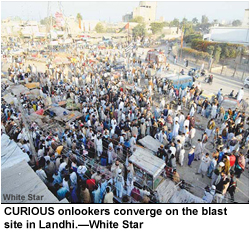
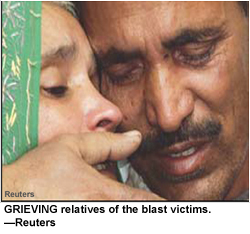 KARACHI, Jan 15: As dawn broke on Tuesday, dozens of men, women and children thronged Orthopaedic Wards 14 and 17 of the Jinnah Postgraduate Medical Centre: relatives of the people injured in Monday’s bomb blast at the Gul Ahmed Chowrangi in the Landhi industrial area satisfied themselves that their loved ones had survived.
The victims, however, have yet to recover from the terror they suffered. While the extent of their injuries varies, they all agree on one thing: delayed reaction on the part of the authorities to cap losses after the damage.“I lay on the road for nearly an hour,” says Javed, a 25-year-old trader in weekly markets who fears the loss of his left leg after his latest medical examination. “The area’s residents were the first to appear and they started moving the injured and the dead to nearby hospitals.”
The people injured in Monday’s incident were taken from the outskirts of the city to the Jinnah Postgraduate Medical Centre in vehicles ranging from minibuses to trucks and open-top Suzuki pick-ups. This exposes the level of disaster management available in this city of 16 million people.
That the lack of official response has serious repercussions is evident from 26-year-old Sohaibullah’s account. He had to walk and crawl towards the truck arranged by area residents to take the injured to the JPMC. This, he believes, further deepened the wounds on his legs and left shoulder.
“I waited for help for half an hour but finally had to move on my own – it was dark and I was afraid the people would miss me, lying there on the road,” he says. “For over half an hour, there were only screaming people and a thick cloud of dust. I did not see any ambulance, police or Rangers’ mobile during that time. They came almost an hour later.”
Sohaibullah’s observation matches the JPMC emergency register to some extent, which recorded the arrival of the first victim at 2055. The blast occurred at around 1935.
 Lack of facilities, infrastructure
What this 80-minute delay in access to first aid means to the victims can easily be conjectured and should serve as an impetus that leads the city towards developing an effective plan to meet disaster and emergency situations. Young deaths such as that of 18-year-old Jalilullah, who died of his injuries on Tuesday morning as the 10th victim of the blast, should serve as a reminder of the need to provide prompt and effective medical aid. “Most of the victims we are treating have suffered serious pellet injuries,” says Seemi Jamali, a spokesperson for the JPMC. “We released many of the injured after initial treatment and are taking care of some 25 of the victims in the Orthopaedic Ward.”
Over 50 people were injured in Monday’s incident, which raises several questions in terms of the authorities’ preparedness in keeping the damages at the minimum level for citizens – who are most exposed to terrorism threats.
There are only two major health facilities in the city with the facilities to treat grievously injured people, and in several incidents they have proved very far from the locations where incidents have taken place.
Meanwhile, the country’s business capital has only charity-run ambulance services which receive no support from the authorities. Despite the police and the Pakistan Rangers, who have been deployed in the city since 1988 to maintain law and order, the methods of rescue and investigation in the city have risen no higher than conventional.
President Pervez Mushrraf admitted last week to the country receiving $9 billion from the United States over the past six years for being an ally in the war on terror. It appears, however, that no share is spent on facilities to handle the fallout of this international commitment – the authorities agree with the problem but have yet to find a lasting solution.
‘Move, before it’s too late’
“It is really unfortunate,” says Akhtar Zamin, home minister in Sindh’s caretaker cabinet. “The way the city reacted after December 27 following Benazir Bhutto’s assassination, it set alarm bells ringing and we realised that in view of the recent wave of terror across the country, our cities and towns are not well prepared.”
Compared to recent acts of terrorism, the number of people killed in Monday’s attack is fortunately lower than could have been feared. However, Mr. Zamin believes that it is time to move, before it’s too late, since the threats are rapidly moving to the urban areas.
“We are in government for a very short period,” he says. “Even so, we have been preparing a proposal which suggests a disaster management network with centres in all the prominent localities of the city. This should operate with a fire brigade and a fleet of ambulances, as well as facilities for immediate life-saving medical aid.” Mr Zamin hopes that the recommendations will be compiled within the next two weeks for the future provincial government to consider.
Though it looks good on paper, the effectiveness – or even the materialisation – of the caretaker minister’s proposal is unlikely to give much confidence to citizens such as Zeb Jahan, the elderly, veiled mother of 27-year-old Haseeb who was injured in Monday’s blast.
As she huddles on a bench in the JPMC’s Orthopaedic Ward, looking after her son, she tells Dawn that “we have been living in Landhi for the last 27 years but every time we face any big tragedy, we rush to this place.” Her son was brought to the hospital in an open-top Suzuki and as she considers what may have happened if it had not been available, she dissolves into tears.
“Only the poor help the poor,” says Zeb Jahan. “What does the government look like? What does it do for us?”