



 0
0

Rene Guenon and Hasan Askari
 Hasan Askari was amongst those few critics of Urdu who drank deep from the fountain of western philosophy and wisdom. But after prolonged study and profound contemplation, he marched beyond the west and its philosophy.
This does not mean, as some critics would have us believe, that he rejected the west totally or asked his readers to stay away from western philosophy. Rather, he assimilated western philosophy and tried to go ahead or beyond that. In one of his essays, Askari Sahib asked three questions:
1. Is it possible for us in the existing circumstances to hold eastern values and create a peculiarly eastern literature?
2. Is it possible for us to be completely western in our ways and create a literature similar to that of the west?
3. If both of the above are impossible, is a confluence of both eastern and western cultures in life and literature possible?
As pointed out by Jamal Panipati in his book Nafi Se Isbaat Tak, after answering in the negative all three questions Askari Sahib wrote that the east is left with one choice and that is to assimilate the west and then try to find its own course of action.
Anybody who reads Askari Sahib is often puzzled by his total metamorphosis. From an Askari who was thoroughly impressed by the French writers’ symbolism and eulogised progressivism, the new Askari he carved out disagreed with them all, including the Modernists, and finally spoke for Pakistani literature and an Islamic literature. This drastic change did not occur overnight. Askari, being a voracious reader and a thinker by nature, had been reading and thinking hard all his life. Progressive writers condemned him but he said that the contemporary western aesthetic and artistic values had, after denying everything, reached a new phase where the west was rising above nihilism.
Askari Sahib discovered Rene Guenon during his long mental journey.
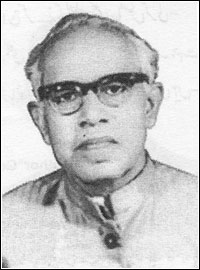 Rene Guenon was a French philosopher. Born in France in 1886, Guenon went to Paris for university education. At that time, Paris was a playground for spiritualists and theosophists from ‘mysterious’ places such as India and China. He joined those spiritualist groups briefly but soon found that they could not satiate his spiritual thirst. Guenon launched his own magazine Gnosis, which used to publish studies on Islam, Hinduism and Buddhism and criticise pseudo-spiritualists. Once, he met a Swedish painter who had converted to Islam after reading Abdullah Ibn-i-Umer’s commentary on the Quran and was carrying out research on Ibn-i-Arabi. Guenon embraced Islam in 1912, adopted a Muslim name – Abdul Vahid Yahya – and settled in Cairo in 1930. He wrote 25 books, which were admired by even the Modernists and the surrealists. Originally written in French, most of his books have been translated into English.
Reading Guenon in the original French, and taking cues from him, Hasan Askari reached Ibn-i-Arabi and finally Maulana Ashraf Ali Thanvi. Guenon was Askari’s mentor and shaped his way to his final intellectual destination.
The limitations of these columns do not permit me to delve into the details of how Hasan Askari shaped a new literary theory and how he influenced an entire generation of writers, critics and intellectuals. In a nutshell, he founded the Traditionalist school of thought in Urdu criticism and the bigwigs of Urdu criticism such as Saleem Ahmed and Jamal Panipati are products of that school.
Born on November 5, 1919, in UP’s Meerut district, Muhammad Hasan Askari obtained a masters’ degree in English from the Allahabad University in 1942. His debut job was as a script writer at All India Radio, Delhi but he soon joined Delhi’s Anglo-Arabic College as a teacher and then taught English at Meerut College. Askari Sahib migrated to Pakistan in October 1947 and with Saadat Hasan Manto, launched the Urdu literary magazine Urdu Adab. It did not survive beyond two issues. In 1950, Askari Sahib came to Karachi and worked as Mah-i-Nau’s editor from January to June 1950. Then, he joined Karachi’s Islamia College and remained associated with it till his death on January 18, 1978.
His literary career began with short-story writing but he soon began writing philosophical and critical essays. His literary column ‘Jhalkian’, published from 1944 to 1957 in Saqi, a prestigious literary magazine edited and published by Shahid Ahmed Dehlvi, gained great popularity as it introduced many literary theories, stirred many controversies and raised many questions.
He experimented with the themes and forms of the short story and was amongst the ones who fine-tuned the stream of consciousness technique in the Urdu short story. His ingenuity and intellect caused quite an uproar on many occasions but such was his influence that even those who opposed him could not resist his fresh and indigenous theories – only to see him rejecting them himself after a while in favour of new ones. When he said that Urdu literature was decadent, there was a reaction but it gained currency and ultimately became a cliché. Then he said that Urdu literature was static, which again caused hue and cry, then became fashionable to say so, before becoming trite.
Askari Sahib translated several literary western masterpieces into Urdu. From English he rendered Hermann Melville’s Moby Dick, Christopher Isherwood’s Goodbye to Berlin, and Shiela Cousins’ To Beg I am Ashamed. From French, he translated Gustav Flaubert’s Madam Bovary and Stendhal’s Le Rougue et le Noir. From Urdu, he translated into English Mufti Muhammad Shafi’s book Distribution of Wealth in Islam and Maulana Ashraf Ali Thanvi’s book Answers to Modernism. He intended to translate Mufti Muhammad Shafi’s Muaarif-ul-Quran, a commentary in eight volumes on the Quran, into English and had nearly finished the translation of the first volume when he died.
Jazeere and Qayamat Hamrakab Aae Na Aae are collections of his short stories. His critical essays have been published in five volumes: Insaan Aur Aadmi, Sitara Ya Badban, Waqt Ki Ragni, Jhalkian and Takhleeqi Amal Aur Usloob. Jadeediat Ya Maghrabi Gumrahiyyon Ka Khaka is a treatise on the follies of western philosophy, adapted from Rene Guenon. Askari Sahib was an iconoclast and demolished many a western literary idol. But he gave and popularised the idea of Urdu literature’s traditions, its continuity and its cultural unity. A few years ago, Lahore’s Sang-e-Meel Publications published his collected works in two volumes.
— drraufparekh@yahoo.com
No end to thana culture in sight
 The rule of law prevents crime detection. This is the finding of people who directly deal with crime and its prevention. But does this reflect the backwardness or inefficiency of the methods employed to uncover crime, the honest officers of our police who admit torture as a common means of investigation crimes, is a question they prefer to avoid answering. Yet they insist that if police went strictly by the rules, few crimes could be solved.
Allegations of extra-legal methods that police employs to crack open hardened criminals and bust crime are common but the victims, mostly innocent, are categorised and dismissed as “unfortunate” cases. Their misfortune starts the moment they are “picked up” by police as a suspect and are tortured to confess a crime they have not committed.
The Police Rules of 1934 require to record every detention in the police station’s daily diary called Roznamcha and to produce the detainee in a court of law within 24 hours. Since that is “too short a time” to establish his guilt, the police, in many cases, do not record his arrest and hold him in illegal custody until he cracks up, guilty or not. Such practices besides being against the law lead to serious human rights violations. But police must produce “results”. It is difficult to bust crimes with the limited resources and time available to police, goes the argument.
For instance, law allows physical remand for maximum of 14 days after which the court is obliged to send the accused to jail in judicial remand. That emboldens hardened criminals to stand firm during the 14 days in police custody and deny his crime till he goes into the relative comfort of the jail.
During the physical remand the police tortures the suspect in open violation of human rights as they have no modern technique or facilities to investigate or interrogate the criminals, suspect and the accused. All that is demanded of them is to produce a person who admits the crime.
In order to discourage these illegal and inhuman practices the high-ups of Islamabad police had introduced a concept of Human Rights Officer (HROs) in January 2006.
The objective of the HROs, appointed at all the police stations of the capital was to protect the human rights of arrested persons especially in respect of illegal detention, torture, medical facilities and the detainee’s production in a court of law within 24 hours.
The HROs were also responsible to protect the rights of juvenile suspects and women in police custody. They were to record names and addresses of persons picked up by the police and to inform family members that the person was in police custody. But interestingly no such legal power was provided to the officials to protect themselves for providing such protection to the detainees and delay in detection of the said crime.
Most of the human rights violations occurred during night when the HROs were not present in the police stations. The HROs questioned the detained persons every morning about the police treatment. The HROs were selected from the rank of sub-inspector and inspector who had served as human right officers for the United Nations Mission. However, the concept has failed to deliver as some incidents of human rights violations were witnessed at different police stations failing to improve the thana culture”. They also failed to lodge complaint against colleagues involved in violations.
Since the deployment of HROs, at least four cases of human rights violations against the police officials of the Shahzad Town, Golra, Tarnol and Aabpara police stations have been registered with the police high-ups. The then SHOs and HROs of the Shahzad Town and Golra were suspended consequently.
An investigation officer (IO) of the Tarnol police station was suspended for keeping a woman in custody during night and an IO of the Abpara police station was suspended for torturing a man in police custody.
Likewise two cases of alleged suicide attempts in police custody were reported during the absence of HRO, as he was on special duty and not aware of the incident.
Besides the reports of the HROs for the last six month of 2007, submitted in the offices of senior police officials have been nil. They also failed to give maximum time to their duties, as most of the time they engaged in other duties assigned by high-ups. It was, therefore, decided to withdraw the uniformed HROs from the police stations and replace them with civilians. Accordingly they were drawn from the police stations on December 8 and replaced with civilians.
The high-ups of the city police redesigned the concept and deployed neutral and volunteer members of civil society as HROs, claiming that they can play more effective role, as they have access to police stations and encouraged to ask questions regarding persons called to police stations for questioning. But where the uniformed personnel failed it can be imagined how people in civvies can safeguard the rights of suspects in police custody.
| © DAWN Group of Newspapers, 2008 |


























