0
0

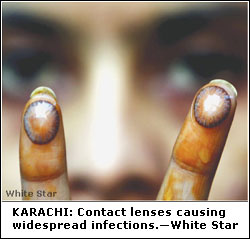 KARACHI, Jan 13: Earlier used primarily for vision correction and lately as decorative and party lenses, the soft contact lenses (polymer lenses) are reportedly proving to be a threat to the users’ eyesight.
Eye specialists at government and private hospitals have recently reported a surge in serious eye problems, including damages to the corneas and permanent eye injuries, caused by contact lenses, mostly among the youth.
With a wide range of such lenses available in the market in different colours, more and more young people, especially women, are increasingly buying these lenses without taking into consideration the health hazards associated with these products.
Due to carelessness in the use of such lenses or due to use of substandard and inferior quality lenses, or using those without proper fitting, and delay in reporting to specialists in the early stage in case of an infection or corneal ulceration, some of the young women have ended up losing their eyesight, the doctors maintained.
Two of the girls who have lost their sight in one eye after their corneas became infected still visit Jinnah Postgraduate Medical Centre for treatment of their eyes.
One of the two girls in question, a student of BA final year at a women’s college in PECHS told Dawn at the JPMC that she had been using the lenses for the last two years, just to change the appearance of her eyes, particularly during the college hours.
“I kept changing the lenses periodically, costing Rs1,600-1,700 every time, but during my last visit the shopkeeper gave me some different lenses at much cheaper rates on the pretext of the non-availability of the old ones”. The girl, a resident of Baldia Town, said that the new lenses started problems about two to three months back, but she failed to approach an eye-consultant on time and finally lost vision of an eye.
Another girl suffering from visual impairment also belongs to Baldia Town. In her early teens, the girl with no sense of the big loss or shade of emotion said she wanted to appear with green eyes, and purchased the cosmetic lenses in the company of a friend from a shop in Golimar, Nazimabad, without taking her father into confidence. The problem began in July, with redness and sensitivity to light in one of her eyes, she added.
Referring to the cases of the two girls and others a postgraduate student in the eye department of JPMC, Dr Ashar, said that such cases indicated the absence of any regulation on the corrective or non-corrective (fashion) lens business. The market is full of lenses of various origins, but without being checked, he viewed.
Dr Alyscia Cheema, an assistant professor at the JPMC’s ophthalmology department, said that she had seen at least nine women in one month ending Dec 15 at the hospital, who had suffered fungal/bacterial infections in their corneas due to contact lenses.
Half of the patients in question also suffered a permanent visual impairment due those infections, she said, adding that she was making efforts for cornea transplants on the two Baldia town girls belonging to the low-income group.
She said that an eye infection could be averted only when persons experiencing unusual symptoms promptly contacted an eye specialist. “Sometime patients with microbial keratitis caused by contaminated soft lenses or the devices used to maintain them, report to us so late that we have to face enormous difficulties in obtaining a specimen for laboratory analysis, which also delays the right treatment to such patients”, Dr Cheema remarked.
Dr Javed Niazi, head of JPMC ophthalmology department, stressing the need for a responsible and appropriate use of contact lenses said that people rarely bothered to get their eyes examined and obtained valid prescriptions, while on the other hand manufacturers and marketers were not also providing due information on their products or instructions and guidelines for lens users.
He said that the problem of infections linked to contact lenses was not confined to the lower or middle income groups only and the well-off or educated ones were also reporting to eye consultants or ophthalmologists.
Dr Sharif Hashmani, president of Ophthalmologists Association Pakistan, Karachi chapter, said that he had been receiving at his hospital every month at least two cases of permanent vision impairment due to an infection known as Acanthamoeba keratitis, which primarily affected otherwise healthy people most of whom used contact lenses.
He said that as good practices lenses should be prescribed by ophthalmologists, but today one could buy these lenses, without any prescription, even from beauty parlours and big stores. “The lenses are being imported mostly without any certification from different countries, which should not be taken lightly any more as ill imports and marketing are turning drastic now”, Dr Hashmani said.
Dr Akbar H. Soomro, a former principal of the Sindh Medical College and an ophthalmologist, observed that poor lens fit was also a factor behind many infections.
Among other factors, air and water pollution and abundance of dust particles in the air of cities were also responsible for unsuitability of lenses in countries like ours and as such there was a need for schedules for wearing contact lenses outlined by eye doctors and the lens manufactures.
The former general secretary of the Pakistan Medical Association, Karachi, Dr Qaiser Sajjad, stressed the need for collection of data on infections related to contact lenses from major government and private hospitals and urged eye-specialists to understand the trend and the real reason for the infection.
Experts say that once the cornea gets affected it can lead to watering, redness, intolerance to contact lenses and decreased vision. Most of the infections can be treated with medicines, but the healing process itself may leave a corneal scar, which can cause visual impairment.