



 0
0

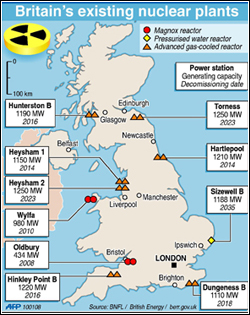 LONDON, Jan 10: Britain gave the go-ahead to a new generation of nuclear power stations on Thursday, setting no limits on nuclear expansion and adding momentum to atomic energy’s worldwide renaissance.
Prime Minister Gordon Brown’s government argues Britain must build new nuclear plants to help meet its climate change goals and to avoid overdependence on imported energy amid dwindling North Sea oil and gas supplies.
Nuclear power stations provide about 18 per cent of Britain’s electricity now, but many are nearing the end of their lives.
Energy Secretary John Hutton said the evidence in support of new nuclear stations was compelling.
“I therefore invite energy companies to bring forward plans to build and operate new nuclear power stations,” he told parliament.
He said he would not set “some sort of artificial cap” on the proportion of Britain’s electricity derived from nuclear power.
Environmental group Greenpeace, which succeeded in blocking an earlier pro-nuclear decision, said the public had been misled during recent consultations and its lawyers were already considering a fresh challenge.
“This is bad news for Britain’s energy security and bad news for our efforts to beat climate change,” Greenpeace Executive Director John Sauven said, adding that there were safety problems with the government’s plans to store highly radioactive waste underground.
The opposition Liberal Democrats said the public consultation on nuclear power had been a “sham”, but the Conservative Party lent its support.
“It is our duty to set aside political scrapping so as to make sure we do what’s right for our country,” said Conservative business spokesman Alan Duncan.
RENAISSANCE: The government called nuclear energy an unattractive option in 2003, but since then surging prices for oil and gas have helped make it more competitive and the focus on cutting carbon emissions to fight climate change has intensified.
Already, countries such as France and Finland are building new nuclear plants and, in the United States, companies have begun filing licence applications, reinforcing the view atomic energy is part of the solution to the world’s energy problems.
However, there is opposition to nuclear among some countries, including Germany which remains an anti-nuclear stronghold with no prospect of new reactors being built.
For critics, the toxic waste from nuclear power generation, which will remain for thousands of years, is one of the powerful reasons to say atomic energy is not worth the risk.
London Mayor Ken Livingstone called the government decision “the mistake of a generation”.
Nuclear operators say they could have new plants running in Britain by 2017, but analysts point to tough global competition for components and experienced nuclear workers.
“The UK will need to work hard to remain an attractive option,” said Tony Ward of Ernst & Young, adding that more than 30 reactors were under construction around the world, and over 90 were in the pipeline.
Hutton said he expected several new plants to be running by the mid-2020s and French nuclear engineering firm Areva said it aimed to built at least four reactors in the UK, possibly six.
The government green light was accompanied by publication of an Energy Bill to be fast-tracked through parliament with the Climate Change Bill and the Planning Bill.
Hutton said the government would give more support to wind, wave and tidal energy.
The trio of bills form the backbone of the government’s new energy and climate policy for the next decades.
The British public is divided on nuclear, with 44 percent saying companies should have the option of investing in new nuclear power and 37 percent disagreeing.
The last of Britain’s existing nuclear plants is scheduled to be closed by 2035. Analysts say renewable sources of energy would not be sufficient to replace them.—Reuters



























