



 0
0

In search of El Dorado
 Anyone who has gone through A. Hameed’s book ‘Ibn-i-Insha: Yaden, Baten, Bahar, Khizan’ knows what a romantic and idealist Ibn-i-Insha was.
The book records some fond memories of ‘golden’ days when the two authors strolled together in old Lahore’s streets which, according to A. Hameed, were carved out straight from The Arabian Nights.
Ibn-i-Insha was a progressive writer but he was a romantic, too. Relics of the past and natural beauty haunted him. The moon mesmerised him and he named his first collection of poetry ‘Chand Nagar’. Yet at the same time he had a profound knowledge of all political movements and felt a deep affinity with Marxism. He was an idealist and romantic who believed in realism and progressivism. But above all he was a humanist.
Ibn-i-Insha admitted that he was a romantic and that the contradiction between his disposition and the realities of the stony world around him gave birth to his longer poems. He wrote that “in Grimm’s fairy tales an obstinate dwarf says an ounce of humanity is worth the wealth of the entire world. Many of my poems are dear to me just because they are about that ounce of humanity”.
Ibn-i-Insha adored Edger Allan Poe’s mysterious works. In the foreword of ‘Chand Nagar’, he wrote: “There is a poem by Edger Allan Poe, El Dorado, that is, the city of dreams. In this poem a knight embarks upon a journey on horseback in search of El Dorado, the fabulous golden city, travelling for years without any trace of his cherished land. Just when he was about to lose heart he found an old and decrepit man who told him to go beyond the lunar mountains, to the long valley of shadows. Who knows that knight found the city of dreams or not but he did find an excuse to go on and on. A poet should mentally be like that knight, like Ulysses, he must have an El Dorado, a city of dreams, a Chand Nagar to seek.”
His other collections of poetry include ‘Us Basti Ke Ik Kooche Men’ and ‘Dil-i-Vahshi’. ‘Billoo Ka Basta’ is a collection of poems written for children.
What surprises the reader is Ibn-i-Insha’s dual personality. His poetry is melancholic and talks of pains and sorrows but his prose has witticism and spontaneous humour. His travel accounts, written in a lighter vein, transformed the entire course and mood of Urdu travelogue writing. Now rarely do we come across any Urdu travel account that does not try to be funny because this genre has been stamped by Ibn-i-Insha so indelibly that travel writing can hardly be imagined without a light, easy air that Ibn-i-Insha created. His travelogues, ‘Chalte Ho To Cheen Ko Chalye’, ‘Awara Gard Ki Diary’, ‘Ibn-i-Batoota Ke Taaqub Men’, ‘Dunya Gol Hai’ and ‘Nagri Nagri Phira Musafir’, though written in the sixties and seventies, still have an appeal because of their beautiful prose and humour.
His book ‘Urdu Ki Aakhri Kitab’ is ranked among the select humorous Urdu prose. The satire of the book, in addition to making you laugh, makes you think hard about our history and society.
Ibn-i-Insha’s humour columns that he wrote for Imroze, Hurriyet and Jang, have been collected in two volumes’ ‘Khumar-i-Gandum’ and ‘Aap Se Kya Parda’, though many of them are yet to be published in book form. He translated some of O. Henry’s and Edger Allan Poe’s works into Urdu.
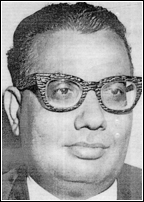 Ibn-i-Insha was born on June 15, 1927 in a small town near Ludhiana, East Punjab. His real name was Sher Muhammad but he adopted many pen names such as Asgher, Mayoos Adamabadi, Sehrai and Qaiser. Finally he became Ibn-i-Insha which gave him such fame that his real name was forgotten.
After graduating from Punjab University in 1946, Ibn-i-Insha joined the agricultural research council as sub-editor in 1947. Before migrating to Pakistan in 1947, he remained associated with All India Radio briefly. Here he joined Radio Pakistan but then he came to Karachi and from 1950 to 1962 he worked in different capacities in the constituent assembly, department of village publicity and council of agricultural research. In 1962, he was made director of the national book council, Karachi.
Ibn-i-Insha was a romantic who had embarked upon a journey early in his life in search of his El Dorado that was beyond Chand Nagar. In the quest he passed through many a beautiful valley but as is the fate of every writer, the elusive great and golden city remained beyond his reach. He died in London on January 11, 1978 and was buried in Karachi.
Little hope for Olympic glory as Pakistan sports takes a beating
We, as a nation, do not learn from our mistakes. Instead, we have a rather annoying habit of repeating them, albeit with a new dimension added to it every time. This is quite visible in all spheres of life and sports is no exception.
It is a sad scenario that today we stand nowhere among the top in any of the major sports and have, in fact, ruined all the good work done by the stalwarts of yore. Despite meagre resources, the heroes of yesteryears reached the zenith of their respective fields due to their unflinching commitment and hardwork.
The year that has just ended has failed to bring any laurels in sports for Pakistan. It is a shame, though, that the officials of most sports federations and set-ups continue to thrive over lame excuses and false promises despite successive failures.
Be it hockey or cricket, squash or snooker, soccer or boxing, track and field or tennis or any other discipline, every sport nosedived to an all-time low but no heads have rolled, neither have there been any resignations that could possibly allow some room for new faces.
People in the corridors of power are enjoying lavish perks and privileges besides getting their four-year terms in office extended as a reward for all the failures.
2008 is the year of Olympic Games and the nations across the globe are eyeing for glory at Beijing. Their preparations which kicked-off soon after the 2004 Athens Olympics have now entered final phase. The Beijing Olympics open on Aug 8. In the picture emerging so far, Asian powerhouse China looks set to eclipse the United States at the top of medals tally. Their athletes are working strenuously to achieve the feat at home with solid commitment and supreme confidence.
At Athens, the Chinese improved their overall medals tally to finish second only to the US. The Chinese went home with no less than 32 gold, 17 silver and 14 bronze medals. The gap between China’s performance and that of the United States was not much at all. The US which is considered a force to reckon within the quadrennial Olympics, took home the honours with 35 gold, 39 silver and 29 bronze medals — a difference of only three gold medals with China.
China’s progress into global sports ascendancy has been the result of gradual successes. It started in 1996, during the Atlanta Olympics where China finished fourth with 16 gold, 22 silver and 12 bronze medals. Then it was placed behind the US, Russia and Germany.
Four years later, in Sydney, Australia, China leaped forward with 28 gold, 16 silver and 15 bronze to earn third place behind the United States and Russia in the overall medals tally.
Today, it is the second most powerful country at the Olympics.
On the contrary, Pakistan which returned empty-handed from Athens, is lagging far behind the standards required to achieve glory at the world’s biggest spectacle.
To date, Pakistan has fetched just three golds, as many silver and four bronze medals at the Olympics. With the exception of two bronze — Mohammad Bashir freestyle wrestling at the 1960 Rome and Syed Hussain Shah boxing at the 1988 Seoul — the remaining medals have been won by the hockey team.
Despite tall claims, the deterioration in the national game continued and no improvement whatsoever was witnessed. In 2006 Busan Asian Games semis, Pakistan were knocked out by minnows China who shocked their much experienced opponents 2-1. Since then, the Chinese, who have learnt the basics of the game from Pakistan itself, have repeatedly tested their masters.
If we glance at 2007 alone, Pakistan barely managed to beat China 3-1 in penalty shootout after being tied 2-2 in regulation and extra time at the Azlan Shah Cup. In the four-nation Good Luck Beijing contest that followed, China held Pakistan to a 2-2 draw.
The two again clashed in the Asia Cup at Chennai where the three-time former champions Pakistan tasted a shock 2-3 defeat at the hands of the Chinese in a classification match.
Things did not end here as in the same competition, Pakistan got a 3-1 drubbing at the hands of outsiders Japan.
With the Beijing Olympics just round the corner, the cupboard of Pakistan sports, quite sadly, is pretty much bare. Neither the merit nor the degree of preparation can give any hope to the Pakistani athletes to conquer the podium at the forthcoming Games. However, one can only hope for some miracle to happen in the remaining seven months to bring some glory for Pakistan, or else the year 2008 will be as forgettable for sports fans as was 2007.
Dark beginning to 2008
 THE first week of 2008 was supposed to herald in a new democratic era with the participation of major political parties in free and fair general elections as originally scheduled on January 8. That this has not happened is a bleak start to the new year.
What made the first week of the new year even bleaker in the capital city was the imposition of electricity loadshedding beginning from January 1. For a city which previously was minimally impacted by loadshedding, the frequent electricity outages totalling three to seven hours or more daily is a dark experience for consumers — domestic, commercial and industrial.
Take for instance, one particular locality of the capital, a sector bordering Rawalpindi. The timings of loadshedding here have been very erratic, changing every day since the exercise started. On the first day, electricity went off only once for half an hour; and on the second day, it went off three times, each lasting for an hour.
On the third day, power went off a total of five times, all different timings from the previous days and of different durations lasting from half an hour to two hours, with the two- hour duration occurring twice.
On the fourth day, loadshedding began at midnight with electricity going off and on at intervals until 7am. It went off again two more times during the day, once in the afternoon and once in the evening, the timings again different from the third day.
Pakistan is not the only country facing loadshedding; some others in the same boat are South Africa, India, Bangladesh, Nepal, Uganda and Colombia. But it is the irregularity in the timings and duration of the loadshedding, rather than the loadshedding per se, which is causing more inconvenience and frustration to consumers.
If it is necessary to impose so many hours of loadshedding daily, the least the capital authorities could do to minimise inconvenience to consumers is to have specific and regular timings for it so that consumers can expect when their electricity supply will be cut off and thus, set their routines accordingly.
Iesco issues a statement daily, which is published in the press, specifying which feeders or transformers in the twin cities will be affected by loadshedding and when, but it is not a user-friendly schedule and is incomprehensible to the ordinary consumer.
Whatever the reasons behind the power shortage, now that loadshedding is a fact of life in Islamabad, it falls upon Iesco, together with Wapda and the Capital Development Authority, to jointly come up with an integrated loadshedding schedule so that electricity consumers across the capital territory can be informed of electricity interruptions in advance.
Unlike the unpredictable timings in Islamabad, loadshedding timings in Cape Town are very regular and consistent, i.e., for a duration of two hours anytime between 6am and 9am and again for two hours anytime between 6pm and 9pm. The loadshedding schedule is communicated through a website to inform consumers of the plan of electricity outages.
In addition to adopting such measures, appeals also need to be made to consumers to use electricity sparingly and use electrical equipment as efficiently as possible, especially during morning and evening peak hours, in order to reduce the demand of electricity and assist in minimising loadshedding. Steps like avoiding ironing and other three-phase stages during these time periods can bring a relief in loadshedding.
Another measure, adopted in India, which can be undertaken to cut loadshedding in the capital, is the implementation of a voluntary load reduction scheme, under which if the load is reduced to a certain percentage through self-control measures by the citizens, loadshedding in the city is removed in the evening.
Yet another measure is fixing single-phase transformers so that citizens will at least have basic light available in the households during loadshedding in the evenings.
Even if loadshedding has to last several weeks or even months, careful planning of the timings, enabling the public to access the loadshedding schedule and information as easily as possible, and the adoption of other relief measures can go a long way in helping consumers to cope with the power interruptions.
Needless to say, however, all these are temporary solutions to the problem of power shortage. The real solution lies in good planning and an efficient policy on power that will increase the generation capacity and availability of power in accordance with the growth in demand for power, a demand that can only be expected to rise sharply in the coming years given the developments being planned in the federal capital territory.
| © DAWN Group of Newspapers, 2008 |



























