0
0

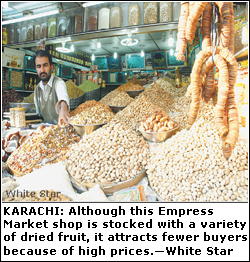 KARACHI, Jan 6: Pakistanis consume as much as 116,000 tons of dried fruit annually, and traders say dried fruit’s demand increases every year because of their growing use in sweetmeats and various dishes.
However, there are millions of people who cannot afford to buy dried fruit because of high prices and their low incomes. Many of them hardly taste these fruit in the season as they first have to meet the demand for essential goods, whose prices are already sky-rocketing. Some people feel happy even to have peanuts, but their prices also shoot up when the weather turns chillier.
As for dried fruit’s prices, they hinge on international market prices, production cost in the relevant countries, local production and the movement of goods across the border.
The import bill of dried fruit in 2006-2007 surged by 21 per cent in terms of value -- $70 million (115,622 tons) as compared to $58 million (111,000 tons) in 2005-2006.
Pakistan gets its dried fruit mainly from Afghanistan and Iran. It also depends on local production in the Northern Areas and border areas along the neighbouring countries. The peak season of dried fruit sale begins on November 15 and ends in February.
Retailers, after buying dried fruit in the main wholesale markets just ahead of the winter, make heavy profits by charging high rates when the demand touches its peak from December to January.
Prices fluctuate and show a mixed trend, depending on the crop size, arrival through import and the local production.
As many people avoid buying in bulk from the wholesale markets, a majority of consumers having no knowledge of the prevailing wholesale prices are compelled to buy dried fruit at the general and super stores and from pushcart vendors, who charge twice as much of the actual price.
In Jodia Bazaar and the Marriot Road areas, the hub of all wholesale goods, retailers buy goods in bulk. As a result, the wholesale traders also sell the products to consumers preferring bulk purchases.
Many retailers also mix the previous year’s unsold stocks with new products and the consumers having no knowledge of it purchase them at high prices.
There is a slight difference in prices of dried fruit selling at Jodia Bazar (main wholesale market) and Empress Market (semi-wholesale market) in Saddar.
The price of pine nuts is Rs720 per kilo at Empress Market, while traders in Jodia Bazar demand Rs700 for it. However, their last year’s price was Rs1,100-1,200 per kilogram.
The main reason for the decline in pine nut prices was the suspension of their export this year. They were exported to several countries last year, a trader said, adding that they were produced in Pakistan.
The price of American almonds at Empress Market is Rs450-480 per kilo while they were selling at Rs600 per kilo last year. However, a Jodia Bazar trader said this year their prices hovered between Rs450 and Rs600 per kilo, depending on the quality, whereas they were available at Rs400-500 last year. They are imported from the US and their price in the local markets depends on the price fluctuation in US markets.
Walnuts sell at Rs130-140 per kilo at Empress Market and Rs120-130 per kilo in Jodia Bazar. Their price has been the same as it was last year. They arrive here from the Chaman and Quetta areas. A trader said that some importers had brought in American walnuts, but their prices were Rs200 per kilo.
The price of cashew nuts in Jodia Bazar is Rs550-560 per kilo, while they are sold at Rs600 per kilo at Empress Market. Last year, they sold at Rs450-500. This commodity finds its way into Pakistan from India, Vietnam, etc, either directly through importers or via Dubai.
Dealers at Empress Market demand Rs600 per kilo for pistachios while in Jodia Bazar dealers charge Rs575 for it. Last year they were selling at Rs400-450 per kilo. They mainly arrive from Iran, while some quantities arrive from Quetta, Chaman and Afghanistan. Salted pistachios also arrive from Iran and are selling at Rs400 per kilo.
The rate of raisins at Empress Market is Rs120 per kilo and at Jodia Bazar it is Rs140 per kilo. Last year they were sold at Rs90-100 per kilogram. They are also exported.