0
0

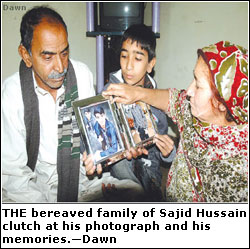 KARACHI, Jan 2: As the city limps back to normality after the four-day violence following Benazir Bhutto’s assassination, the family of a victim, Sajid Hussain, sees a bleak future for themselves.
The 23-year-old only bread-earner of the eight-member family, who was burnt to death with six of his colleagues last week when a mob set an Italian company’s garment factory ablaze, has left behind a heart-patient father, a diabetic mother and seven grieving siblings with little to survive on.
“We got worried when we failed to contact him (Sajid) after more than 24 hours,” says Ali Akbar, an uncle of Sajid’s. “Then we finally received a call from the factory the next evening that some people had been found dead inside the factory and their bodies had been moved to the Jinnah Hospital.”
Akbar’s nightmares materialized when he recognized the charred body of his nephew lying with the bodies of the six other coworkers in the JPMC mortuary. In an 80-sqaure-yard house of Fazal Hussain in Shah Faisal Colony, where his family was all set to celebrate Sajid’s wedding in March, the aged father now finds himself counting the days of mourning.
Crouched in a corner of the sitting room of the house, he recalls with a quivering voice the days when Sajid was “well set and supported the household cheerfully”.
“I had already nothing to celebrate or enjoy in life, but they (the children) had pinned all hopes on their beloved brother,” he says and breaks into tears, clutching at the 12-year-old Mudassir, the youngest of his eight children.
After a week of the tragic incident, families of the victims of the Masco export firm fire yet to overcome their grief. Residents of the city’s poor neighborhoods, all the seven workers of the factory were trapped when dozens of miscreants stormed into the factory and set it on fire.
Though hundreds of the factory workers ran to safety, they haven’t overcome the fear gripping their hearts.
Asghar, a printing master in the factory, struggles to calm his nerves and shares with this reporter what he wants to forget forever.
“They (miscreants) were countless,” he says. “They first ransacked the office. Then they started collecting the valuables, including refrigerators, computers and water dispensers, and finally set the printing section on fire.”
He says there were nearly 1,000 workers inside the factory when it was attacked, but a majority of them escaped after the mob entered the production unit.
“The situation was so dangerous that hundreds of workers, including women and young girls, started running to the main Korangi Road to seek protection and finally landed in a factory near Chamra Chowrangi. There we found a shelter to spend the whole night under,” he says with fear writ large on his face.
Though he still can’t understand why the seven of his colleagues could not make out of the burning factory, Asghar considers himself lucky to have survived after spending some 36 hours in horror.
“They (victims) would have been trapped in a fire that blocked both the entrances and exits of the factory while chemical and gases used for industrial work could have caused suffocation in the area they were hiding in,” he says.
Whatever the causes behind the seven deaths, for Farzana, the widow of another factory fire victim, Kalim Ahmed, life has lost its meaning after her husband’s death. One of the two rooms of the rented flat in Shah Faisal Colony, relatives return home without condoling with the widow, who has almost lost her senses.
“First we were here to join her in the hour of grief, but now we are here for her (Farzana) treatment as she has no children,” says her niece Rabia. “Aunty received a call that evening from Uncle who said he would stay in the factory overnight as the law and order situation in the city was very bad.”
Waiting for her husband’s return, the widow received another call from the factory the next evening but this time it was not from Kalim.
“A man from the factory called to ask the family to send someone over as there were some people who were injured in a fire who had to be recognized. But it proved wrong as he was already dead,” says Rabia, whose face looks grim with markings of stress and grief.
As uncertainty and grief grips the victims’ families, standing outside the ruined factory, giving an ugly look after the massive fire and exuding the stench of dead bodies, a social worker of the area moves about desperately.
"I fear more bodies are trapped in here," says Yousuf Khattak, a labour activist, who helped retrieve the bodies next day of the fire. “There is a need to remove the rubble with due care, under the supervision of a government body.”
He also suggests the compilation of a data of the factory workers to see if anybody is missing.
Though Asghar, the printing master at the factory, has resumed his job, he tries to recall the faces behind the arson attack. He believes they were not political workers, but gangsters.
His observations match the assessment of police, who have already registered an FIR (226/2007) under Sections 147, 48, 149, 395 and 302 of the Pakistan Penal Code for the incident. The law-enforcement agencies have also found some 48 factory trucks loaded with valuables in the locality surrounding the factory and have arrested six men.
“We have major leads after the recent arrests and we are poised to arrest more people who were behind this horrible crime, which was not a job of politically-motivated activists but vandals,” says Capital City Police Officer Azhar Ali Farooqi.
The police success in retrieving the looted goods of the factory may bring some disclosure to the investigations, but experts stress the incident should set alarms ringing in the quarters concerned as the city has a history of such brutal acts committed in the garb of protests.
In May 2005, six workers of a US fast-food chain died when a restaurant was torched by a mob protesting against the suicide bombing of a mosque in the city and killed five others. Four employees of the restaurant were burnt to death while two others froze to death while trying to hide in the walk-in cold storage.
“Our society is being brutalized,” says prominent psychiatrist Dr Haroon Ahmed. “Actually during the last 15-20 years, we have lost all forums of protest, and violence has taken over. And the youth’s exposure to the media has added fuel to the fire.”
He believes that as the government violates the law and is not held responsible, in agitation from the masses the law of the land is defied in desperation.