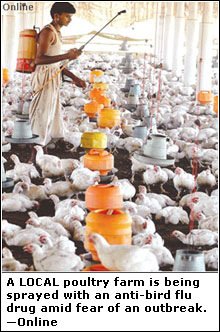
 KARACHI, Dec 26: Bird flu has not been found in poultry in Karachi and Sindh during the current winter but there is a continued need to remain on high alert, said health, agriculture and livestock officials of the Karachi district and the provincial government at a meeting held on Wednesday.
While urging that there was no need for panic, the meeting concluded that efforts must be made to counter the existing communication gap on the H5N1 bird flu virus, said a source privy to the proceedings.
The meeting, convened by the executive district officer (health) of the city district government Karachi (CDGK), came in the wake of Pakistan’s first human death caused by the deadly virus. About a week ago, federal health officials confirmed the death of one of the eight people who had tested positive for the H5N1 bird flu virus in the NWFP since October. It is not yet known whether the latest cases of bird flu in humans were linked to sick birds or were transmitted from human to human.
The CDGK meeting reviewed the city’s preparedness in terms of combating the spread of bird flu, caused by the H5N1 virus and also known as avian influenza or Asian bird flu. Amongst the attendees were EDO health Dr A.D. Sajnani, EDO agriculture Dr Mohan Lal, Director Poultry Ali Akbar Soomro, Dr Aslam Jalali of the provincial livestock department, Dr Aslam Pervez of the CDGK, representatives of the World Health Organisation and the Pakistan Poultry Association, and representatives of poultry farmers.
According to Dr Jalali, poultry samples were being culled and frequently tested in laboratories but no bird flu cases had so far been found in Karachi or Sindh. He said that his department had also conducted tests on backyard poultry and the birds in the big Empress Market shops.
Dr Sajnani pointed out the dearth of communication between the livestock, agriculture and health departments, and the poultry farmers. This was obvious, he said, given that the handlers of public health and hospitals sometimes gained information from the media about a bird flu outbreak. “Only a timely flow of information can help evolve strategies and effective implementation and counter-measure plans,” he stated.
Some participants also laid emphasis on the need for the CDGK health department to build its capacity in case of the H5N1 virus being transmitted to humans.
Meanwhile, a poultry farmer’s representative said that there was a need to test wild birds, the seasonal migratory birds at Manchar Lake and other water bodies across the province, and the birds housed in zoos and Empress Market.
Mutation fears
The H5N1 virus has been circulating in Asia since 1997 and first appeared in Pakistan around two years ago. Since then, several outbreaks have been reported in various parts of the country, an official told Dawn.
The national poultry disease reference laboratory last confirmed the presence of the virus in Karachi in the first week of April this year. Prior to confirmation from Islamabad, between four and seven thousand birds died of the viral infection while about 28,000 birds were killed at three Gadap town poultry farms, which were then maintained by the farms and provincial livestock department.
At least 208 people have died from the virus. Experts say that in its present form, bird flu is transmitted only through people with some sort of contact with infected birds.
However, scientists are of the opinion that the virus is evolving and could mutate into a form that spreads easily amongst people, which could potentially spark a pandemic. Many countries have stockpiled anti-viral bird flu medicines that could prevent some of the effects of the virus in humans by boosting the body’s immune system.