0
0

 KARACHI, Dec 19: Unlike the performing arts, which are going through a lean period these days, the fine arts have never enjoyed such a fruitful period in this city. At least one new exhibition opens every week.
However, most works on display bear the stamp of mediocrity and it is not too often that one gets to see outstanding work. Fortunately, Cambridge-based Dr Fatima Zehra’s collection of exquisite miniatures, mostly on the theme of Sufism being exhibited at Chawkandi Art until the 26th is – to use an old phrase – an experience to remember. For art lovers and students of the fine arts, it’s an opportunity not to be missed.
The first painting that attracts you as you enter the gallery depicts a pair of cypress trees, one against a plain backdrop and the other with an attractive geometric design in the background. The conical tree points towards the sky giving the impression that it is aiming at Heaven. Cypress trees are symbols of eternity and divinity and are often mentioned in Persian Sufi poetry, especially in the verses of Maulana Rumi.
The tree on the left has to bear the weight of a parasitic creeper which is dotted with flowers in full bloom. Dr Zehra explains that the creeper is the lover and the tree the Beloved, in the Sufi sense of the word.
A more fascinating composition is one that features the great Persian poet Hafiz Shirazi. Most notable in the composition, apart from the figure of the poet, are the enchanting geometric patterns. Incidentally, the painting has all the three notable features of Islamic art — calligraphy, geometric patterns and Islimi (the flora and the fauna), which is called Arabesque in the west.
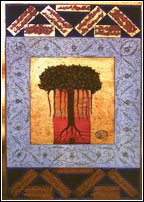
The other two titanic Sufi figures that appear in her next two miniatures are Maulana Rumi and Bulleh Shah. “I have painted the face of Rumi with love and devotion,” she says. The most notable part of the composition, embellished with lines from Bulleh Shah’s poetry, is a banyan tree which bears the heat of the plains but provides shade to those who want respite from the scorching sun. The National College of Arts graduate claims that she was weaned on the Sufi saint’s verse.
The inner part of the painting has a lot of different drawings and denotation systems.
The most peopled, if one may use the word, composition is the one that has a lot of admirers of Sufi saints — the artist’s own image can be seen in one corner too. The scene is from the town of Fez in Morocco which is the last resting place of many Sufis; nowhere else in the world are so many buried in one city.
The inner part of the painting has a lot of different drawings and denotation systems. This writer also notices the influence of the Kangra School of miniatures in the composition and asks Dr Zehra for confirmation. “The influence has got to be there because I received my initial training in the Kangra School,” she says.
“But please note that the border is a combination of Mughal and Persian Schools,” adds the practitioner cum academician, who has been a visiting professor since 2002 at the Faculty of Art and Design in Leicester’s De Montfort University.
She is also a visiting tutor at the Fine Arts Department in Fatima Jinnah University, Islamabad.
Dr Fatima Zehra conducts workshops on Indian, Mughal and Persian paintings at the British Museum and at the Victoria &Albert Museum, London, just to mention two. She has also illustrated a book published in the UK, Kingdom of Joy: Tales from Rumi by the noted Islamic scholar Dr Abdur Rahman Azzam in Oxford and it carries a preface by Prof Annemarie Schimmel. The book is on sale at Chawkandi and so is the print of a miniature embellished with the poetry of Bulleh Shah. Even from a short distance it looks like an original work. For Rs1,000 it’s a good buy.