



 0
0

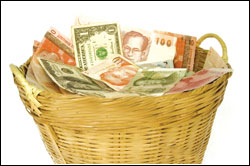 As the Karachi Stock Exchange 100-share index soars, crossing 14,500 points, despite the political uncertainties and economic problems, the rupee, which is the index of the strength of the economy, has been slipping against the ever sliding dollar.
The greenback has touched its lowest against the stronger international currencies.
Many, particularly exporters, see the rupee at 61.20-22 to a dollar as overvalued and are pleading for adjustments in the exchange rate.
Any depreciation of the rupee will increase the cost of imports and make exports cheaper but the exporters will get more rupees for every dollar of sales to the extent the currency value dips.. The cost of the foreign debt will go up and the size of the fresh capital inflows will increase in terms of rupees. The foreign exchange cost of official expenditure beginning with defence equipment and training, foreign travel and the student’s foreign studies will increase.
As a whole, it will make life more expensive as the country is too dependent on imports far too many things beginning with food items like milk and milk products, vanaspati, tea and crude oil for which the import bill comes up to $7 billion.
So any move towards downward adjustment of the exchange rate will have to be made after careful consideration. The issue of depreciation of rupee has come up at a time when India has re-valued its rupee to 39 a dollar compared to over Rs61 a dollar in Pakistan.
There was a time when the Pakistani rupee was much stronger and its one hundred rupees got one hundred and forty-four Indian rupees. We had refused to devalue the rupee in 1949 so as to profit from the international demand created by the Korean War.
This scribe as the first regular correspondent of APP in New Delhi got Rs144 for every Rs100 sent from here. The bonanza came to an end in 1954. That was the time when we could buy the Time Magazine for 75 paisa and Life and Readers Digest for Rs1.25. The dollar was then at Rs3.35 and now costs over Rs61.
After that bonanza, the rupee went down and down and in 1972 it was devalued by 57 per cent and came to 10 for a dollar after its earlier peg at 11 for a dollar.
But the pressure on the rupee has mounted because of the $7.2bn trade deficit in the first five months (July-November) of this fiscal year. While the imports are up at $14.55, the exports are at $7.58bn, increasing the trade deficit by 32.28 per cent.But with exports being half of the imports, urgent action has become imperative. Governor State Bank of Pakistan Dr Shamshad Akhtar says there is no need for a formal devaluation as the inter bank market rate will adjust itself to the need. Since the rupee is a float, a formal devaluation is not needed.
Devaluation is a direct result of high and long sustained inflation; hence the rupee has been slipping against the dollar even while the dollar has been sliding against the euro. Food inflation is higher than the general inflation. Increase in export prices is also higher than the usual inflation. Industrial inflation too is higher. All that adds to the pressure on export goods prices that is building up since a long period of time.
The situation can be saved if adequate preventive action is taken. To begin with, if absolutely necessary, the devaluation should not be excessive but be moderate. The government can reduce the impact of the devaluation, if it could reduce the taxes like the import duties, excise duties, sales tax and withholding tax.
In addition, the government has to make the cost of production and transportation cheaper by reducing the cost of the utilities. A step in this direction is being taken by the decision to refund the sales tax of the independent power producers.
The rise in price of imports brings in additional revenues. The government should be prepared to forego them but the governments are unwilling to let go of the windfall gains. The government is now importing a whole variety of new items including wheat and short staple cotton from India to the extent of 500,000 bales.
As far as possible, formal devaluation should be avoided, although that will be attractive to the overseas Pakistanis as well who would get more rupees for their remittance. Once the process of devaluation starts, there is no end to that. The result has been the rupee has come down from Rs3.35 to a dollar to over Rs61.
There is continuous pressure by the US and the West to revalue China’s currency for years together. But while China is willing to make adjustments it does not want to revalue its currency and make the exports more expensive for the European and American market. We should learn a lesson from China as well as from India, although revaluation has hurt India’s exports marginally. The government should come up with the right concessions for the exporters and also to reduce the pressure on the people following any abrupt drop in the rupee’s exchange value, if forced by circumstances.
The governments have played with the rupee too much and have not been interested in making it an index of the strength of the economy. A strong economy and a weak rupee do not go together. The two should go together and not an economy with too many deficits including a large balance of payments deficit and a heavy budget deficit. Make the rupee stand up and speak for itself instead of being supported feebly half the time.






























