



 0
0

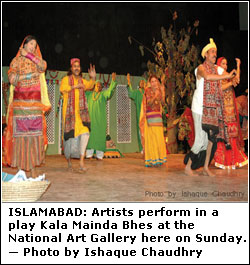 ISLAMABAD, Dec 9: Ajoka once again took theatre goers by storm, by presenting its second play at the National Art Gallery auditorium in the chilly Sunday night.
Inspired by a true story, the theatre group’s second stage drama took the audience on a roller coaster ride of emotions, occasionally stunning them into silence.
Shahid Nadeem’s script fused with Madeeha Gauhar’s artistic direction produced the breath-taking spectacle — Kala Mainda Bhes.
The play is based on a real life incident that took place in a small village in the Cholistan desert. A local peer (spiritual man) and his chelaas control a well, the only source of water, and sold to the villagers. Allah Wassayah, (played by Furqan Majid) in an attempt to break the monopoly brings in water from a neighbouring village. The peer has his bull killed. The villagers celebrate when Allah Ditta, a poor peasant, ultimately manages to discover water. Exercising his powers as the religious head, the peer proclaims the well as a property of Allah and therefore his.
The aridity of the desert is juxtaposed against the barrenness of Allah Wassayah’s wives and water against fertility.
“Kala Mainda Bhes presented a composite paradigm of village life in Pakistan. The reality of deprivation, misery, lack of basic amenities and the immoral exploitation by the venerated is presented with no holds barred. The custom of Wata Sata used reprehensibly to exchange a woman, Sundri, for a bull is only too eloquently underlined.
The play is not just a tale of woes. The individual and community problems have been woven with the inherent human resilience of celebration and affirmation of life and the eventual victory of good over evil. The first wife, Sundri, suffering the humiliation of having to put up with a second wife, Sohni, and then the victim of Wata Sata for an animal, rises above these enormities to care for the orphaned children and encourages the so-called Jhala to continue his undeterred search for clean drinking water and finally the revolt of the people against the villainous ‘Man of God’.




























