0
0

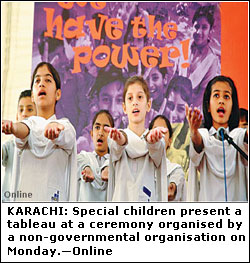 KARACHI, Dec 3: “According to a census carried out by the government of Pakistan in 1986, almost 10 per cent of the country’s population has disabilities,” said Prof Abdul Hameed while addressing a conference titled “The Decent Work Opportunities for Persons with Disabilities”, organised by the University of Karachi to mark the International Day for Disabled People observed on Monday.
He said that in a country with a fluctuating social and political economy, people were vulnerable to all types of coercion, overwork, intimidation and abuse. “There is an alarming gender disparity in employment opportunities even within their own population” he observed.
Speaking at the inaugural session, KU Vice Chancellor Dr Pirzada Qasim Raza Siddiqui said society had quite a peculiar attitude towards people with disabilities. “What should be remembered is the fact that these people do not deserve our sympathy but a better treatment,” he stressed.
He regretted that the Karachi University also lacked the essential infrastructure and facilities for special people. “We don’t have lifts, ramps or even special toilets for the handicapped students of this institution,” he said.
Dr Naseem Uddin, a teacher at the Punjab University, pointed out that disability in a person was looked upon from a humanitarian perspective and was one the basic issues of the human rights as well. “The basic idea of human rights laws, centred on the concept of human dignity, is that each and every citizen enjoys equal rights, notably the right to live a full and decent life,” he said.
Dr Khalid Naeem, highlighting the constitutional status of special citizens, said: “Since the mid-’80s, the country has enacted legislation which embraces a rights-based discourse rather than a custodial discourse; and which seeks to address issues of social justice and discrimination.” He pointed out that the legislation also embraced a conceptual shift from disability being looked upon as an individualised “medical problem” to something that the community could do about by letting the disabled participate and have access to regular societal activities such as employment, education, recreation, etc.
Dr Shahida Sajjad, introducing the subject, referred to a research study conducted in Karachi and informed the audience that 100 employers of various institutes and organisations were interviewed to ascertain their attitude towards their handicapped employees in terms of compensation, promotion, incentives and training facilities. “They were pretty stark and we came to know that even the two per cent quota reserved for special people was not being extended to them,” she revealed.
It was noted that special citizens were largely deprived of the quota by all private and public sector concerns. Even if any of the special citizen is able to secure a job, the person is discriminated against in terms of wage, status and privileges.
Dr Anjum Bano Kazmi in her presentation about the visually impaired people highlighted some of the basic problems generally faced by such people. “When a visually impaired person is given a chance to work, he proves his/her mettle well. However, it is difficult for the employer to determine that in what capacity such a persons can work efficiently,” she said. Dr Kazmi stressed the need for an interlinked body that could ensure the right environment for such persons.
Dr Nasir Salman, Hina Fazil, Dr Ismaeel Saad, Zahid Majeed and Mansoob Hussain also shared their views on the issue.
The special citizens present on the occasion narrated their hardships and struggle during the programme.