



 0
0

A gift for journalists — and the rest of us
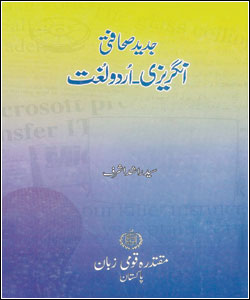 The Muqtadira Qaumi Zuban, or National Language Authority, has come up with yet another good book. ‘Jadeed Sahafati Angrezi-Urdu Lughat,’ an English-Urdu dictionary of modern journalistic terms, caters to the needs of both students and veterans of journalism. Common readers (like this writer) who stumble on new and alien terms while reading will find it to be a virtual treasure. It comes in handy for journalists and scholars whose work involves translating from English.
Compiled by veteran journalist Syed Rashid Ashraf, ‘Jadeed Sahafati Angrezi-Urdu Lughat’ not only gives the Urdu equivalents of English terms used in the media but also defines them in a very clear and easy language, especially the words and phrases that have a historical background or have ‘interesting’ connotations have been comprehensively explained.
As stated by Prof Fateh Mohammad Malik, the National Language Authority’s chairman, in his preface to the book, “The world of mass communication is expanding exponentially and new terms based on new notions are pouring in. These modern terms and expressions generally get currency in the western electronic and print media first and are then assimilated to our media quickly. The need for a dictionary explaining such words in Urdu was being felt for long.”
Syed Rashid Ashraf, says Prof Malik, “is a senior journalist and his association with the BBC for decades has added to his invaluable experience and acumen. What makes this dictionary all the more useful is the fact he has kept in view Urdu’s texture and temperament and its development in the modern times.”
The author in his candid introduction has rightly pointed out that “the English language is expressing itself on the international expanse with vigour and influence and is penetrating into the warp and the weft of our society. But it is strange that the medium needed to reach the common people is Urdu and it can be assumed that it will remain so for a long time to come. This underscores the need for translation.”
It is interesting to note that sometimes the translation of a particular term or phrase or idiom from English into Urdu poses a difficulty even to those who have spent their lives in this field. “For example”, says the author, “what is a ‘quite American’? How to translate ‘photo opportunity’ or ‘enlightened moderation’ into Urdu? How to describe ‘walk about’ or ‘surrogate mother’?”
The real strength of the dictionary lies in the fact that it vividly describes the most modern terminologies and latest expressions as well as biblical allusions and references in chaste, current and idiomatic Urdu, something that is missing in most of the English-Urdu dictionaries, though two good English-Urdu dictionaries can be cited as partial exceptions to this: Oxford English-Urdu Dictionary by Shan-ul-Haq Haqqee, and Qaumi Angrezi Urdu Lughat by Jameel Jalibi (published by the NLA).
Just to give the readers an idea of what invaluable knowledge is packed between the covers of ‘Jadeed Sahafati Angrezi-Urdu Lughat’, I would enlist a few entries from the dictionary: Are you decent?, bloody Mary, daisy chain, eleventh commandment, (the) end of history, jailbait, Gonzo journalism, Mexican overdrive, Posslq (person of opposite sex sharing living quarters), Pravda, Russian roulette, sitcom (situation comedy), underwhelmed, Zoo daddy. About 6,000 such interesting entries and their delectable meanings await anybody who is willing to forgo a pizza and spend Rs350 on this book instead.
By looking up an entry ‘pinyin’ in this book, for the first time I learnt why Mao Tse-tung was respelled as Mao Zedong, Canton as Guangzhou and Peking as Beijing.
The 494-page book also offers a list of abbreviations in addition to Urdu and Persian equivalents of some terms used by Iran’s government offices and organisations.
But there is one feature of the book that is beyond comprehension: every entry begins with a capital letter whether it is a proper noun or otherwise. Why? Blame it on the composers, and be happy.
drraufparekh@yahoo.com
Bickering over new treaty throws EU into disarray
It was supposed to simplify and streamline the European Union. But with only a few days to go before the new EU reform treaty is signed in Lisbon, it looks like the much fought-over blueprint will actually result in further institutional disarray in the 27-nation bloc. The impact on EU dealings with the rest of the world could be especially strong.
The very signature of the treaty has become entangled in controversy. Environmental groups warn that Portugal’s insistence that the document should be formally signed in Lisbon on Dec 13, only hours before all 27 EU heads of government meet for their traditional end-of-year EU summit in Brussels, will mean additional carbon emissions as leaders jet from one EU capital to another, breaching the bloc’s tough stance on combating global warming.But discomfort over the reform treaty — expected to enter into force in 2009 — goes deeper than its impact on the environment. As experts take a closer look at the provisions of the treaty, the growing consensus seems to be that the EU is headed for more institutional confusion and turf battles — especially in the foreign policy arena — among the bloc’s already-feuding policymakers.
The problem centres around the treaty’s failure to ensure a clear-cut division of power and competence among three top EU jobs: the president of the European Commission, the president of the European Council and the EU High Representative for Foreign Affairs and Security Policy.
There is already, of course, a Commission president. Former Portuguese premier Jose Manuel Barroso, has headed the powerful EU executive since 2004. His term is set to end in 2009 but Barroso is widely believed to be angling for another five years in the top job.
While Barroso’s wish is expected to come true — EU leaders like his pragmatic, non-confrontational style and, in any case, for many it will probably be a case of “better the devil you know” — the appointment of new president of the European Council is expected to be a difficult and possibly acrimonious affair.
So far, speculation on who will be the first man/woman in the new high-profile job has centred on Tony Blair, former UK prime minister.
Other frontrunners include Luxembourg’s Prime Minister Jean-Claude Juncker, currently head of the euro group, and still loyally committed to the dream of an increasingly integrated EU, and Danish Prime Minister Anders Fogh Rasmussen. Other names may crop up in the coming months.
The problem is, however, that for all the pomp and ceremony attached to the post, the future EU Council president will have no executive powers. In theory at least, he will do little more than preside over bi-annual EU summits, known in the bloc’s jargon as European Councils, which bring together EU heads of state and government.
Notwithstanding the treaty provisions, however, the conventional wisdom in Brussels is that the new president will want to make his/her mark on the EU — and global — stage. This means seeking a stronger institutional role and influence than set out in the treaty, which in turn could lead to potentially explosive run-ins with the head of the European Commission.
“Does the new president have sufficient personnel, administrative and financial resources at his disposal” to carry out duties such as leading, preparing and giving a sense of continuity to leading EU projects, such as on climate change and energy? asks a leading EU analyst.
On paper at least, the future EU foreign minister — known as the High Representative for Foreign Affairs and Security Policy — will have his power and competence set out in clear terms. The future minister — combining the posts of current EU foreign policy chief Javier Solana and EU external relations commissioner Benita Ferrero-Waldner — will be “double-hatted”. He will be vice-president of the Commission but also chair meetings of EU foreign ministers.
But many in Brussels believe that given the bloc’s growing foreign and security policy ambitions, the EU foreign minister is likely to come into continuous conflict not only with the Commission President but also the new Council President.
His power over trade and development aspects of EU foreign policy is also open to question. If he/she is also given the trade and aid portfolios, it will mean that the commissioners responsible for those questions will become junior members of the EU executive, answering to the foreign minister.
A great deal will, of course, depend on the personality of the different people in question. Solana, for instance, had hardly any territorial squabbles with the former EU external relations commissioner Chris Patten. Both liked and respected each other and decided very early on to cooperate rather than compete. Relations between Solana and Ferrero-Waldner are widely believed to be more difficult, however.
Plans to create a first-ever EU diplomatic service — known in EU jargon as an “external action service” — are also likely to lead to fraught debate. The treaty foresees that the new department will include representatives of the European Commission, the EU Council of Ministers as well as national diplomats from the EU member states.
Work on setting up such a service is expected to start in earnest next year. But there are serious doubts that given their different traditions, priorities and expertise, officials from very different EU institutions and backgrounds will be able to forge a true foreign service, working in the interests of the EU rather than different national capitals.
As they haggle over the future of their different departments, EU policymakers admit that the real challenge facing the bloc in future years will be to limit undue political interference from EU member states, especially the bloc’s biggest and most influential members, Germany and France.
This will require strong EU institutions, capable of standing up to Berlin and Paris, not in-fighting in Brussels.
| © DAWN Group of Newspapers, 2007 |


























