



 0
0

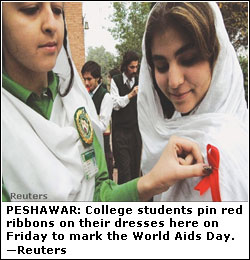 RAWALPINDI, Nov 30: Pakistan still has a window of opportunity to prevent the rapid spread of HIV among vulnerable groups by scaling up its targeted intervention, the World Bank (WB) in a statement said here on Friday.
Though the estimated HIV burden is still low (around 0.1 per cent of the adult population), Pakistan is facing a concentrated epidemic among injecting drug users (IDUs) with HIV prevalence of more than five per in three of the four provinces.
The World Bank, which is supporting a HIV/Aids project with $37.1 million no-interest credit as well as grant money to scale up existing activities, highlighted the state of HIV/Aids in Pakistan on the eve of World Aids Day being observed on Saturday.
This year, the event will focus on leadership, the theme set by the World Aids Campaign under the five-year slogan “Stop Aids, Keep the Promise”.
According to UNAIDS estimates, about 85,000 people are living with HIV in Pakistan. Officially reported cases are, however, much lower.
As in many countries, underreporting is mainly due to the social stigma attached to HIV, limited surveillance and voluntary counselling and testing systems, and the lack of knowledge among the general population and health practitioners.
Though overall HIV prevalence is low in Pakistan, there is growing evidence of local concentrated epidemics among IDUs in major cities.
The combination of high levels of risk behaviour and limited knowledge about HIV among injecting drug users and sex workers could lead to the rapid spread of HIV.
One study in Karachi showed an increase in HIV prevalence among injecting drug users from under one per cent in early 2004 to 26 per cent in March 2005, while other studies have found that HIV prevalence among IDUs has reached 24 per cent in Quetta, 12 per cent in Sargodha, nearly 10 per cent in Faisalabad and eight per cent in Larkana.
Among female sex workers in Karachi, HIV prevalence in 2005 was two per cent while it was below one per cent in Lahore and Rawalpindi.
It is estimated that 40 per cent of the 1.5 million annual blood transfusions in Pakistan are not screened for HIV. About 20 per cent of the blood transfused comes from professional donors.
Pakistan has a high rate of medical injections - around 4.5 per capita per year. Studies indicate that 94 per cent of injections are administered with used injection equipment. Use of unsterilised needles at medical facilities is also widespread.
According to WHO estimates, unsafe injections account for 62 per cent of Hepatitis B, 84 per cent of Hepatitis C, and three per cent of new HIV cases.
Efforts to increase awareness about HIV among the general population are hampered by low literacy levels and cultural influences. In 2006 female literacy was estimated at 42 per cent.
Restrictions on women’s and girls’ mobility limits access to information and preventive and support services.
The Government, through a broad consultative process, has developed a national HIV/Aids Strategic Framework (2007-11) that sets out the strategies and priorities for effective control of the epidemic.
A draft national Aids policy and HIV and Aids Law, both recommending the formation of a National Aids Council, have been prepared by the National Aids Control Programme and will be presented to the new parliament. Approval of the policy and law would be an important step towards the multi-sectoral dimension of the national response.




























