0
0

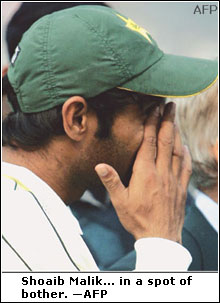 KOLKATA, Nov 27: Pakistan’s under fire captain Shoaib Malik, who is battling against time to get fit for the second Test here, has been urged to change his approach following India’s six-wicket victory in the opening Test of the three-match in Delhi.
Malik strained ligaments in his left ankle while playing football shortly after the first Test at the Feroz Shah Kotla finished early on Monday. Any decision on him playing the Kolkata Test, which starts at the Eden Gardens on Friday, will not be taken before Thursday.
But apart from the injury problems at hand, Malik is getting a fair amount of flak for his lacklustre leadership against India in the current series. Former Pakistan skipper Imran Khan, writing in Tuesday’s edition of the Hindustan Times, which is one of India’s top English dailies, called upon Malik not only to lead from the front but also perform with the bat and ball to merit his selection in the Test side.
“Sadly, Malik appears to be a captain who is not in control at the moment and that will not change till he proves that his position in the side is undisputed,” Imran wrote in his column. “At present he is a bits and pieces player who is a part-time spinner and a useful batsman.”
Imran, one of the greatest all-rounders of his era and arguably the most successful Pakistan captain, stressed Malik has to perform to gain the respect of his team-mates. “Malik has the potential to be a good captain because he has a calming presence on the field. However, if his own form does not improve, he will be unable to show any flair in his role as the leader. He will remain tentative, and his risk-taking abilities will be found wanting,” Imran went on.
Commenting on the result of the first Test, Imran said: “India emerged as the far better side because Pakistan clearly lacked the temperament and technique when it came to Test cricket. This was the main reason for their defeat.”
On the other hand, Imran was impressed with Anil Kumble’s leadership qualities and noted that he had the flair for the top job in the sport for a long time. “Kumble has the stature to command respect of his team. He led by example and was tenacious even when things were not going his way. It was an irony that it was the Indians playing under a new captain. But since the ‘debutant’ in question had 17 years of international experience behind him, he looked the part,” the legendary all-rounder observed.
Ravi Shastri, the ex-Indian all-rounder and now a TV commentator, believed Malik’s captaincy was faulty in the Delhi Test. “The biggest difference between the two teams was the stature of the rival captains [Malik and Kumble]. Pakistan played their best cricket against India when they had inspiring figures like Imran Khan and Wasim Akram as leaders. And it doesn’t need rocket science now to guess why they are slipping up?” Shastri pointed out in the same newspaper.
Shastri, who was interim manager-cum-coach of the Indian after the World Cup this year, hailed Shoaib Akhtar’s superb exhibition of fast bowling in the first Test. “He was captivating; a tearaway fast bowler who has now added variety to his armoury. Shoaib has set up this series nicely and once Umar Gul is back in the fold, it would strengthen Pakistan’s pace attack.”