0
0

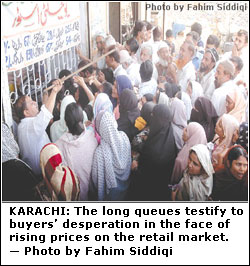 KARACHI, Nov 27: The substantial price difference between rates on the retail market and those at the Utility Stores, in addition to inadequate supplies of certain essential items, has led to long and slow-moving queues outside the government-subsidised stores as citizens seek to benefit from lower ghee and atta prices.
While a 10-kilogramme bag of atta is available at the Utility Stores for Rs130, the same commodity costs Rs180-190 in the retail market. Similarly, the Utility Stores sell ghee at Rs67 per kilogramme, as opposed to a retail market price of Rs117. Gram pulse (dal channa) and moong pulse, which are available at Rs29 and Rs42 per kilogramme respectively at the subsidised stores, are otherwise being sold at between Rs36 and Rs45 for the former and from Rs45-50 for the latter, depending on the quality. The Utility Stores sell super rice and tota rice at Rs54 and Rs28 per respective kilogramme, while the retail market prices them at Rs68 and between Rs32-36 respectively.
Deeply perturbed by the unchecked rise of the prices of essential commodities in the retail markets, people have no option but to form long queues well in advance of the Utility Stores’ opening hours in the hope of getting their groceries while items are still available. The number of customers increases drastically when trucks loaded with atta arrive with supplies. However, sugar is not a much sought-after item at the Utility Stores this year because of the negligible price difference: it is being sold at Rs25 per kilogramme while being available in the open retail market at Rs26.
No control mechanism
The surge in the numbers of regular and franchised stores in the city – currently at 120 as opposed to 38 a year ago – has not helped alleviate the suffering of consumers who are forced to shop at the state-owned Utility Stores.
The longest queues can be seen in the more densely populated areas of the city. Due to the substantial difference in prices, a very large number of buyers with limited financial resources are forced to look towards the subsidised items in order to meet their daily needs.
The city government, which was assigned the task of keeping a check on and monitoring prices, has shown no progress in putting the brakes on the increasing prices of essential items. In the absence of effective price-control measures, retailers enjoy a free hand in squeezing as much money as possible from their customers’ pockets. While an official price list is issued every month by the city government, consumers have seen no signs of practical implementation.
Meanwhile, on the Utility Stores’ side, there have been reports that people – in connivance with the officials of the stores – have made pools in order to buy the maximum quantity of the items that are most in demand, so that they can then sell them at a profit to retailers.
This points towards a glaring deficiency in the working of the Utility Stores Corporation (USC): that it has not been able to come up with any mechanism to check the duplication of purchase. The real sufferers are the genuine buyers who either have to wait long hours for their goods, or even return empty-handed when they are informed that the stocks have been sold out for the day.
Supply outstrips demand
The zonal manager Sindh of the Utility Stores Corporation, Masood Alam Niazi, told Dawn that the current crisis of availability has been recorded only for atta and ghee, because of the rocketing price difference with the retail market. The situation of other commodities, particularly sugar which is often subject to sudden price-hikes, is under control, he maintained.
“The quantity of atta being supplied to the stores has outstripped the demand,” he commented. “Karachi is getting 10,000 tonnes of atta every month out of PASSCO’s over 50,000-tonne supply for the whole country. There are an estimated 4,000 regular and franchised stores all over the country. Conversely, local flour millers are getting around 50,000 tonnes a month but nobody is monitoring the reasons why millers do not sell atta at reduced rates.”
Commenting that the rush of buyers at the Utility Stores can only be slowed down if the prices of daily-use items on the retail market level are effectively controlled, Mr Niazi pointed out that last year, sugar was a highly sought-after commodity because of higher market rates. As a result, the USC had to set up a system where customers had to first buy some other item to ‘earn’ the right to purchase sugar. The scheme was soon suspended, however, because of pressure from consumers. “We cannot check double or triple purchases in the absence of any controlling mechanism,” he stated.
Asked about the issue, the chairman of the Sindh circle of the Pakistan Flour Mills Association (PFMA), Chaudhry Ansar Jawed, said that the city gets 55,000 tonnes of wheat from the food department, against the requirement of 160,000 - 170,000 tonnes a month.
“The price of atta No.2.5 per 80-kilogramme bag has surged to Rs1,450 as compared to Rs1,400 in just a week,” he said. “This is because wheat prices have increased to Rs1,700 per 100 kilogrammes from Rs1,550 a week ago.” Mr Jawed added that huge quantities of wheat and atta are also being smuggled into Afghanistan, which has caused a shortage here in Pakistan.
Asked why atta remains expensive despite the fact that it is procured from the food department at Rs1,215 per 100-kilogramme bag, Mr Jawed said that mills have to blend official wheat with that from the open market in order to maintain the quality ratio, which increases the price.