0
0

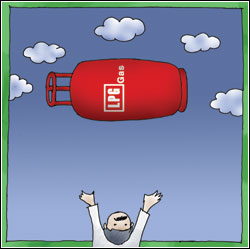 The liquefied petroleum gas (LPG) is emerging as an important source of energy. Its market share is minuscule, currently at less than one per cent, but energy experts see a great potential for expansion in the sector.
These experts, however, feel that the real potential of the LPG sector would only be realised if the government sees through the ramblings of special interest groups and abstains from appeasing private parties through direct intervention in the market.
Early this year, the government introduced import price parity in the price fixation mechanism of LPG. It linked producer price of LPG to Saudi Aramco Contract Price (CP) that was more than double the price being offered by local manufacturers. The local companies offer price to LPG marketing companies was Rs17,000 per metric ton pre-February 2007.
The government linked it to international CP and put a cap at Rs40.000 in the second month of this year. It pushed the retail price up, at least by Rs100 per cylinder, making the source dearer for the end consumer.
The government spends millions of rupees in subsidising other major sources of primary energy supplies (natural gas and petroleum products) to provide a relief to end consumers and to expand its coverage. Why did the government change its position and pushed the prices up for this particular energy source?
The seniors in Oil and Gas Regulatory Authority (OGRA), when reached in Islamabad to seek answer to the question, sidetracked.
They, however, defended the policy describing it as, ‘future-oriented’. Sustaining the current pace of economic development would be impossible if we fail to plan for future energy needs in advance, they explained.
The cheapest energy source-- the natural gas reserves are depleting and the rising oil prices in the international market -- are making it a luxury that Pakistan can ill afford, goes their argument.
The thrust of the government’s energy policy, therefore, is to explore new arrangements with gas surplus neighbouring countries and to promote alternate energy options, they said.
”It was under this broad guideline that the government encouraged foreign companies to invest in the energy sector. The price mechanism was readjusted to make the market attractive for potential investors whom we are trying to lure”, a high-ranking official told Dawn on request of anonymity.
Insiders, however, insist that the pricing policy was tailored to fit the requirements of certain import dependent LPG companies with right connections.
Abbas Bilgrami, managing director, Progas Pakistan Ltd that developed fully integrated LPG infrastructure at a whooping cost of $50 million with a private jetty at Port Qasim, storage, bottling plants, branded cylinders, logistic and distribution network, told this scribe that the linking was absolutely necessary or his company would have been forced out of market.
“There is a huge potential dormant demand out there for this safe, comparatively cheap, viable and a green source of energy in both domestic and commercial segments of users.
The potential future demand is much beyond the production capacity of local producers and importers have a huge responsibility and scope in promotion of this source of energy”, he said.
“An international investor brings in standards, sophistication and expertise at a high cost, which in itself is valuable. We will have to make the market attractive by keeping price at a level where the viability of their business is not compromised,” he made his case while talking to Dawn a few weeks back.
Zafar Z. Ahmed, MD Jamshoro Joint Venture Ltd (JJVL) who also heads LPG Association of Pakistan challenged the wisdom of the government’s LPG pricing policy that in his view runs against the interest of the majority.
“Where in the world does the government asks producers to sell at higher price than what they are willing to offer? It is an absurd policy that needs to be reversed. Sooner the better”, he said.
“Pakistani products should be sold at domestic prices. The market share of import in the market is hardly five per cent. Compromising the interest of local producers with 95 per cent share in the market does not make any business sense”, he said from Islamabad.
A senior source in the ministry explained that only in cases of predatory pricing i.e. when a producer or a group of producers deliberately bring the prices down to drive a new entrant out of the market or to block new entries in the field the government can step in to bring correction for free and fair competition. In this case, however, the government intervention is not justified.
”Have you ever seen a businessman complaining against a policy that allows him a bigger margin? There is more to local producers’ public pleas for removal international price parity mechanism than their concern for the consumers and the nation,” an expert raised a point.
“ The entry of international players in the market would increase pressure on them to introduce safety standards which involves investments that locals feel they can delay if they could drive international investors out of domestic market”, he maintained.
“Locals might not have manipulated the prices here but their mindset is predatory as they like to operate in comfort of competition with their like and not overseas investors who introduce qualitative competition in the market”, another energy marketing guru said.
It is a fact that price of LPG cylinder in the market did not increase proportionally to the increase in producers’ price which indicated high margin of profit that LPG distribution companies were making.
Zafar Ahmed roughed up this argument to say that higher retail price led to shift of customers towards other competitive sources, the demand shrunk and suppliers were forced to sell at the minimum viable price to win back their share in the energy market. “We cannot work outside the sustainability level of our end consumer”, he said.
Javed Nazeer, Senior Executive Director Operations, OGRA, reached in Islamabad for comments responded: “Our job is to implement the policy of the government which we do to the best of our capability. Policy guidelines are given by the government.
Yes, when requested we give our opinion but the policy decisions are taken by the cabinet in the economic co-ordination committee. The decision to link price of LPG to Saudi Aramco Contract Price was taken by the government and not OGRA”.
The energy experts in Islamabad felt that direct intervention of the government in price fixation belie its claims of de-regulation. They felt that the government should use indirect fiscal measures to achieve its targets in the energy sector.
“The government should use fiscal tools of tax incentives to direct the investment in priority areas of the economy and leave the rest to the market forces-- demand and supply. After a brief period of volatility, the market price will prevail with interplay of demand and supply.
This would also help in removing the huge discrepancy in the opportunity costs of different sources of energy in the country”.
Currently, about 50 per cent of available stocks are consumed by the transport sector. There are areas in three smaller provinces particularly that fall outside the cheaper energy network.
With comparatively lower infrastructure investment requirement, LPG can be used to fill in these gaps in energy cover. It is a pity that economically most backward households are forced to use expensive sources as fuel for cooking and heating.
The policy should not be designed to salvage businessmen who make wrong commercial decisions. For most efficient utilisation of Pakistan’s resources, the government needs to encourage competition where private sector may focus on scales and not margins.